
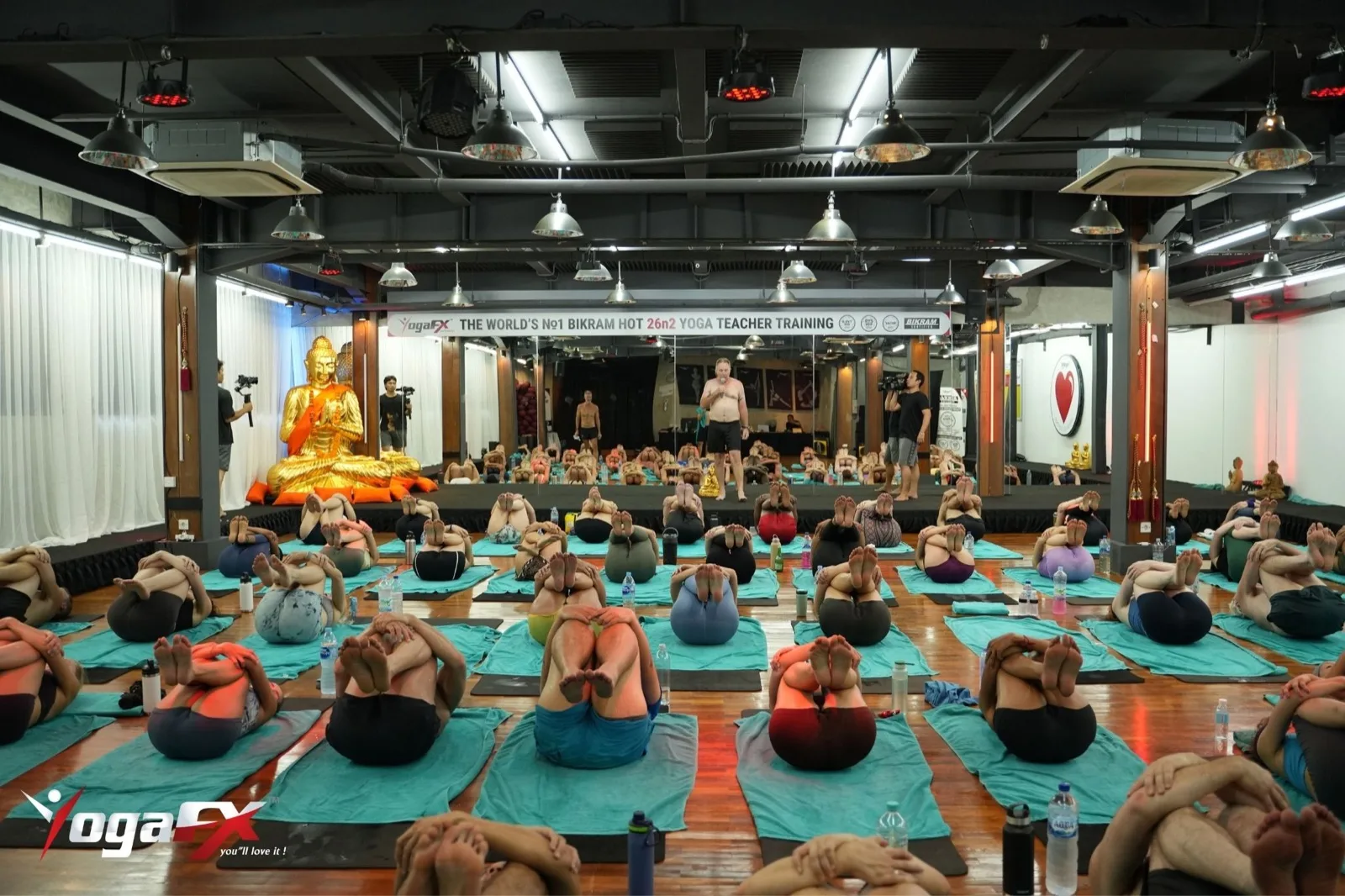
What is Bikram yoga? It is a fixed 90-minute hot yoga class of 26 postures and 2 breathing exercises, always taught in the same order, in a room of about 40°C and 40% humidity. At YogaFX in Seminyak, Bali, that heat comes from the tropics, not from a heater.

Everything else follows from that fixed shape. The teacher guides you by voice instead of demonstrating. There is no music, and the class never changes from one day to the next. That is why a Bikram class feels so different from a flow class, and why beginners and long-term students can practise in the same room.
What is Bikram yoga, exactly?
Bikram yoga is a hatha yoga sequence. Bikram Choudhury brought it to the West in the early 1970s, building on the physical conditioning teaching of Bishnu Charan Ghosh in Calcutta. Today the same method is more often called Hot 26&2 yoga or 26 and 2 yoga.
People often type “what is Bikram yoga” into Google because the name has changed over the years. The short answer is that the label matters less than the format. Five things stay the same in every class:
- Length. 90 minutes from the first breath to the final one.
- Order. 26 postures and 2 breathing exercises, in the same order every class.
- Heat. About 40°C and 40% humidity, which is why you sweat so early.
- Voice. The teacher speaks a scripted dialogue and does not demonstrate.
- Quiet. No music, so you hear the dialogue, your breath and your own thoughts.
Because the order never changes, you learn the class the way you learn a song. By your fifth or sixth visit you stop wondering what comes next. Instead, you start noticing how each posture feels. For a full posture-by-posture explanation, read our Bikram yoga 101 guide to the 26&2 method.
What is Bikram yoga? The 26 postures and 2 breathing exercises
To answer what is Bikram yoga in practice, start with the shape of a class. It opens and closes with breathing, and the postures sit in between. First comes the standing series, which builds balance and leg strength. Then comes the floor series, which works the spine, core and hips. The table below shows the whole shape of a class.
| Part of the class | Postures | What it asks of you |
|---|---|---|
| Opening breathing | Standing Deep Breathing (Pranayama) | Slow, deliberate breathing that settles your heart rate and gets your mind into the room |
| Standing series | Half Moon with Hands to Feet, Awkward, Eagle, Standing Head to Knee, Standing Bow Pulling, Balancing Stick, Standing Separate Leg Stretching, Triangle, Standing Separate Leg Head to Knee, Tree, Toe Stand | Balance, leg strength and hip mobility, and usually the biggest cardio demand of the class |
| Rest between series | Savasana (Dead Body Pose) | Lying on your back so your heart rate and breathing can come back down |
| Floor series | Wind-Removing, Sit-up, Cobra, Locust, Full Locust, Bow, Fixed Firm, Half Tortoise, Camel, Rabbit, Head to Knee with Stretching, Spine Twisting | Back-bending, forward-folding and twisting for the spine, core and hips |
| Closing breathing | Blowing in Firm (Kapalbhati) | Sharp, rhythmic exhales that close the class and clear your head |
The standing series tests your balance
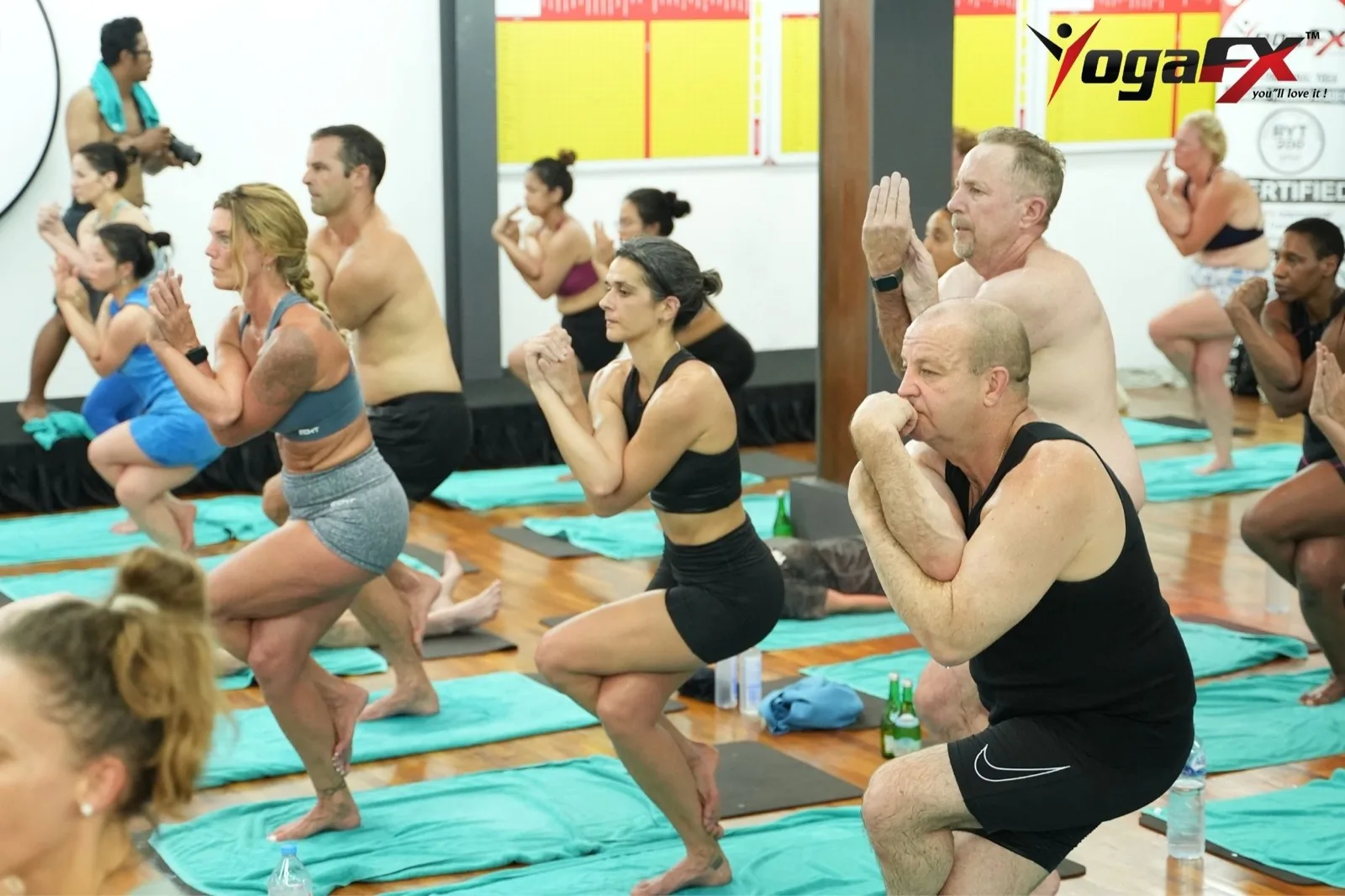
The standing series asks for the most effort, so it is where most beginners feel the heat hardest. That is normal. In Eagle, your arms and legs wrap around each other while you balance on one leg. In Balancing Stick, your body forms a T as you reach forward and kick back.
Both postures work because you can’t check your own limbs by looking at them. Instead, you have to feel where your body is in space, and that sense gets sharper with practice.
The floor series brings you back down
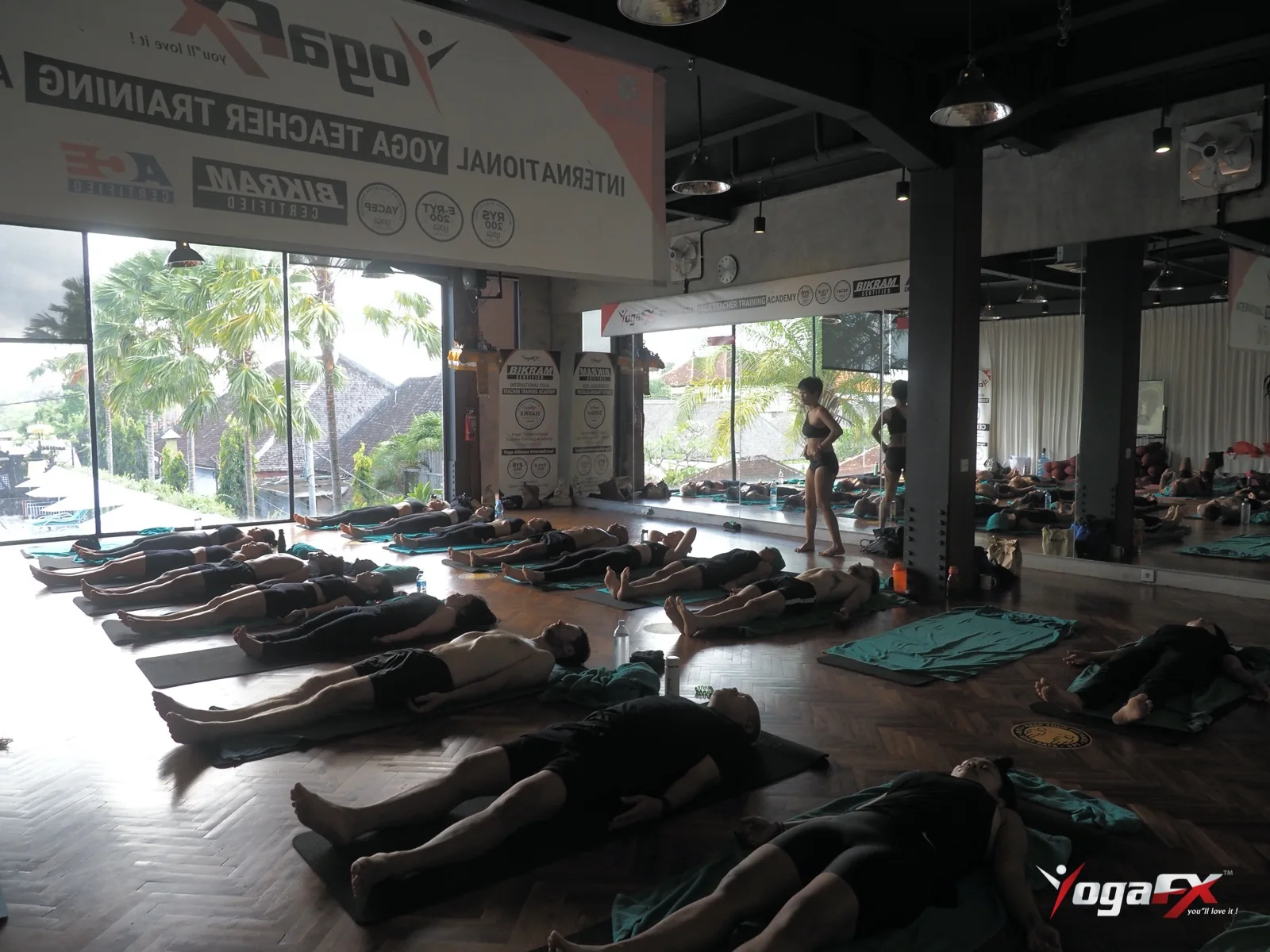
The floor series starts with Savasana and Wind-Removing, then moves into backbends such as Cobra, Locust, Bow and Camel. Forward folds and Spine Twisting follow to balance them out. By the closing breathing, most students feel tired, clear-headed and strangely calm.
Our posture guides to Awkward pose and Camel pose show two of these in detail.
How the dialogue works, and why there is no music
In a Bikram class the teacher speaks a scripted dialogue that tells you exactly what to do, posture by posture. The teacher does not demonstrate, so you listen instead of watching your neighbour. Many first-timers find this the strangest part. Then it becomes the part they miss in other classes.
Ask any regular what is Bikram yoga, and most will mention the voice first. Listening keeps your attention in your own body, and the mirror at the front of the room becomes a tool for checking alignment, not a place to compare yourself with others.
Postures such as Eagle, Tree and Standing Head to Knee also reward steady focus, because a small lapse shows up as a wobble. Our article on how Seminyak students learn the script explains the words themselves.
Mr. Ian Terry, Founder and Lead Instructor at YogaFX (E-RYT 500, with more than 12,000 teaching hours), puts the bigger idea like this:
There can be no greater investment than the one that you make in your health, because without it, nothing else matters.
Mr. Ian Terry, YogaFX
What is Bikram yoga like in a real Seminyak class?
Walk in and the first thing you notice is the warmth, then the quiet. Mats are laid in rows with towels on top, and water bottles sit at the edges. People are already lying still before class begins. Once the dialogue starts, there is very little talk. You move when the voice says move, and you rest when it says rest.
Getting used to the heat
Heat is the part newcomers worry about. In Seminyak the tropical climate does a lot of the work, so some visitors arrive half-adjusted while others need a few classes to settle in. As a rule of thumb, expect 3 to 5 classes before your heart rate and sweat rate stop surprising you. Our guide to heat acclimatization in Bali maps out those first weeks.
If you feel dizzy
The standard advice in our studio is simple. Lower your centre of gravity, lie down on your back in Savasana, breathe through your nose and stay in the room. Leaving the heat suddenly is usually harder on you than resting inside it.
I learned more in those four days than in the previous two months of classes elsewhere.
Jonathan, Google review, 2026
What to bring and how to prepare
- Water. Sip steadily through the day before class, rather than gulping a litre just beforehand.
- Food. Skip heavy meals for 2 to 3 hours before class. A banana or small smoothie works if you need energy.
- Clothing. Light, moisture-wicking clothes work best, and a full-length towel over your mat gives you grip.
- Arrival. Come about 15 minutes early so you can settle your mat and your breathing before the heat does the talking.
First visit nerves are common, and our page on your first hot yoga class in Bali answers the questions beginners ask most.
Bikram yoga vs other hot yoga
Hot yoga is the umbrella term for any yoga practised in a heated room. That includes hot vinyasa and hot power flow, where the sequence changes with every teacher. Bikram yoga is the one version with a fixed sequence, a fixed dialogue and a fixed 90 minutes.
If you are asking what is Bikram yoga compared with other styles, the difference is the fixed format. So the real question isn’t which is better, but which suits you.
If you like variety and music, a flow class may feel more fun. If you like predictability and a clear way to measure your own progress, the fixed 26 and 2 format has a lot going for it. Our comparison of Bikram vs hot yoga in Bali sets the two side by side.
Who is Bikram yoga for?
Anyone asking what is Bikram yoga for deserves a straight answer: a fixed format suits more people than you might expect. These are the students we see most often in the Seminyak room:
- Visitors on a Bali stay who want one structured class that feels like a real challenge, and a good story to tell afterwards.
- Residents and expats who want a weekly habit, because a class that never changes is easy to fit into a busy routine.
- Runners, surfers and gym-goers who want more mobility in their hips and shoulders without learning a new routine every week.
- Future teachers who want to test the method before they commit to a training.
Whoever you are, go at your own pace. Rest when you need to, skip a class when you are ill, and remember that the first few visits are about learning the room, not winning the posture.
What is Bikram yoga good for? What the research says
Health claims around hot yoga are often bigger than the evidence. Here is what three published studies actually found. None of them is a promise about your own results.
Aerobic fitness and heat adaptation
A 2021 study in the International Journal of Yoga (Bourbeau et al.) put 22 adults into a hot yoga group or a normal-temperature yoga group for four weeks. The hot group did 12 sessions on a modified Bikram protocol at 41°C and 40% humidity. Maximal aerobic fitness increased in the hot yoga group only. The researchers also saw higher HSP70 expression there, a marker of cellular heat tolerance.
The record is on the University of Northern Iowa ScholarWorks page.
Calories and hip range of motion
A 2020 crossover study in the International Journal of Exercise Science (Lambert et al.) is a useful reality check. Sixteen experienced practitioners did a one-hour Bikram sequence at 40°C and again at about 23°C. Oxygen use, heart rate and calorie burn did not differ between the two rooms, so heat did not make the workout burn more calories. Hip range of motion did improve more after the hot session.
The study is listed on the Houston Methodist Scholars page.
Mood
A randomized controlled trial from Massachusetts General Hospital (Nyer et al., Journal of Clinical Psychiatry, 2023) tested community-delivered heated hatha yoga in adults with moderate-to-severe depression. Over 8 weeks, with an average of about 10 classes, 59.3% of the yoga group had a drop of 50% or more in depression scores, compared with 6.3% of the waitlist group.
It was heated hatha yoga, not a fixed Bikram sequence, so treat it as encouraging rather than proof for our class. The abstract is on Europe PMC.
- What it suggests: regular hot practice may support aerobic fitness, hip mobility and mood in the groups studied.
- What it does not show: that heat burns extra calories, or that a yoga class replaces medical care.
- What to do: if you have a heart condition or high blood pressure, are pregnant, or take regular medication, speak with a healthcare professional before your first class.
From first class to teacher: the next step
Once you have answered what is Bikram yoga from the mat, teaching it is a natural next question. Some students fall in love with the sequence and wonder what it would take. That path is real, and it starts with a steady practice.
The YogaFX MasterClass is a 6-day hybrid training with online pre-course study and an intensive in Bali. It carries dual certification: a Yoga Alliance RYT 200 and a Bikram Hot 26&2 200-Hour International Yoga Certification.
More than 1,500 students from over 80 countries have trained with YogaFX. Our students have left more than 550 reviews across Google, Yoga Alliance and YouTube. One Yoga Alliance reviewer put it this way:
You will leave not just certified, but transformed as a teacher.
JJ, Yoga Alliance review, 2025
A trainee in one of our YouTube reviews summed up the teaching style in one line: “thank you Mr Ian you never let us quit you kept pushing forward”. Watch the full video below.
If teaching is on your mind, explore original hot yoga teacher training in Bali. Take a few classes first, because the best teachers are students who loved the room.
Try a real Bikram class at YogaFX Seminyak
In short, what is Bikram yoga? It is 90 minutes, 26 postures, 2 breathing exercises and one clear voice in a warm room. The best way to feel that is to spend an hour and a half inside it.
Our studio is at Jl. Pangkungsari Gg Jepun No.888, Kuta Utara, Seminyak, Badung, Bali 80361, and it is open 06:00-22:00 daily. A second studio in Canggu is coming soon, but today every class runs in Seminyak.
Your first class is on us. Claim your Free 1-Day Guest Pass on our Seminyak studio page, bring a hot yoga towel and a bottle of water, and tell the front desk it is your first time. Whether you’re a visitor on a short stay or a resident looking for a weekly habit, the sequence works the same way.
FAQ
What is Bikram yoga called now?
It is now more often called Hot 26&2 yoga or 26 and 2 yoga, after the fixed sequence of 26 postures and 2 breathing exercises. YogaFX is an independent studio and teacher training, not an official Bikram Choudhury teacher training. The class format at our studio is the same fixed 90-minute sequence.
Is Bikram yoga the same as hot yoga?
No. Hot yoga is an umbrella term for any yoga in a heated room, and the sequence usually changes with each teacher. Bikram yoga is one style of hot yoga with a fixed order of 26 postures and 2 breathing exercises, a scripted dialogue, and a set length of 90 minutes every class.
How hot is a Bikram yoga class?
A Bikram class is held at about 40°C with roughly 40% humidity. At our Seminyak studio the heat comes from the natural tropical climate, not from electric heaters. Most newcomers need about 3 to 5 classes before their heart rate and sweating feel manageable, so go gently and drink water through the day.
Is Bikram yoga good for beginners?
Yes, because the sequence is the same every class and the teacher guides each posture by voice, so you always know what is coming. Beginners simply do less depth and rest when needed. If you have a medical condition, speak with a healthcare professional first, then try a free guest pass.
How often should you do Bikram yoga?
Start with the number of classes you can recover from, and add more as the heat gets easier. For aspiring teachers, Mr. Ian Terry suggests building up to three or four classes a week for three to six months. Always listen to your body, and take a rest day when you need one.
Still have questions? Message Mr. Ian Terry and the YogaFX team through our contact page. Ask about your first class, the heat, what to bring, or the teacher training, and we will answer every question personally, so you can walk into the studio feeling ready and relaxed.
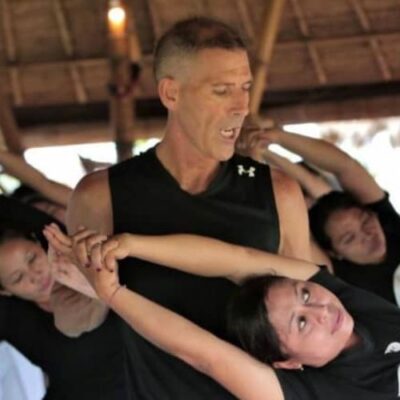 Mr. Ian Terry