
Awkward pose (Utkatasana) is the third posture in the Hot 26&2 class, a deep, held squat with your feet and knees together. Your thighs burn because you hold the position under load while the room is hot. In Bali’s natural heat the burn feels louder, but you can learn to stay with it.

This guide is for visitors and residents who have a mat in Bali and want to understand the pose before class. It covers the steps, where the burn shows up, how to stay calm inside it, what the research says, and how our tropical heat changes the picture.
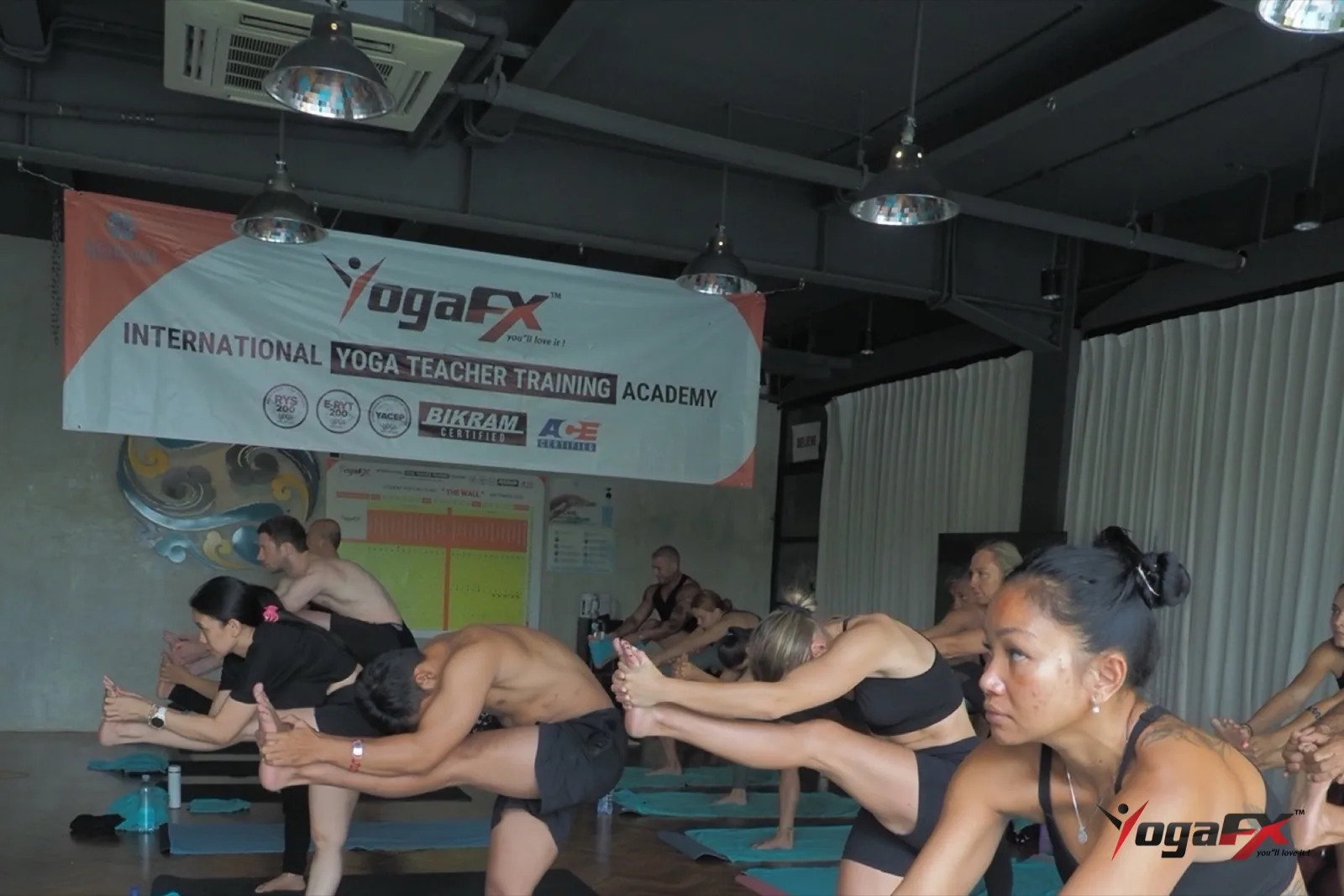
Awkward Pose in a Bali Hot Yoga Class: Why Your Thighs Burn
Awkward pose looks simple from the back of the room. For example, you just sit back, lift your chest, and hold. Then your thighs start to shake, your breath gets short, and the mirror shows a face that says, “How long is this?” That reaction is normal, and it says more about the pose than about you.
Three things work together to create the burn.
- A long static hold. The same muscles stay switched on with no break, so fatigue builds quickly.
- A narrow base. Your feet and knees stay together, so your hips and legs have to steady you.
- A hot room. Heat raises your heart rate and your sense of effort sooner than a cool studio does.
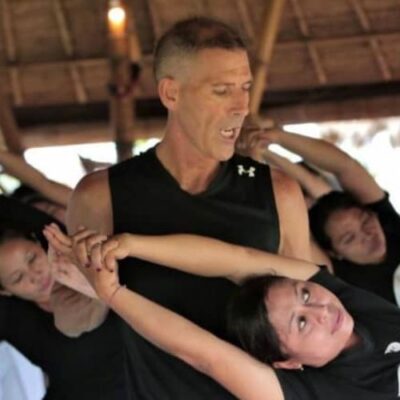
At YogaFX in Seminyak, Mr. Ian Terry, our Founder and Lead Instructor (E-RYT 500, with more than 12,000 teaching hours), teaches awkward pose from the same scripted dialogue in every class. There is no demonstration and no music, so you hear the cue, feel the pose, and make your own small corrections.
That setup suits this posture well, because awkward pose is not about reaching a shape. Instead, it is about staying with an uncomfortable one, and the dialogue gives you something to listen to while you do.
How to Do Awkward Pose (Utkatasana) Step by Step
Here is the pose as we cue it in the Hot 26&2 class. It sits early in the standing series, so your legs are warm but not yet tired. Work through the six steps in order.
- Stand tall with your feet together. Let your big toes and heels touch if that feels steady. If it doesn’t, a fist-width gap is fine.
- Bring your knees together. Press them gently toward each other and keep them there.
- Lift your arms. Raise them parallel to the floor with your palms facing each other and your shoulders relaxed.
- Sit back and down. Imagine lowering into a chair, with your weight in your heels and your thighs doing the work.
- Lift your chest. Keep your spine long and your eyes on one steady spot.
- Breathe and hold. Stay for as long as the dialogue asks, then stand up slowly and take a breath.
Why the Weight Belongs in Your Heels
Most students lean forward without noticing. Their weight slides onto their toes, the front of the knees take the load, and the pose gets harder in the wrong place. So sit back a little more than feels natural, and check that you could wiggle your toes.
In class the posture is taught in several parts, and the later parts make the position more demanding. If you are new, follow the version your teacher calls for, and keep your heels down whenever your balance or your knees ask for it. To see where the pose sits in the full order, read our guide to all 26 postures in order.
Awkward pose at a glance in a Bali hot yoga class
Where the Burn Shows Up in Awkward Pose, and What to Do About It
The burn is not one feeling. It is a handful of different signals, and each one has a simple response. The table below pairs them, so you can adjust on the spot instead of quitting the pose.
| Where you feel it | What is working | What to try |
|---|---|---|
| Front of the thighs | The big thigh muscles hold the squat | Sit back so your weight moves toward your heels, and ease the depth a little |
| Buttocks and outer hips | The hips steady the pelvis and keep the knees together | Press your knees gently toward each other and keep your hips level |
| Lower back | The back muscles hold the spine long | Lift your chest and draw your tummy in lightly, with less forward lean |
| Calves and ankles | They make constant small balance corrections | Spread your weight evenly across both feet and soften your toes |
| Shoulders and arms | They hold your arms level against gravity | Let your shoulders drop away from your ears, with palms facing each other |
| Front of the knees | The joint takes load when weight tips forward | Shift your weight back and rise a little, and stop if the feeling is sharp |
What the Burn Is, and What It Is Not
A deep, tired, shaky feeling in the muscles is the pose doing its job. A sharp, pinching or joint-deep feeling is a different message. If you get it in a knee or hip, come up, rest, and tell the teacher after class. A stretch or a squat hold should feel like effort, never like a sting.
How to Stay With Awkward Pose in a Hot Room
Staying power is a skill, and you can practise it like any other. These five habits help most visitors, and none of them needs extra strength.
- Pick one spot. Fix your eyes on a single point in the mirror and let everything else go blurry.
- Slow your breath. A long, even breath tells your body the pose is safe. A gasping breath tells it to panic.
- Cut the hold into pieces. Think of one breath at a time, not the whole minute ahead.
- Follow the dialogue. The words arrive at a steady pace, so let them carry you forward.
- Rise before you quit. Come up a few centimetres rather than leaving the pose, then sink back when the shaking settles.
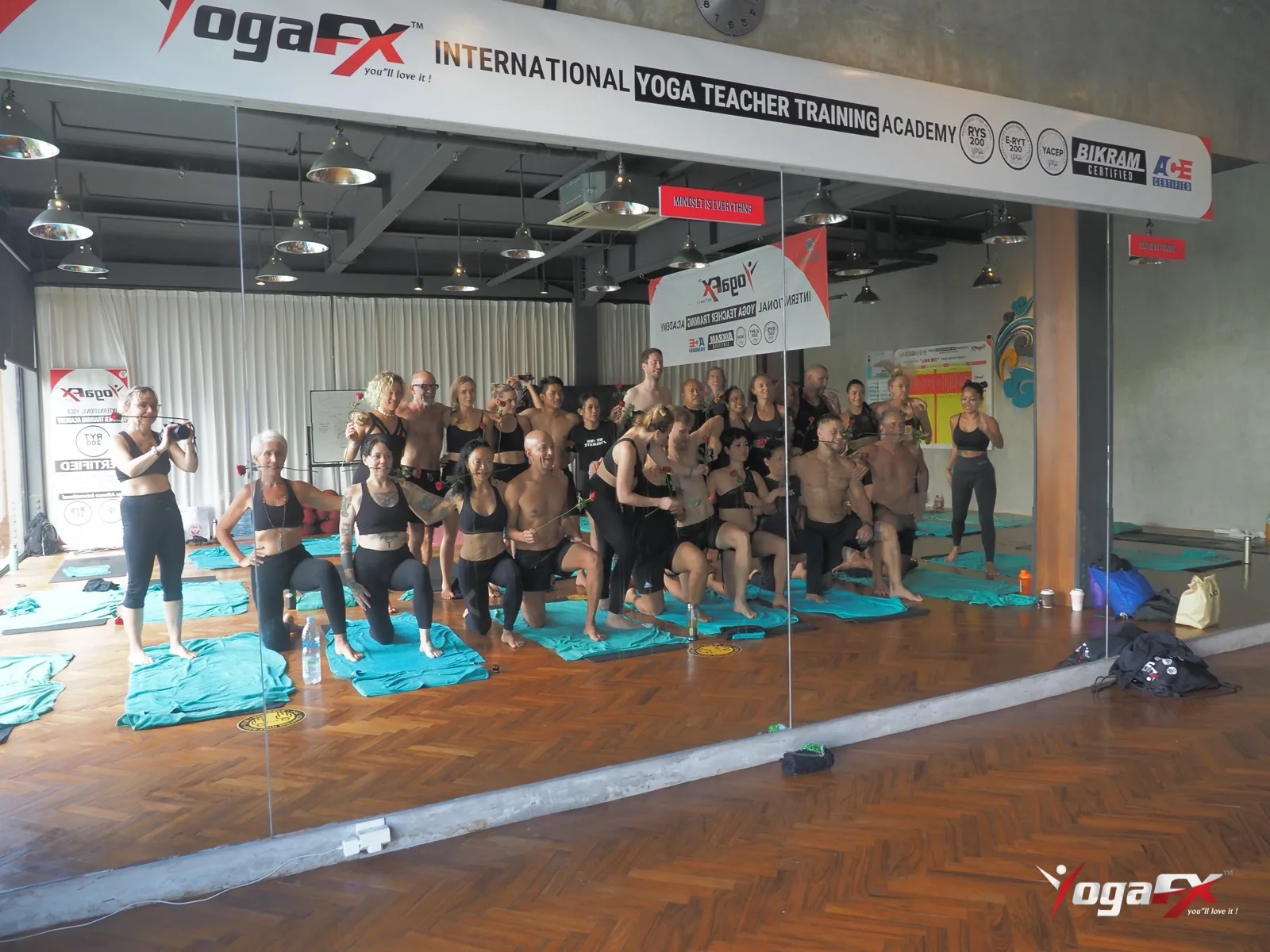
Notice that none of these habits asks you to be tougher. Instead, they ask you to be calmer. Students who stop fighting the pose often find it easier within a few classes, because the effort stays the same while the panic drops away.
Common Awkward Pose Mistakes and Quick Fixes
After many first-timers in the room, the same errors turn up again and again. Each one has a quick fix.
- Weight on the toes. Sit back until your heels press into the mat.
- Knees drifting apart. Squeeze them gently together, as if holding a sheet of paper between them.
- Collapsed chest. Lift your breastbone and look forward, so your spine stays long.
- Held breath. Breathe out slowly, because holding your breath makes the burn feel sharper.
- Sitting too deep, too soon. Choose a depth you can keep for the whole hold, then go lower over several weeks.
Sweat adds one more problem in our tropical room. Your hands and feet can feel slippery, so use your towel before you lift your arms.
Awkward Pose vs Chair Pose: What Is the Difference?
People search for both names, and they refer to the same Sanskrit pose, Utkatasana. The way it is taught can differ a lot between classes, though. Here is how our 26&2 version usually compares with the chair pose you may have met elsewhere.
| Feature | Awkward pose in our 26&2 class | Chair pose in many other classes |
|---|---|---|
| Feet | Together | Often hip-width apart |
| Arms | Parallel to the floor, palms facing | Often overhead |
| Room | Natural tropical heat, 40°C and 40% humidity | Varies from studio to studio |
| Cueing | Scripted dialogue, no demonstration | The teacher’s own words |
| Where it sits | Posture 3 of 26, in a fixed order | Often placed anywhere in a flow |
Neither version is better. That said, the fixed setup of the 26&2 class means you meet the pose in the same place, at the same pace, every time you come back, and that makes progress easy to notice.
What the Research Says About Static Squat Holds and Heat
Three bodies of evidence help explain why awkward pose feels the way it does. We try to be careful about what each one does and does not show.
The Burn Is Real Muscle Fatigue
A 2024 study in Scientific Reports by Dyer and colleagues asked 24 healthy young adults to perform five static exercises for 90 seconds each, including a wall sit. The study found that the gluteus medius and gluteus maximus fatigued more than the rectus femoris, a thigh muscle.
The authors suggested the wall sit as a simple static exercise to tire the hip muscles. A wall sit is not awkward pose, but both are static squat-style holds, so the finding fits.
Heat Raises the Cost of Effort
Cleveland Clinic’s exercise physiologist Michael Crawford explains in this 2026 article that for every degree your internal temperature rises in the heat, your heart rate climbs by about 10 beats per minute. He lists dizziness, fainting, unusual tiredness and muscle cramps as signs to cool down.
Hot-Room Practice Has Been Studied Too
A 2013 study of Bikram yoga practitioners (Tracy and Hart) reported gains in strength and flexibility. We are naming it rather than linking it, because the page would not open for us. Search for it by name if you would like to read the detail.
These findings are encouraging, not final. None of them proves that awkward pose will change your body in a set time, and results vary between people. Please speak to a healthcare professional before you begin a hot yoga routine if you have heart, blood pressure, knee, hip or back concerns. This guide is not medical advice.
Does the pose build muscle? It asks your legs to work hard for a sustained hold, and that may count as strength work. For a fuller answer, read our guide on whether hot yoga builds muscle.
Why Bali Heat Makes Awkward Pose Feel Harder
Our class runs for 90 minutes at about 40 degrees C and 40% humidity, and the heat comes from the tropical climate rather than electric heaters. That changes the pose in three ways.
- Effort feels bigger. Your heart works harder in the heat, so a pose that feels moderate in a cool room can feel fierce here.
- Grip and balance shift. Sweat makes hands and feet slippery, so a steady stance matters more.
- Tiredness arrives sooner. If you feel dizzy or faint, ease out and rest. The pose will still be there on the next breath.
Cleveland Clinic’s general advice for exercising in the heat is to drink fluids regularly, take the intensity down when you need to, and stop if you notice warning signs. It is written for exercise in general, not for yoga, but the common sense carries over.
If you are new to Bali, give yourself time to adapt. Our guide to heat acclimatization for hot yoga walks through three honest weeks, and the hot yoga hydration guide explains what to drink before and after class.
Planning a Bali Stay Around Awkward Pose Practice
Many readers find us while planning a trip, so if you will be in Bali for a week or two, a small plan beats a big one. Come to your first class with no goals beyond finishing it, and let awkward pose be one of the postures you simply survive.
Our classes run at the Seminyak studio, and a second studio in Canggu is coming soon. If you are staying in Canggu, Kuta or elsewhere on the island, plan your travel to Seminyak like any other morning errand. Our hot yoga for beginners guide covers what to bring and what to expect.
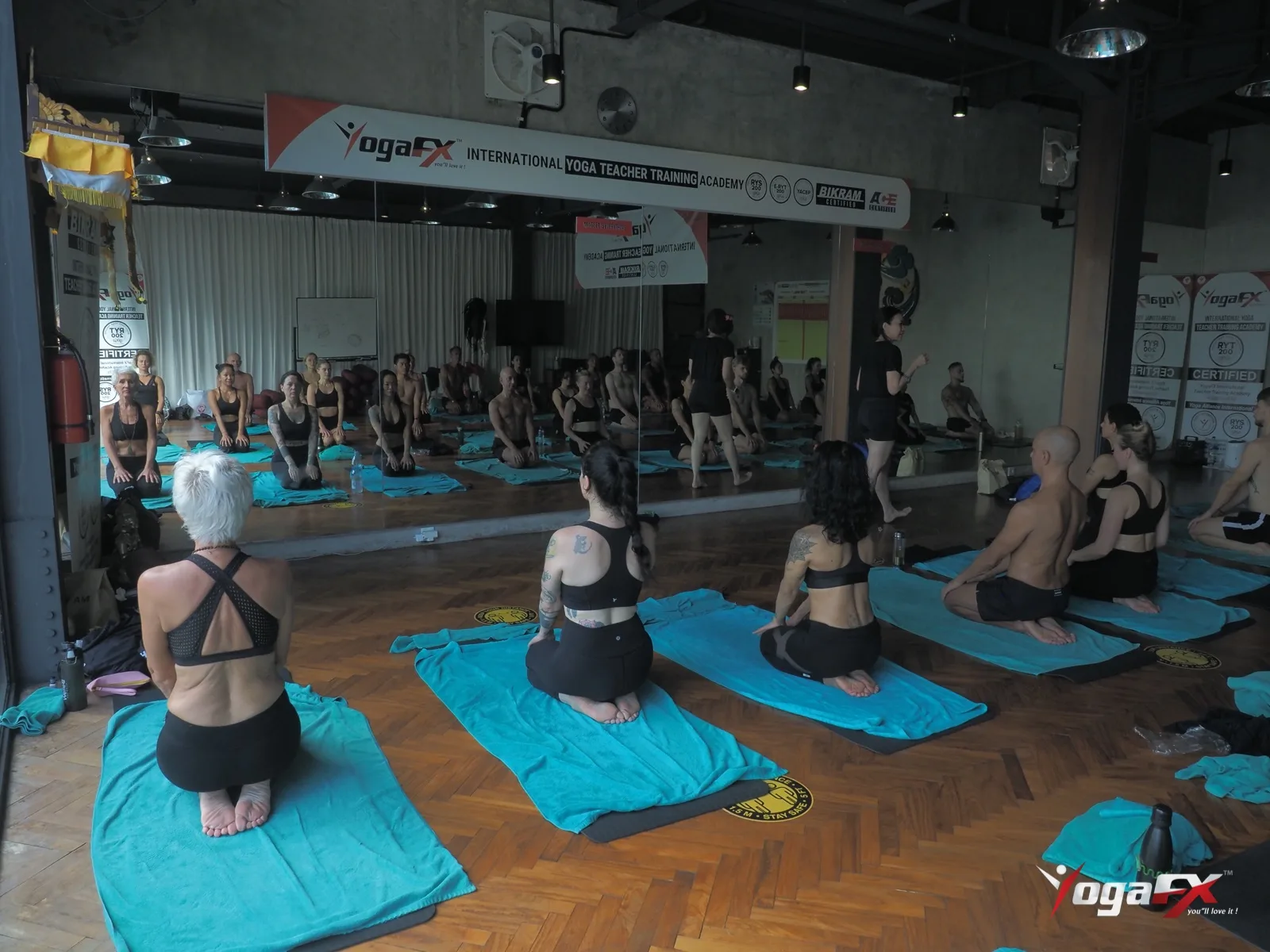
Progress is not a straight line, so treat the pattern below as a rough guide and not a promise.
- Week one. Survive the hold. Keep your heels down and your breath steady.
- Week two. Notice where you shake first, and use the table above to adjust.
- Week three. Stay in the pose a little longer before you rise a few centimetres.
- Week four. Hold your chosen depth with a calmer face, and notice how the burn feels less like an emergency.
What Students Say About the Burn
The pose is famous for making people laugh, groan and quit, then come back. These YogaFX students describe how the hot room feels when the legs are working hard.
Muscles were sore, body and mind break down until I reached a “mind palace” an impenetrable mentality. I felt invincible.
Kevin, Google review, 2025
Kevin joined the hot room alongside his wife, who had signed up for the course. He attended all of the classes, two a day for about three days.
Super fantastic, simple pose but very hard.
Lidya, Google review, 2022
Lidya did not say which pose she meant, but the line fits awkward pose well. It looks simple and it is not.
I was able, day by day, to see significant improvements on my strength and flexibility.
Cinzia, Google review, 2022
Cinzia reviewed the Bikram course she took with us. Her words describe the slow, steady gains that regular practice tends to bring. This short video is from another trainee.
Dian, a trainee in our YouTube review, 2023.
Try Awkward Pose at YogaFX Seminyak
The best way to understand awkward pose is to stand in it, in the heat it was designed for. Our studio is at Jl. Pangkungsari Gg Jepun No.888, Kuta Utara, Seminyak, Badung, Bali 80361. Every class is 90 minutes, in natural tropical heat, taught from the scripted dialogue.
Mr. Ian Terry trained for five years, from 2014 to 2019, with the founder of the Bikram Hot 26&2 method. That background shapes how we cue a pose like this one, with the heels first and the breath second. We teach what we call Original Hot 26&2 Yoga, and we teach it the same way every day.
Ready to try it? Claim our Free 1-Day Guest Pass, where the first class is free. Tell the teacher it is your first time, and ask them to remind you to keep your heels down.
FAQ
What is awkward pose in yoga?
Awkward pose, called Utkatasana in Sanskrit, is a held squat with the feet and knees together and the arms reaching forward. In the Hot 26&2 class it is posture 3 of 26. It builds leg endurance and tests your focus, which is why it feels so demanding.
What is the Sanskrit name for awkward pose?
The Sanskrit name is Utkatasana. Utkata means fierce, powerful or intense, and asana means pose. Many classes call it chair pose, and in the Hot 26&2 class it is taught as awkward pose, with the feet together and the arms held parallel to the floor.
Is awkward pose the same as chair pose?
They share the Sanskrit name Utkatasana, but the setup often differs. In our Hot 26&2 class the feet and knees stay together and the arms are parallel to the floor. Many chair pose versions use a hip-width stance and arms overhead, so the two can feel different.
Why does awkward pose burn so much in hot yoga?
It is a long static hold, so the same leg and hip muscles keep working without a break. Heat adds to the strain by raising your heart rate and your sense of effort. Slow breathing, heels down and a steady gaze all help you stay with it.
How do you modify awkward pose for beginners?
Sit back less deeply, keep your heels down and choose a depth you can hold for the whole pose. If your knees feel pinched, rise a little and move your weight toward the heels. Stop and rest if you feel sharp pain, and ask your doctor first if you have knee concerns.
Still have questions? Message Mr. Ian and the YogaFX team on WhatsApp and we will answer them personally.
 Mr. Ian Terry