
The Bikram yoga dialogue is the fixed spoken script a teacher delivers for the full 90 minutes of class. In our Seminyak hot room, new students learn it by hearing it. Nobody hands you the words. You pick them up class by class, until the cues feel familiar.

That slow, ear-first route is the part most guides skip. They explain what the script is, but not what it feels like to learn it from the mat. This guide follows the path a Bali student takes: first class, first month, and, for those who go on to train, the day the words move from ear to voice.
Mr. Ian Terry, E-RYT 500 and founder of YogaFX, has taught more than 12,000 hours. His view is simple: the script is a teaching tool before it is anything else.
Where the Bikram Yoga Dialogue Comes From
The dialogue arrived together with the method itself. The Bikram Hot 26&2 class pairs 26 postures and 2 breathing exercises with a set of spoken instructions, and teachers deliver those instructions in the same order every time. Mr. Ian trained with the founder of the method from 2014 to 2019, so he learned the dialogue at its source and has taught it ever since.
Why a script at all? Think about who walks into a Bali studio on a given morning. A Dutch backpacker, a Jakarta office worker, a surfer from Canggu, an expat who last stretched in school. They speak different first languages and carry very different bodies. A fixed script gives all of them the same clear instruction, at the same pace, with no teacher improvising and no demonstration to copy.
There is also a legal footnote worth knowing.
In 2015 the US Ninth Circuit ruled, in Bikram’s Yoga College of India v. Evolation Yoga, that the sequence of 26 postures and 2 breathing exercises cannot be copyrighted. That ruling is why any studio can teach the sequence under any name today. It did not turn the script into public property, which is one reason you won’t find an official text online.
For a wider look at what the script covers, our sister site has a broader guide to the 26 and 2 dialogue.
How Seminyak Students Learn the Bikram Yoga Dialogue: 4 Stages
Nobody studies the script before their first class. Students learn the dialogue the way you learn a song on the radio: by hearing it again and again until you could hum along. The Bikram yoga dialogue is learned in four stages, and each one asks something different of you.
| Stage | What you notice | What helps most | What changes next |
|---|---|---|---|
| First class | A steady voice, no music, no demonstration, a lot to take in | Follow the cue you can catch and rest when you need to | The sound of the voice stops feeling strange |
| Classes two to four | The same phrases come back in the same order | Listen for the cue before the posture, not after it | You start predicting the next instruction |
| A handful of classes in | You respond to cues without translating them in your head | Let the words set the pace instead of racing ahead | Your attention shifts from the voice to your own body |
| Regular weekly practice | Small changes show up because the words never change | Compare this week’s posture with last week’s | Some students ask what it would take to teach it |
Stage one: hearing it without trying to hold it
Your first class is mostly about surviving the room, and that’s fine. The dialogue is designed to be heard, so you don’t need to memorise anything. If you catch one cue in three, you’re doing it right. The teacher keeps talking so you don’t have to keep thinking.
Stage two: the words start to repeat
Somewhere in your second or third class, a phrase lands before the teacher finishes it. That small moment surprises many students. It tells you the repetition is working, because your ear has begun to hold the pattern without any effort from you.
Stage three: the voice becomes background
After a handful of classes, you stop listening to the words and start moving with them. This is where regular students say the class “gets quiet” in their heads. The script carries the timing, so your mind is free to notice your breath, your balance and your edge in each posture.
Stage four: curiosity about the other side of the microphone
Some students reach a point where they wonder how the teacher does it. How does she keep the pace in the balancing series? How does he sound calm while the room is working hard? That curiosity is where the road toward teacher training usually starts.
3 Mistakes New Students Make With the Bikram Yoga Dialogue
Three habits commonly slow new students down in a Bikram yoga dialogue class. All three are easy to fix once you know them.
- Trying to memorise on day one. The Bikram yoga dialogue is built for the ear, so memorising early only adds stress to a room that is already demanding.
- Waiting for a demonstration. Students from other styles keep glancing at the teacher. In a dialogue class the teacher does not demonstrate, so the glance never pays off.
- Judging the class by the first 20 minutes. The Bikram yoga dialogue feels repetitive at first and rewarding later. Give it a few classes before you decide.
None of these is a failing. They are just the natural reflexes of someone used to a different kind of class, and they fade quickly.
The Class the Dialogue Lives In: Key Numbers
The script only makes sense inside the room it was built for. Here are the numbers that shape how the Bikram yoga dialogue sounds and feels in our studios.
How to Listen to the Bikram Yoga Dialogue in Your First Five Classes
You can’t study for the dialogue, but you can listen better. These habits help new students get more from each class without trying harder.
- Arrive early and settle. A calm start lets you hear the opening instructions instead of catching up with them.
- Follow the voice, not the room. Looking at your neighbour is a habit from other classes. Here the teacher tells you everything you need.
- Rest without guilt. Stepping back is part of the class. You’ll hear the cues from your mat and rejoin on the next one.
- Notice one cue per class. Pick a single phrase to listen for, such as the breathing count at the start. One anchor is enough.
- Drink water before and after. A thirsty brain misses words, and the heat adds up faster than you expect.
Notice what is missing from that list. There is no step that says “memorise the words”. That’s deliberate. The room does the teaching, and your job is to stay present for it. If you want a gentler start, our guide to your first hot yoga class in Bali walks through what to bring and what to expect.
What Students Say About Learning the Bikram Yoga Dialogue
Nobody scripted these. They come from public reviews that students left after training with Mr. Ian and the team. Each one touches a different part of the same journey.
“I stayed up late and woke up early to prove to myself that I cared about passing on the profound benefits of the practice of 26 & 2 hot yoga, and to show up prepared for my fellow classmates.”
Greta, Google review, 2026
Greta’s line captures what the dialogue asks of a future teacher: preparation that is really care for the people in the room. It also shows that the effort doesn’t stop when the class ends.
Aditya, in a 2019 YouTube review, compared our training with an earlier one-week course where he barely got to teach until the last day. Here, he said, trainees are pushed to teach early. He also said the point is to watch the students’ bodies and ask what they need, not only to know the dialogue and perform it. Watch his review below.
A second trainee, speaking in a 2024 YouTube review, kept it short and heartfelt:
“This is the best learning that I’ve ever learned.”
A trainee in our YouTube review, 2024
More student voices are collected on our graduate stories page.
What Research Says About Learning by Repetition and Heated Practice
The Bikram yoga dialogue works partly because of how memory works. Two well-known findings from psychology explain why hearing the same words again and again helps them stick. Neither study is about yoga, and that’s the point: this is how people learn spoken material in general.
- Spacing helps. A 2006 review in Psychological Bulletin pooled 839 assessments of distributed practice from 317 experiments in 184 articles. It found that the gap between study sessions and the time until you need the material both affect how much people remember (Cepeda et al., PubMed).
- Retrieving helps. In a 2006 study in Psychological Science, students who were tested on prose passages remembered more after two days and a week than students who simply studied again (Roediger and Karpicke, PubMed).
Each Bikram yoga dialogue class is a spaced repetition session and each predicted cue is a small act of retrieval. That is a reasonable explanation for the “I knew what she’d say” moment in stage two. It’s an explanation, not a proven effect of the dialogue itself.
Heat and focus: what to watch for
Listening closely in a warm room takes energy, so it pays to know the signs of overheating.
The US Centers for Disease Control and Prevention lists muscle cramping, unusually heavy sweating, shortness of breath, dizziness, headaches, weakness and nausea as symptoms that your body is getting too hot, and advises taking breaks and carrying water (CDC, About Heat and Your Health). If you feel any of these in class, rest and tell your teacher.
Heated yoga and mood: what one trial found
Many students ask whether a Bikram yoga dialogue class does anything for the mind. The best-known trial is an eight-week randomised study from Massachusetts General Hospital (Nyer et al., 2023). It compared community-delivered heated hatha yoga with a waitlist in adults with moderate-to-severe depression. About 59% of the yoga group had a symptom drop of 50% or more, compared with about 6% of the waitlist group (Europe PMC record).
Read that carefully. The trial was small, it compared yoga with waiting rather than with another treatment, and the authors call for further research with active control groups. It says nothing specific about the dialogue. If you live with depression, please consult a healthcare professional before changing your care.
From Student to Teacher: When the Words Move From Ear to Voice
For students who decide to train, the Bikram yoga dialogue route changes shape. You no longer receive the dialogue, you deliver it. The training is hybrid: trainees begin learning the words online before the intensive, then use the in-person days in Bali to practise delivery with direct feedback. Graduates earn a Yoga Alliance RYT 200 certificate plus a Bikram Hot 26&2 200-Hour International Yoga Certification.
Here is the quiet advantage of learning the Bikram yoga dialogue in the room first. By the time you sit down to memorise, your ear already knows the pace, the pauses and the order. You are not starting from zero. You are turning something familiar into something you can say out loud.
Three things change when you move from listener to teacher:
- Pace. You set the speed of the Bikram yoga dialogue instead of following it, so you have to breathe with the room.
- Voice. Tone matters as much as wording. A steady, calm voice keeps a hot room settled.
- Attention. You still speak the words, but you also watch bodies, as Aditya described.
Delivery is the harder skill. Knowing the words is one thing. Speaking them with the right timing for a room of beginners is another.
That is why our trainers correct you as you speak, and why a printed script can never replace a teacher in the room. The next batch checks in on Sunday, 24 January 2027, and checks out on Friday, 29 January 2027. You can read the full details on our Bikram yoga teacher training page.
If you want the bigger picture before you decide, start with our complete guide to the 26&2 method.
Hear the Bikram Yoga Dialogue Live in Seminyak
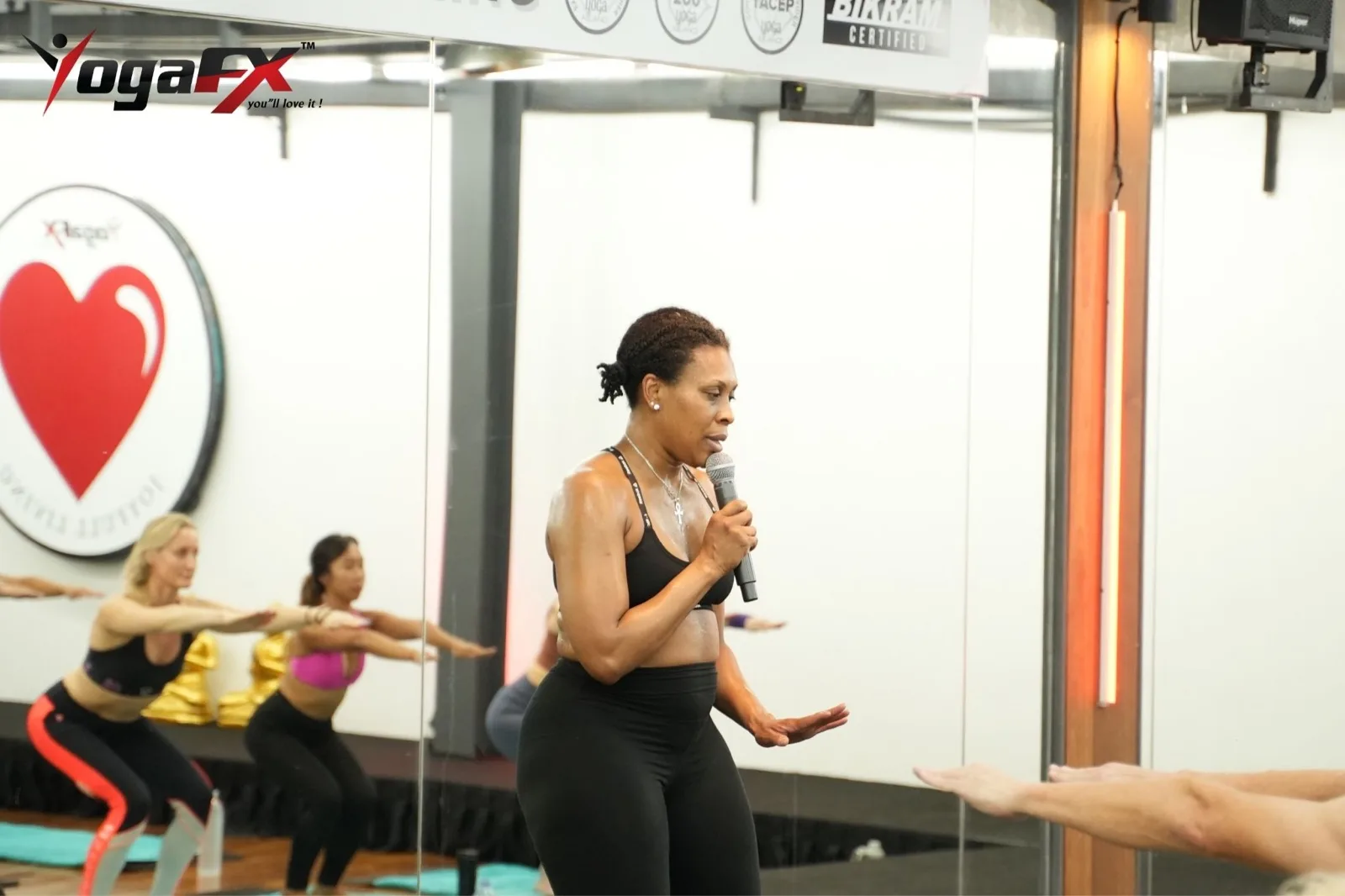
No guide to the Bikram yoga dialogue replaces sitting in the room. Every class at YogaFX Seminyak is taught through the original dialogue, with no music and no demonstration, in a room of about 40°C. Class runs from 06:30 to 08:00, booking only, so book the mornings that suit your week.
Try your first class free. Claim a free guest pass, listen for one cue, and see which stage you’re in by the end. You can contact the studio to book it.
FAQ
What is the Bikram yoga dialogue?
The Bikram yoga dialogue is the fixed spoken script a teacher uses to lead a Bikram Hot 26&2 class. It guides students through 26 postures and 2 breathing exercises in the same order every class, with no music and no demonstration. The words set the pace, the breathing and the rests for the whole room.
Is there an official Bikram yoga dialogue PDF?
No official version is published online. The PDFs and flashcards you find are unofficial and often contain errors. A printed script also leaves out timing, pauses and voice, which teachers learn from a trainer who corrects them as they speak. Students do not need the text at all, because the dialogue is designed to be heard.
How do you memorize the Bikram yoga dialogue?
Students rarely try. They hear it class after class until the phrases feel familiar. Trainee teachers memorise it in stages: the words first, then spoken delivery, then teaching real students with feedback. At YogaFX the first stage starts online before the in-person intensive in Bali.
Do you need to know the dialogue before your first class?
No. Your first class is for hearing it, not knowing it. Follow the cues you catch, rest when you need to, and drink water. Most students notice phrases repeating by their second or third class, and many stop consciously listening after a handful of classes.
Is a Bikram yoga dialogue class the same as hot yoga?
Not always. Many hot yoga classes use music, shorter formats or freestyle cueing, and teachers may demonstrate. A dialogue class is silent apart from the teacher, runs the same sequence in the same order, and relies on spoken cues. Ask the studio whether the original dialogue is taught word for word.
Still have questions? Message Mr. Ian and the YogaFX team on WhatsApp and we will answer them personally.
 Mr. Ian Terry