
Hot yoga inflammation research is small and early. One 2020 study found a sharp rise in a signalling protein called IL-6 right after a single hot class, while another marker, TNF-alpha, stayed flat. We found no trial showing that hot yoga lowers chronic inflammation. Treat it as a plausible helper, not a treatment.

Mr. Ian Terry, E-RYT 500, has taught more than 12,000 hours and leads the YogaFX teaching team in Seminyak. Visitors planning a Bali stay often ask him whether a daily hot class will calm a sore, inflamed body. His honest answer is that it may help you feel better, but nobody can promise a drop in a blood marker.
Below you will find what the CRP blood test really measures, what the hot yoga inflammation studies did and did not show, and how to practise sensibly in Bali heat. This is general information, not medical advice.
The short answer on hot yoga inflammation
Here is where the evidence on hot yoga inflammation stands today, in plain words. Each point is explained further down, with the source beside it.
- One hot class changes some blood markers for a while. In a 2020 crossover study, IL-6 rose after hot yoga but not after the same yoga in a cool room.
- That is a one-session snapshot. The blood was drawn 30 minutes after class, so the study says nothing about chronic inflammation.
- Yoga in general looks promising. Harvard Health describes small studies that found indications of lower inflammation, and calls the first one exploratory.
- No lasting benefit is proven for hot yoga. We did not find a trial that tracked CRP before and after weeks of hot classes.
- Pacing matters more than any number. Heat is a stress on the body, so build up slowly and drink well.
This article is part of our hot yoga health guide, which brings together the research on benefits, safety and the heat.
What inflammation and CRP actually mean
Inflammation is your body’s response to injury, infection or strain. Short bursts are normal and useful, but the worry is chronic low-grade inflammation, which is a long-running background level that people try to track with blood tests.
The most common test measures C-reactive protein (CRP). According to Johns Hopkins Medicine, CRP is a protein the liver produces in the presence of infection or inflammatory disease. Doctors have used it for many years to gauge how much inflammation or infection is present.
Why one blood number is not a verdict
CRP is a general signal, not a precise one. The same Johns Hopkins page notes that levels rise with infection, and also with ageing, smoking and obesity. It adds that a CRP test taken out of context can have questionable value.
So when a website says hot yoga inflammation markers fall, or that “hot yoga lowers CRP”, ask three things. Who was tested, for how long, and compared with what? Most of the time the honest answer is a small group, a short period, and no comparison at all.
- CRP rises with a cold or flu. A test during illness tells you about the illness.
- It is shaped by lifestyle. Smoking and body weight both push it up, so those need attention first.
- It needs a doctor to interpret. Your own number only means something alongside your history.
What the hot yoga study actually measured
The most direct study we could open is by Lambert and colleagues, 2020, in the International Journal of Exercise Science. Sixteen experienced yoga practitioners did a one-hour Bikram sequence (the same family as our Hot 26&2 class) twice, once at 40°C and once at about 23°C, in random order and at least 96 hours apart.
Researchers drew blood just before class and again 30 minutes after. They measured three signalling proteins: IL-6, IL-10 and TNF-alpha. Here is what happened.
- IL-6 rose in the hot room only. The paper reports a 15.5-fold increase after hot yoga, against about 1.9-fold after cool-room yoga.
- TNF-alpha did not change. The authors saw no post-exercise change in TNF-alpha or IL-10 in either condition.
- Energy cost looked similar. Hot yoga did not significantly raise the aerobic energy cost compared with the cool room.
16 people
Experienced practitioners, mostly women, each doing both a hot and a cool class.
1 session
One hour of Bikram yoga at 40°C. Blood drawn before and 30 minutes after.
IL-6 up
A 15.5-fold rise after hot yoga only, a short-term signal.
TNF-alpha flat
No change in TNF-alpha or IL-10 in either room.
Does a higher IL-6 mean the class “caused inflammation”? Not on this evidence. The study was built to compare energy use and range of motion, and it caught the blood markers at one moment. It cannot tell us whether levels settle, fall below where they started, or matter for long-term health.
Notice also who took part in this hot yoga inflammation study: 16 regular practitioners, mostly women. Results from a group like that may not carry over to a beginner, an older adult or anyone with a medical condition.
What research on yoga in general suggests
Wider yoga research is a little more encouraging. Harvard Health describes small studies in which yoga was linked to lower inflammation. One was an exploratory 12-week study. Another followed a three-month yoga retreat, where researchers found indications of lower inflammation and significantly lower cortisol.
Those are yoga studies, not hot yoga studies, and the page itself uses careful words such as “suggest” and “indications”. So the fair reading is that regular yoga may help, and the heat may or may not add anything to hot yoga inflammation results.
Our own guide to cortisol and hot yoga covers the stress-hormone side of this story. And if you want a broader view, what the research shows about hot yoga sets out the benefits and the limits in one place.
The cell-stress side: HSP70
A 2021 trial by Bourbeau and colleagues, 2021 compared hot and normal-temperature yoga in 22 healthy adults over 12 sessions. Its headline result was higher HSP70 in blood cells of the hot group only. HSP70 is a stress-response protein rather than a standard inflammation marker, so it does not answer the inflammation question directly.
We unpack that result in our guide to heat shock proteins and hot yoga. The short version is the same as here: interesting science, early evidence.
Hot yoga inflammation: what is shown and what is not
A table helps to sort hot yoga inflammation claims by the strength of their support. The right-hand column is the one to remember.
| Claim you may read | What the sources show | How firm is it |
|---|---|---|
| Hot yoga raises IL-6 right after class | Rose 15.5-fold in 16 practitioners, hot room only (Lambert, 2020) | Shown once, small sample |
| Hot yoga raises TNF-alpha | No post-exercise change in either condition | Not shown |
| Hot yoga lowers CRP | We found no trial measuring CRP across weeks of hot classes | Not shown |
| Yoga may lower inflammation overall | Small exploratory studies, described by Harvard Health as suggestive | Early and general |
| Hot yoga is an arthritis treatment | No source we checked supports this | Not shown |
| Bali natural heat is better than a heated room | No study compares the two | Unknown |
The pattern in the hot yoga inflammation evidence is clear. The most solid row describes a short-lived lab signal, and every row about long-term benefit sits in the weaker half. That isn’t a reason to skip class. It is a reason to ignore anyone who sells hot yoga as a proven anti-inflammatory fix.
Hot yoga inflammation questions we hear in Seminyak
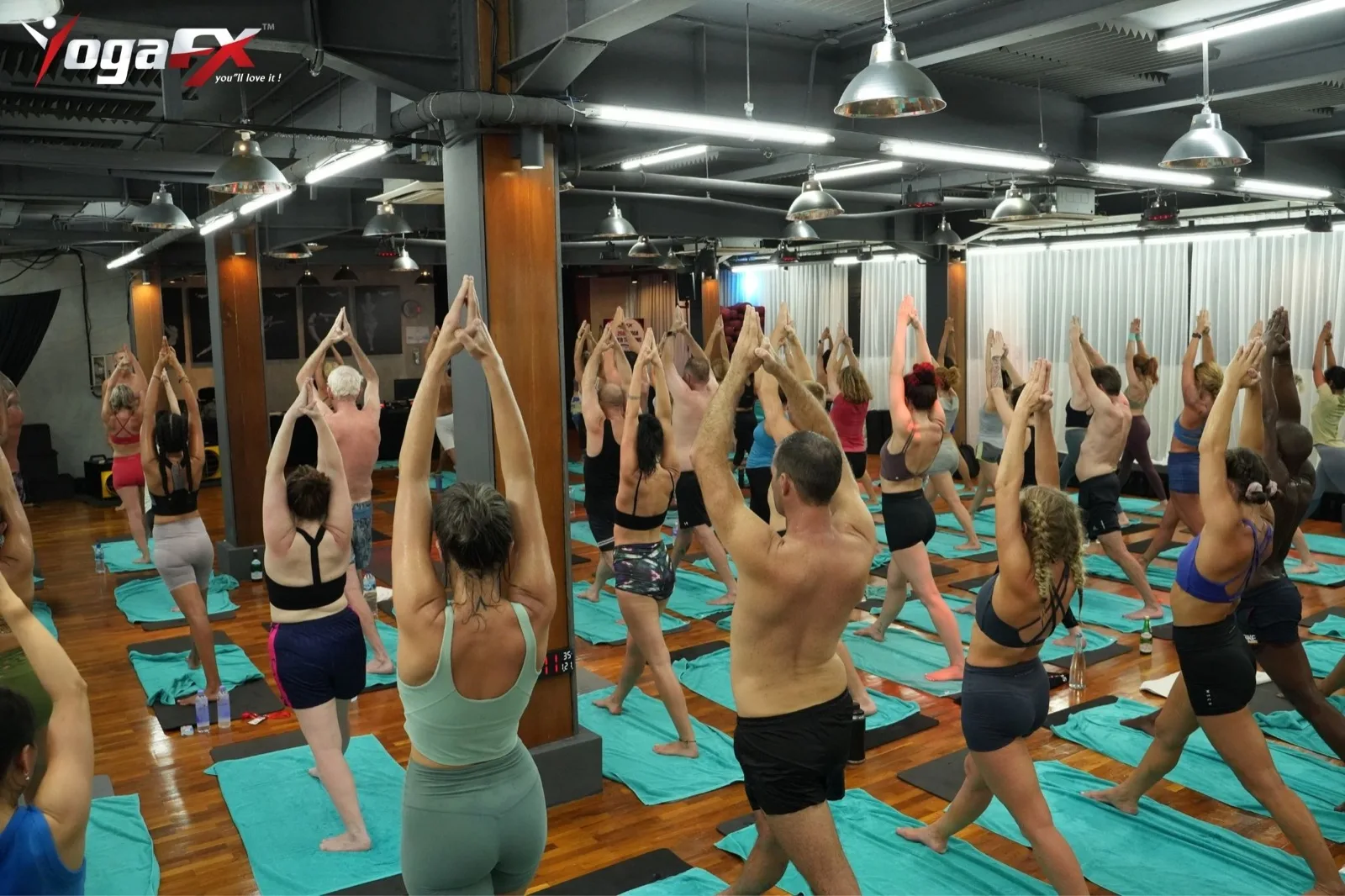
At YogaFX the heat comes from the tropical climate, not from electric heaters. A class runs 90 minutes at around 40°C and 40% humidity, and the studio is open from 06:00 to 22:00 every day. That is the real-world setting for everything above.
Visitors from cooler countries usually arrive with one of three worries. Their joints ache, their muscles feel sore, or they have read that heat “inflames” the body. Here’s how we think about each one.
- Sore muscles after class. Mild next-day soreness is common when you are new to the postures, and it usually eases within a day or two. Our guide on feeling tired after hot yoga explains the usual causes.
- Aching joints. Joint pain is a reason to talk to a doctor, not to push deeper into a posture. Teachers can adjust a posture but cannot diagnose a condition.
- Fear of heat itself. Heat is a stress on the body, and your body adapts to it over weeks, not days. Our heat acclimatization guide gives a week-by-week view.
We cannot say that a month of classes will change your blood tests or your hot yoga inflammation markers. What we do see is people sleeping better, moving more easily and feeling calmer. Those are real changes, even if they aren’t lab results.

A sensible plan for a Bali stay
If you are visiting for a few weeks and wondering about hot yoga inflammation, build the habit gently. The plan below is our general advice, not a medical programme, and it assumes you are healthy and have cleared hot yoga with your doctor.
| Stage of your stay | What to do | Why it helps |
|---|---|---|
| First few days | Take it easy: two or three classes, rest days between | Your body is meeting tropical heat for the first time |
| Week one | Sip water through the day and all through class | Sweat loss is real, and dehydration spoils the session |
| Weeks two and three | Add classes slowly if you feel steady | Heat adaptation builds over weeks, not days |
| Any time | Skip class if you feel unwell, feverish or sore in the joints | Heat adds strain when the body is already stressed |
For hydration details, see our hot yoga hydration guide, which covers water and electrolytes in Bali heat. It matters here because a poorly hydrated body handles heat badly, whatever the inflammation numbers say.
What students say
None of the students below mention inflammation, and we would not expect them to. Their words show what practice feels like from the inside. Both come from video reviews on our YouTube channel, shared with first names only where a name is given.
Jeanett, YouTube review, 2019, recorded a short thank-you to the teachers for the inspiration she took from her time with us in Bali.
A trainee in our YouTube review, 2018, put it simply: “The best instructor I’ve ever seen in my life. Perfect. Well done, man.”
These reviews come from our teacher training graduates, so they describe a six-day programme, not a drop-in class. Even so, they show the support around the heat, and that support is what helps people keep practising long enough for any benefit to appear.
Who should check with a doctor first
Heat raises the heart rate and body temperature. Please talk to a doctor before starting hot yoga if any of these apply:
- You have a heart condition, high blood pressure or a history of heat illness.
- You live with an inflammatory or autoimmune condition, such as arthritis, or take medication for it.
- You are pregnant or trying to conceive, or you take medication that affects fluids or temperature control.
- You feel unwell, have a fever or are recovering from an illness.
Stop and rest if you feel faint, confused or nauseous. This article is general information, not medical advice, so please consult a healthcare professional before you begin. It does not replace care from your doctor.
FAQ: hot yoga and inflammation
Does hot yoga reduce inflammation?
Nobody can promise that. One 2020 study found IL-6 rose after a single hot class, and TNF-alpha did not change. We found no trial showing hot yoga lowers chronic inflammation. Yoga in general looks promising in small studies, so regular practice is reasonable, but it is not a treatment.
Does hot yoga cause inflammation?
Not in any way that has been shown to be harmful. After one hot class, researchers saw a short-term rise in IL-6, which was measured 30 minutes later. That is a snapshot from 16 people, not proof of lasting inflammation. Muscle soreness after class is common and usually settles within a day or two.
Is hot yoga good for arthritis?
We cannot say so. None of the sources we checked tests hot yoga as an arthritis treatment, and it should not replace medical care. Heat and effort can also aggravate sore joints for some people. Please talk to your doctor before starting, and stop if a posture hurts a joint.
What is CRP and does hot yoga change it?
CRP is a protein the liver makes when there is infection or inflammation, and doctors use it as a general marker. Johns Hopkins Medicine notes it also rises with ageing, smoking and obesity. We found no trial measuring CRP across weeks of hot yoga, so any claim is unproven.
How often should I do hot yoga during a Bali stay?
No study sets a dose for inflammation. Our advice for newcomers is to start with two or three classes in the first days, rest between them, drink steadily and add classes slowly. If you feel unwell, skip class. Your doctor can tailor this to your health.
Still have questions? Send them through our contact page and the YogaFX team will answer personally. To feel the room yourself, claim the Free 1-Day Guest Pass at our Seminyak studio, where your first class is free.
 Mr. Ian Terry