
The main heat therapy benefits are lower heart risk in long-term sauna studies, lower blood pressure in some trials, and better mood in heated yoga research. A 90-minute hot yoga class in Bali’s natural heat is active heat therapy, while a sauna is passive. The evidence for both is promising but not settled.

Short answer first, because you probably want to decide something: should you sit in a sauna, take a hot class, or do both? This guide to heat therapy benefits sets the research next to what happens in a real Seminyak studio, so you can choose with your eyes open.
Heat therapy benefits are real enough to take seriously, and uncertain enough to take carefully. We keep both ideas in mind throughout.
Medical note: this article is general education, not medical advice. If you have a heart condition, high or low blood pressure, are pregnant, or take regular medication, speak to a healthcare professional before you add any heat to your week.
Heat therapy benefits: what the research actually says
Heat therapy simply means warming the body on purpose, through a sauna, a hot bath, an infrared cabin or hot exercise. A 2026 review in Comprehensive Physiology (Richey et al.) puts it plainly. The predominance of evidence suggests heat therapy touches many parts of health and performance, but the reasons, the size of the effect and the groups who gain most are “far from completely understood”.
That honesty matters. Many articles on heat therapy benefits read like sales pages. The review itself spends time on studies that found little or no benefit, and so should anyone writing about this topic.
Here is what the research does support, in plain terms:
- Heart and circulation. A long-running Finnish sauna study links regular sessions with fewer sudden cardiac deaths, although it shows association, not proof.
- Blood pressure. Combining exercise with sauna has lowered blood pressure in some trials, both right after the session and a day later.
- Mood. A trial of heated yoga in adults with depression reported lower symptom scores, which we cover below.
- Limits. Some trials found little or no benefit, and the review says so openly.
Notice the careful verbs: link, some, may. They are there on purpose, and you will see them again below.
What counts as heat therapy?
Four routes dominate the research on heat therapy benefits, and they are not interchangeable. Each one delivers a different mix of temperature, humidity, time and effort.
- Finnish-style sauna. Dry air at roughly 80 to 100°C, with humidity usually under 20%, according to the Comprehensive Physiology review.
- Hot-water immersion. Studies use water between 37 and 41°C, for 30 to 90 minutes per session.
- Infrared sauna. Heat from infrared light. The Mayo Clinic says larger studies are still needed.
- Hot exercise. Movement inside a heated room, such as a Bikram-style class at about 40°C and 40% humidity.
The last option is the one most people forget when they search for heat therapy benefits. When you move in the heat, you get the warmth and the exercise at once. That is a strength, because both are good for you. It is also a research headache, because scientists cannot easily tell which of the two caused the benefit.
Heat therapy benefits compared: sauna, bath, infrared and a Bali class
The table below sets the four routes side by side, so the heat therapy benefits of each are easy to compare, using figures from the sources named in this article. Where a source gave no number, the cell says so instead of guessing.
| Heat route | Typical conditions | You are… | What the evidence says |
|---|---|---|---|
| Finnish sauna | 80 to 100°C, humidity under 20% | Resting | Long-term Finnish data link frequent sessions with fewer sudden cardiac deaths |
| Hot-water bath | 37 to 41°C, 30 to 90 minutes | Resting | Studied in many trials, with results that vary by condition |
| Infrared sauna | Not given in the Mayo Clinic Q&A | Resting | Some proof it may help long-term conditions, but larger studies are needed |
| Hot class in Bali | About 40°C, about 40% humidity, 90 minutes | Moving | Heated-yoga trials show mood gains, but heat and exercise cannot be separated |
If you want the head-to-head detail, our guides on hot yoga versus a sauna and hot yoga versus an infrared sauna go deeper on each pairing.
Heat therapy benefits for your heart and blood pressure
The strongest sauna finding comes from Finland. The 2026 review in Comprehensive Physiology (Richey et al.) describes a Kuopio study of 2,315 middle-aged men followed for a median of nearly 30 years. The lowest risk of sudden cardiac death appeared in men who used a sauna four to seven times a week for more than 19 minutes per session.
A 2018 review in Mayo Clinic Proceedings by Laukkanen and colleagues also covers sauna bathing and cardiovascular health. We name it here without a link because the journal page blocked our automatic check, so read it as a pointer to further reading, not as a quotation.
There is a catch, though. Those Finnish men chose to use saunas, and people who sauna regularly may also live differently in other ways. So it’s an association, not a guarantee.
Blood pressure: promising, but not for everyone
The same review notes that exercise combined with sauna use lowered blood pressure right after the session and 24 hours later in some studies. Yet the review also emphasises studies that found little or no benefit. In short, the heat therapy benefits for blood pressure depend on who you are and what you do in the heat.
Heat therapy benefits for the heart, in other words, are best read as encouraging, not guaranteed. This is exactly why “just sit in the heat” is weak advice for anyone with a cardiovascular condition. Speak to your doctor first, then start gently.
Heat therapy benefits for mood and stress
Mood is where heated yoga has its best-known trial. In 2023, researchers at Massachusetts General Hospital (Nyer et al.) tested heated yoga in adults with depression over eight weeks. About 59% of the yoga group cut their depression symptoms by half or more, against about 6% of the waitlist group.
That is a striking result for the mood side of heat therapy benefits, and it deserves two caveats. The trial tested a supervised eight-week programme in adults with depression, so it is not a treatment promise for anyone reading this. If low mood is affecting your life, please see a qualified professional.
On the passive side, the Mayo Clinic Q&A on infrared saunas is refreshingly blunt. Studies “found some proof that saunas may help” with long-lasting conditions, but “larger and more-exact studies are needed”. When asked whether infrared saunas bring clear health benefits, its answer is a single word: “Perhaps.”
We like that answer. It’s what a good teacher would say. Heat feels good, it may well help, and the honest position is to hold the claim loosely.
You can browse the full hot yoga and your health guide for every study we cite, including how heat may affect the body at a cellular level.

What a 90-minute class adds that a sauna does not
A sauna asks nothing of you. A class doesn’t let you coast for 90 minutes. That difference is the whole story of this comparison.
A 2014 University of Wisconsin study (Porcari et al.) measured the workload of a 90-minute hot yoga class. Women averaged about 333 calories and men about 460, with heart rates around 80% of their maximum. Those numbers describe real cardiovascular work, not rest.
So when you step out of class, you have collected two things at once, and both feed the heat therapy benefits people look for: heat exposure and exercise. A sauna gives you the first only. That is why we suggest thinking of the two as partners, not rivals.
Where the sauna still wins
- Recovery days. When your body wants rest but your mind wants warmth, a short sauna asks very little of you.
- Total control. You pick the temperature, the length and the exit time.
- Easy on joints. There is no balancing, no bending and no standing for 90 minutes.
Where a hot class wins
- Fitness. You build strength, balance and flexibility while you warm up.
- Guided pacing. A teacher scripts every minute, so you never have to decide how long to stay.
- Community. You practise beside other people.
If you already use a hotel sauna in Seminyak, read planning a sauna after hot yoga before you stack the two on the same day. And for the humidity question, here is how Bali humidity compares with a steam room.
Heat therapy benefits and safety: who should be careful
Heat therapy benefits come with risks, and every form of heat therapy shares the same ones. You can overheat, you can dehydrate, and you can feel faint when you stand up. The Mayo Clinic guidance on heat exhaustion lists the warning signs of heat exhaustion: heavy sweating, dizziness, faintness, fatigue, a weak and rapid pulse, muscle cramps, nausea and headache.
Its advice is simple and worth memorising. Stop all activity and rest, move somewhere cooler, and drink cool water or a sports drink. Seek urgent medical help if the person becomes confused, loses consciousness or cannot drink.
The same page notes that some medicines can affect how well your body stays hydrated and responds to heat. It also says infants, young children and adults over 65 are at higher risk. If either group describes you, check with your doctor.
Our own habits follow from that:
- Drink water before, during and after any hot session, whether it is a class or a sauna.
- Never push through dizziness, nausea or a pounding headache. Sit or lie down and tell your teacher.
- Skip alcohol on the day, because it can add to dehydration.
- Ease in with shorter sessions if you are new to heat, and build up over weeks, not days.
If you are pregnant, live with a heart condition, or manage blood pressure, get your doctor’s agreement first. A qualified healthcare professional knows your history. We do not.
Why Bali’s natural heat suits a hot class
At YogaFX, the Seminyak studio does not use electric heaters. Our classes follow Original Hot 26&2 Yoga, a fixed 90-minute sequence of 26 postures and 2 breathing exercises, taught in warm tropical air at about 40°C and 40% humidity. A script guides the class, so there is no demonstration and no background music.
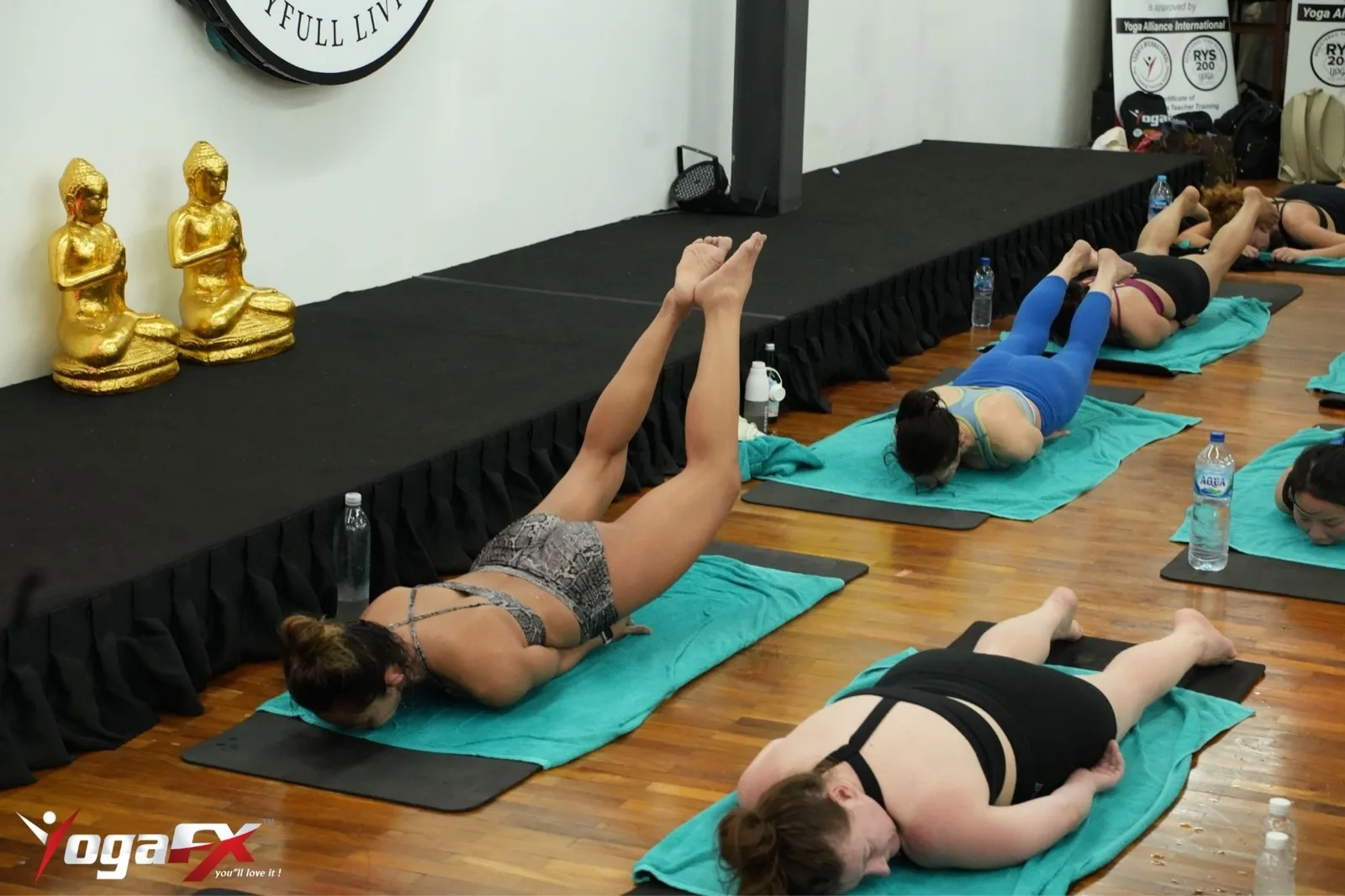
Mr. Ian Terry, our Founder and Lead Instructor, is an E-RYT 500 teacher with more than 12,000 teaching hours. He teaches the same scripted dialogue whether the room holds a handful of students or dozens, as in the workshop pictured below.

Because Bali sits in the tropics, the room starts warm and your body is already used to the climate. Everyone responds differently, so treat your first class as a test and leave the room if you feel unwell.
Practical details for planning a visit:
- Where: the YogaFX studio at Jl. Pangkungsari Gg Jepun No.888, Kuta Utara, Seminyak, Badung, Bali 80361.
- When: the studio opens daily from 06:00 to 22:00.
- What to bring: a mat towel, a large water bottle and light clothing.
- First visit: the Free 1-Day Guest Pass covers your first class, so you can test the heat at no cost.
What our students say about training in the heat
Two voices from our review library show the pattern.
“Exceptional teacher and excellent course planning.” She added that it was “a wonderful changing life experience.”
Cristina, Google review, 2024
“Authentic stuff, and this is what I need.”
A trainee in our YouTube review, 2024
Reviews describe experience, not medical outcomes, so we show them as colour rather than proof. Still, they tell you what the room feels like when you are in it.
How to combine a hot class and a sauna this week
You do not have to pick a side to collect heat therapy benefits. Here is a sensible way to use both, assuming you are healthy and your doctor is happy.
- Class days: do the 90-minute class, drink plenty of water, and rest afterwards. Skip the sauna on the same day if you are new to heat.
- Rest days: if you use a sauna, keep it short and listen to your body.
- Weekly rhythm: two or three classes plus one optional rest-day sauna is a calm starting pattern.
- Stop signals: dizziness, nausea, a racing pulse or a pounding headache mean you stop, cool down and drink.
To judge the heat therapy benefits for yourself, keep a simple note after each session: how long you stayed, how you felt that evening and how you slept. After three weeks, your own notes will tell you more than any article can. That includes this one.
Heat therapy benefits FAQ
Is heat therapy good for you?
Heat therapy may help blood pressure and mood for some people. A 2026 Comprehensive Physiology review says the evidence is promising but the effect size and best methods are not fully understood. Check with a healthcare professional first if you have a heart condition or take medication.
How long should you use heat therapy?
It depends on the method. Hot-water studies used 30 to 90 minutes at 37 to 41°C, while Finnish sauna studies linked benefits to sessions longer than 19 minutes. Beginners should start with short sessions, drink water and stop at any dizziness. A 90-minute yoga class is guided, not self-paced.
Is hot yoga the same as a sauna?
No. A sauna is passive heat, so you rest while your body warms. A hot yoga class combines heat with 90 minutes of movement, balance and breathing. A 2014 Wisconsin study measured heart rates near 80% of maximum in class, which is exercise intensity a sauna does not provide.
Can a sauna replace cardio?
Not on the evidence we have. Saunas ask little of your muscles, and studies link regular use with heart benefits, but those are associations, not substitutes for exercise. A hot class adds real movement. Many people use a sauna on rest days and keep exercise on training days.
Who should avoid heat therapy?
Infants, young children and adults over 65 face higher heat risk, according to Mayo Clinic. Some medicines also affect hydration and heat response. If you are pregnant, have heart or blood pressure problems, or feel unwell, speak to your doctor before any sauna or hot class.
Still have questions? Message Mr. Ian and the YogaFX team on WhatsApp and we will answer them personally. Ready to feel the heat for yourself? Claim your Free 1-Day Guest Pass at the Seminyak studio and take your first class on us.
 Mr. Ian Terry