
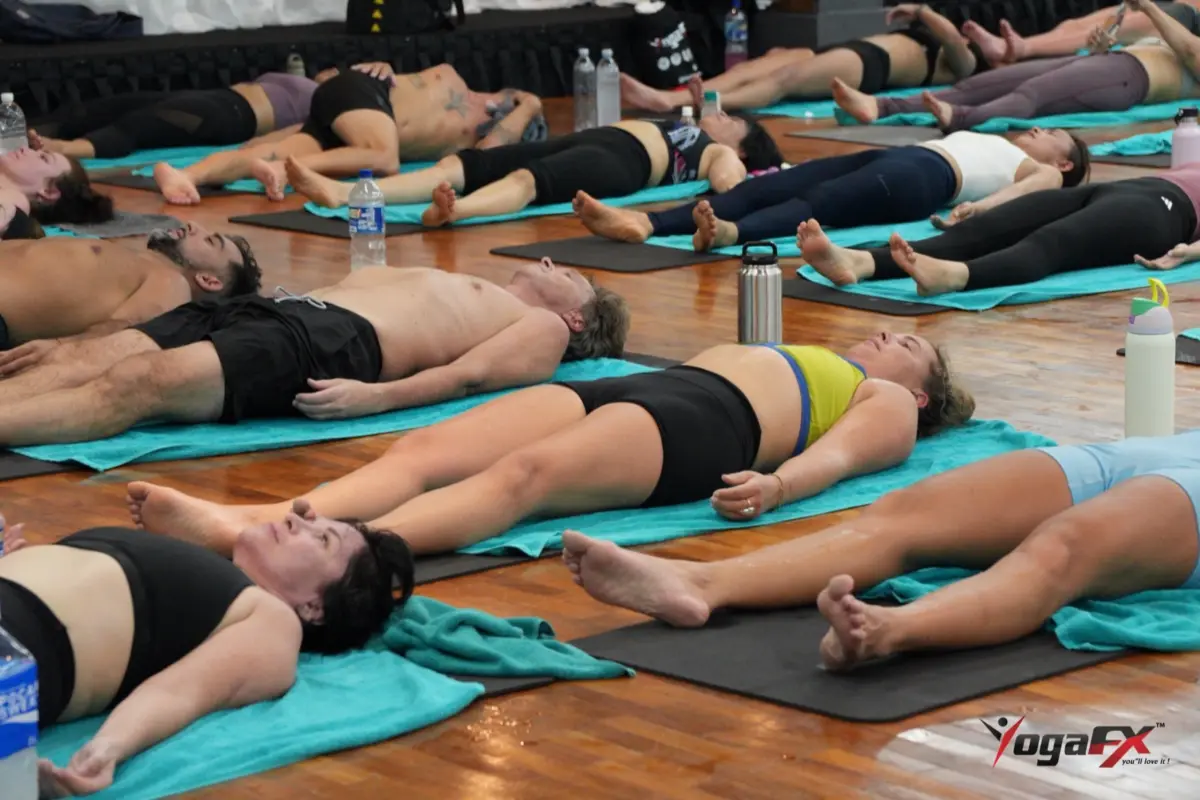
Short answer: is hot yoga good for you? For most healthy adults, research says it can be. The best evidence points to better mood, a solid heart rate workout and a moderate calorie burn. However, studies are small and short, and the heat makes hot yoga unsuitable for some people without medical advice.

Search for hot yoga online and you will find two extremes. One side promises that it melts fat and fixes stress. The other warns that it is dangerous. The truth sits in between.
At our studios in Seminyak and Canggu, we want you to start with accurate expectations. So this article sums up what the research shows. It also covers where the research falls short and who should be careful.
One note on method. We opened every study cited below and checked it before it went in. Where we could not open a paper, we left the claim out instead of repeating it from memory.
Is hot yoga good for you, according to research?
Is hot yoga good for you? The research we could verify says yes for most healthy adults. The clearest evidence is for mood and for a moderate cardio workout. The catch is quality. Most trials are small, last only weeks and use healthy volunteers, so they show promise rather than proof.
Here is how the main areas stack up, from the strongest evidence we could check to the weakest:
| Area | What the studies show | How strong is it? |
|---|---|---|
| Depression symptoms | 59.3% of the heated yoga group halved their symptoms in 8 weeks, against 6.3% on a waitlist | Promising: one randomised trial, waitlist comparison |
| Heart rate during class | 72.3% of predicted maximum for novices and 86.4% for experienced students | Measured directly, but only 24 people |
| Calorie burn | About 286 kcal on average per 90-minute class, ranging from 179 to 478 | Single small study, large individual variation |
| Heat illness risk | Heavy sweating, dizziness, nausea and a weak, rapid pulse are the warning signs | Well established medical guidance |
| Flexibility, balance and strength | Commonly reported by regular students, but we did not rely on a single study | Needs more controlled trials |
Is hot yoga good for your mental health?
What the Massachusetts General Hospital trial found
Hot yoga shows real promise for low mood. In a 2023 randomised trial led by Massachusetts General Hospital, adults with moderate to severe depression took heated hatha yoga classes. They attended at least twice a week for 8 weeks.
Among those analysed, 59.3% of the yoga group halved their symptoms. In the waitlist group, only 6.3% did. You can read the abstract on PubMed (Nyer et al., 2023).
Why the result needs a caveat
The study randomised 80 adults and analysed 65 of them, so it is small. The authors call the results preliminary. They also ask for trials with an active comparison group.
That caveat matters. The waitlist group did nothing. So the trial cannot say how much benefit came from the heat and how much came from exercise, company and routine. Our article on the hot yoga depression study goes through the findings in more depth.
Hot yoga can be a helpful part of looking after your mind. It is not a replacement for professional treatment. If you are struggling, please speak to a doctor or therapist first and treat the class as a support.

What does hot yoga do for your heart and calorie burn?
Heart rate and effort
During a hot yoga class your heart rate rises and stays raised. A 2014 San Diego State University study measured 24 practitioners, 19 women and 5 men. Each did a standardised 90-minute Bikram class (Pate and Buono, 2014).
Novices averaged 72.3% of their predicted maximum heart rate. Experienced students averaged 86.4%. Part of that rise comes from the heat itself, because your body sends more blood to the skin to cool down. So not every heartbeat counts as fitness.
Calories and weight loss
The same study measured about 286 kcal on average per class, from 179 to 478 kcal. The authors found the effort light to moderate. They also called claims of burning up to 1,000 calories unfounded. We agree with them.
For weight loss, hot yoga helps most as a steady habit alongside sensible eating. The scales often drop after one class, but that is mostly water. It returns as soon as you rehydrate. Our guide to whether hot yoga is good for your heart explains the numbers further.
Whether regular practice improves long term heart health is still an open question. No verified study we found answers it yet.
Does hot yoga improve flexibility, balance and strength?
Many regular students report better flexibility, balance and leg strength. It is the first thing most people ask us about. We stay careful, though. The research on these outcomes is smaller and less consistent than for mood. We have not leaned on any single paper here.
What we can describe is what we see in the room. The 26&2 sequence includes long holds in postures such as Awkward Pose, Standing Bow and Triangle. These load the legs and glutes hard. Many students notice firmer legs and a stronger back before they notice any change in flexibility.
A note of caution: the heat makes you feel more flexible than you are. That makes it easy to overstretch. Ease into each posture and stop at a strong stretch, never at pain.
Mr. Ian Terry, E-RYT 500, has more than 12,000 teaching hours. He tells every new student the same thing. The posture is not the goal. The breath and the control are.

What are the limits of the evidence?
So, is hot yoga good for you? It is a fair question with a hopeful answer. Still, the evidence has clear gaps:
- Small samples. Many trials have fewer than 100 people.
- Short studies. Most last weeks, not years.
- Healthy volunteers. Results may not carry over to everyone.
- Few fair comparisons. Hardly any studies compare the same yoga with and without heat.
There are also popular claims the research does not support. The biggest is the idea that sweat is how the body cleans itself. Sweat cools you down, while your liver and kidneys do the real waste removal. We explain what sweat really does in our guide to hot yoga and sweat. Be wary of any studio or influencer who promises miracle results from heat alone.
Who should be careful with hot yoga?
Some people need a doctor’s advice before they try it. Check first if any of these apply to you:
- Heart or blood pressure. A heart condition, or high or low blood pressure.
- Pregnancy. The heat adds strain, so ask your doctor first.
- Heat illness history. Past heat exhaustion or heatstroke.
- Diabetes or medication. Anything that affects heart rate or hydration.
- Recent illness. Fever, vomiting or diarrhoea. Wait until you are fully well.
This article is for general education and is not medical advice. Please consult a healthcare professional before practising in a heated room if any of the above applies to you.
Warning signs to watch for in class
Even healthy students need to know the warning signs. Mayo Clinic’s overview of heat exhaustion lists heavy sweating, cool and moist skin, faintness and dizziness. It also lists fatigue, nausea, headache, muscle cramps and a weak, rapid pulse.
Mayo Clinic advises stopping all activity, resting somewhere cooler and drinking cool water. It says to get medical help if symptoms worsen or do not ease within an hour. In class, the rule is simple. If you feel any of these signs, sit or lie down, sip water and tell the teacher. Nobody will mind.

What do students say about hot yoga at our studios?
Research tells you about averages. Students tell you what it feels like. These are short quotes from video reviews on the YogaFX YouTube channel, left by students after they trained with us.
“This is actually quite life-changing for me.”
Anne, YouTube review, 2025
“This is really hard and it’s really wonderful at the same time.”
Liz, YouTube review, 2025
“I’m really proud of all of us.”
Laura, YouTube review, 2024
Notice that Liz says it is hard. That is honest, and it is what we tell new students too. Hearing from real students is often more useful than any statistic.
Is hot yoga good for you if you are a beginner?
Is hot yoga good for you when you have never tried it? Yes, if you pace yourself. Beginners are not expected to complete every posture. In fact, the first class is mostly about learning to breathe steadily in the heat and to rest without guilt.
Expect to feel warm, a little unsteady and very sweaty. That is normal. Most newcomers find the second and third classes much easier, because the body starts to understand what is coming. The teacher will also remind you to rest whenever you need to.
The 2014 study above compared novices with experienced practitioners. Novices worked at a lower share of their maximum heart rate. So a beginner is not asked to match the effort of a regular, and nobody should push to catch up.
Is hot yoga good for you every day?
Many people ask: is hot yoga good for you if you go daily? We do not know of a verified study that answers this, so we would not promise it. Our teachers suggest building up slowly and keeping at least a couple of easier days each week. Daily practice can suit experienced students who recover well, but it is not a requirement for results.
How often should you do hot yoga?
There is no research-backed magic number, so this is teaching experience, not a study result. Most beginners do well with two to three classes a week for the first month. After that, you can add more as your heat tolerance improves.
Consistency beats intensity. A student who shows up three times a week and rests when needed will usually get further than one who does a heroic double class and then disappears for a fortnight. The 2023 depression trial also asked for regular attendance, at least twice a week.
Listen to your body on the days between classes. Heavy tiredness, headaches or poor sleep can mean you need a lighter week. Our article on hot yoga for beginners covers how to pace your first weeks.
How to try hot yoga safely in Bali
If the evidence has made you curious, the best test is your own body. A YogaFX class runs 90 minutes at 40 degrees C and 40% humidity. The heat is natural and tropical, not from electric heaters. The teacher talks you through every posture from a script, so there is no demonstration to copy and no music to follow.
Our studios in Seminyak and Canggu are open from 06:00 to 22:00 every day. For a first class, these habits make a real difference:
- Eat lightly. A small meal a few hours before class is usually easier than a full stomach.
- Arrive hydrated. Start sipping water well before class, not when you first feel thirsty.
- Choose a cooler spot. A place near the door or a window lets you cool down easily.
- Rest when you need to. Sitting out a posture is part of the practice, not a failure.
- Tell the teacher about any health condition or medication before you start.
Our page on drop-in hot yoga classes in Bali explains schedules and what to expect on the day.
Our honest verdict
So, is hot yoga good for you? Our honest verdict is yes for most healthy adults who practise sensibly. That means staying hydrated, eating lightly and building up gradually. The best evidence supports mood and a moderate cardio workout. It is not a miracle and not a guaranteed weight loss tool. It is also not suitable for everyone without a doctor’s advice first.
At YogaFX, the approach Mr. Ian Terry built into our teaching is simple. The benefits come from showing up regularly, not from suffering through the heat. Two to three classes a week for a couple of months will tell you more than any study can when you ask, is hot yoga good for you?
FAQ
Is hot yoga good for you?
For most healthy adults, yes. Research links hot yoga with better mood, a raised heart rate and a moderate calorie burn. Most studies are small and short, and people with heart conditions, blood pressure problems or pregnancy should get medical advice before trying it.
Is hot yoga better than regular yoga?
Not necessarily. Hot yoga adds heat, which raises heart rate and makes muscles feel looser, but few studies compare the same yoga with and without heat. The best style is the one you enjoy and can practise regularly and safely.
Does hot yoga help with depression?
It may help. A 2023 randomised trial found that 59.3% of people doing heated yoga halved their depression symptoms after 8 weeks, compared with 6.3% on a waitlist. The result is promising but preliminary, and it should support professional treatment, not replace it.
How many calories does a hot yoga class burn?
A 2014 study of a 90-minute Bikram class measured about 286 kcal on average, ranging from 179 to 478 kcal. The authors found the effort light to moderate and called claims of up to 1,000 calories unfounded. Your own result depends on your size and experience.
Who should not do hot yoga?
People with heart conditions, high or low blood pressure, pregnancy, a history of heat illness or medication affecting heart rate or hydration should speak to a doctor before trying hot yoga. Anyone unwell with fever, vomiting or diarrhoea should wait until they are fully recovered.
Free Guest Pass
The best way to find out whether hot yoga is good for you is to try it with teachers who will look after you. Claim your Free 1-Day Guest Pass for a 90-minute class at our Seminyak or Canggu studio, by booking only. Message us on WhatsApp at +62 811 3888 330 to book.
 Mr. Ian Terry