
Bishnu Charan Ghosh (1903 to 1970) was a Calcutta teacher of physical culture who founded a college of physical education in 1923 and co-wrote a strength-training book in 1930. He is the teacher most often named when people ask where the postures in a Bikram-style class come from, including the 26 postures taught in Seminyak.

That short answer has more to it, and some of it surprises people. Below, we separate what the sources support from what yoga websites repeat out of habit. We also show how that history turns up in a real class at our Bali studio, so you can decide whether the class suits your stay.
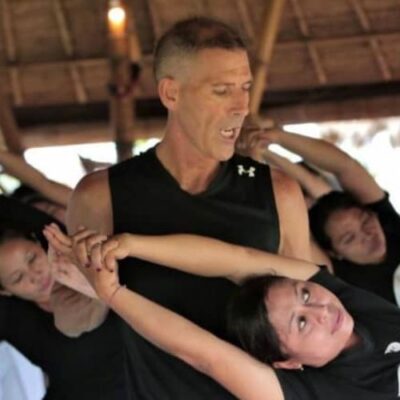
Mr. Ian Terry, E-RYT 500 and founder of YogaFX, has more than 12,000 teaching hours. He trained for five years, from 2014 to 2019, alongside Bikram Choudhury. We keep to what sources can support, and we say so where the record runs out.
Who Was Bishnu Charan Ghosh? Five Facts to Start With
If you are planning a stay in Bali and wonder who stands behind the class, start with these five facts. They come from the Wikipedia biography of Ghosh and a 2024 paper in the Journal of Yoga Studies. We opened both pages before writing this guide.
- Born in Lahore, worked in Calcutta. Ghosh was born on 24 June 1903 in Lahore and died in Calcutta on 9 July 1970, aged 67.
- Youngest of eight children. His older brother, Mukunda Lal Ghosh, later became known worldwide as Paramahansa Yogananda.
- Founder of a college. In 1923 he set up the College of Physical Education in Calcutta.
- Author of a strength book. Muscle Control and Barbell Exercise appeared in 1930, co-written with K.C. Sen Gupta.
- Teacher abroad. The Wikipedia biography says he taught at Columbia University in New York in 1939.
Notice what is missing from that list. There is no date for “invented the 26 postures”, because no source we opened gives one. That gap shapes the rest of this guide.
This history is one part of our complete Bikram yoga guide, which covers the 26 postures, the breathing and the 90-minute class.
Bishnu Charan Ghosh in Calcutta: College, Gymnasium and Muscle Control
Calcutta is where Bishnu Charan Ghosh built his name. His college gave him an institution, and his gymnasium gave him a daily room of students who wanted results. As a result, his teaching grew out of practice, not out of philosophy.
Bishnu Charan Ghosh: A Physical-Culture Teacher First
Bishnu Charan Ghosh taught strength, flexibility and body control. Ida Josephine Pajunen of SOAS University of London, writing in the Journal of Yoga Studies in 2024, describes his earliest book as one that “does not contain āsana”. Instead, she says it includes some elements of hatha yoga repackaged as “muscle control”. You can read the paper in full at the Journal of Yoga Studies.
That detail changes the picture. Many websites describe Bishnu Charan Ghosh as a yogi who taught postures from the start. The paper points the other way: he began in physical culture, and it says asana practice grew in the late 1930s and 1940s.
What the Book of Bishnu Charan Ghosh Tells You
Wikipedia notes that the 1930 book relied heavily on a 1913 book of the same name by Maxick, a strength performer. So the roots are strongman training and body control, not a meditation manual. The same paper adds that Ghosh published a book on yoga and health in 1961, which shows his interest in yoga grew over time.
Three points are worth holding on to:
- Strength came first. His earliest book is about muscles and barbells.
- Asana came later. The paper dates the growth of asana practice to the late 1930s and 1940s.
- Health became the theme. A 1961 book on yoga and health links his later work to yoga as a health practice.
Bishnu Charan Ghosh and Yogananda: Brothers, Not Proof of One School
Bishnu Charan Ghosh was the younger brother of Paramahansa Yogananda, the teacher best known for Autobiography of a Yogi. Both the Wikipedia infobox and the journal paper confirm the family tie. The paper says Bishnu Charan Ghosh was influenced by his older brother.
Jerome Armstrong, author of a book on Calcutta yoga, goes further in an interview with The Week. He says Ghosh trained in yoga asanas in the 1910s through his brother, and taught them to his student Buddha Bose around 1930. That is one researcher’s account, so we present it as such.
Here is the careful reading of Bishnu Charan Ghosh and his brother. A brother relationship is documented. A shared teaching school is a separate claim, and it needs its own evidence. For a longer look at the people around Ghosh, see our guide to the male teachers who shaped the Hot 26&2 we teach in Bali.
From Bishnu Charan Ghosh to the 26 Postures: What the Record Supports
Most readers want one answer here: did Bishnu Charan Ghosh create the sequence we practise? The sources we opened do not say that. They do say the link is real, so the question becomes how strong it is.
According to Wikipedia, Bikram Choudhury “claimed to have been taught by Ghosh from the age of five”. The same page says he “did not become a regular student at Bishnu’s gymnasium until 1962”, and that his system “was based on Ghosh’s teachings”.
The journal paper adds that Bikram yoga “includes postures from the Bengali sources and a health-based approach”. It also notes that it is “a set sequence of postures which never changes”, so it is practised in a heated room.
The table sets common claims beside what the sources say, and what that means for a class in Seminyak.
| Common claim | What the sources say | What it means in our Seminyak class |
|---|---|---|
| Ghosh taught Bikram Choudhury | Wikipedia: regular student from 1962; Choudhury says he was taught from age five | We teach the class as a method, with its sources and limits stated |
| Ghosh created the 26 postures | Wikipedia and the journal paper link the system to Ghosh’s teaching; neither gives a posture-by-posture chain | We call Ghosh a root of the method, not the author of the sequence |
| Ghosh and Yogananda ran one school | Brothers is documented; a shared school is not shown in the pages we opened | The family tie is history, and the class does not depend on it |
| Heat comes from Ghosh | The paper ties the heated room to Bikram yoga’s fixed format; we found no source placing heat in Ghosh’s gymnasium | Our warmth is Bali’s own, about 40 degrees Celsius and 40% humidity, with no electric heaters |
Where the Record on Bishnu Charan Ghosh Runs Out
How much of the sequence came straight from Bishnu Charan Ghosh, and how much Choudhury changed later, is still debated. One biography cannot settle it. Anyone who offers a tidy chain from one man to the other is simplifying the story.
If you want a source-by-source timeline, our teacher-training site lays out the Calcutta lineage behind Bikram yoga in more depth. For the wider story of how the 26 postures reached Seminyak, read our Bikram yoga history in Bali guide.
How the Bishnu Charan Ghosh Story Shows Up in a Seminyak Class
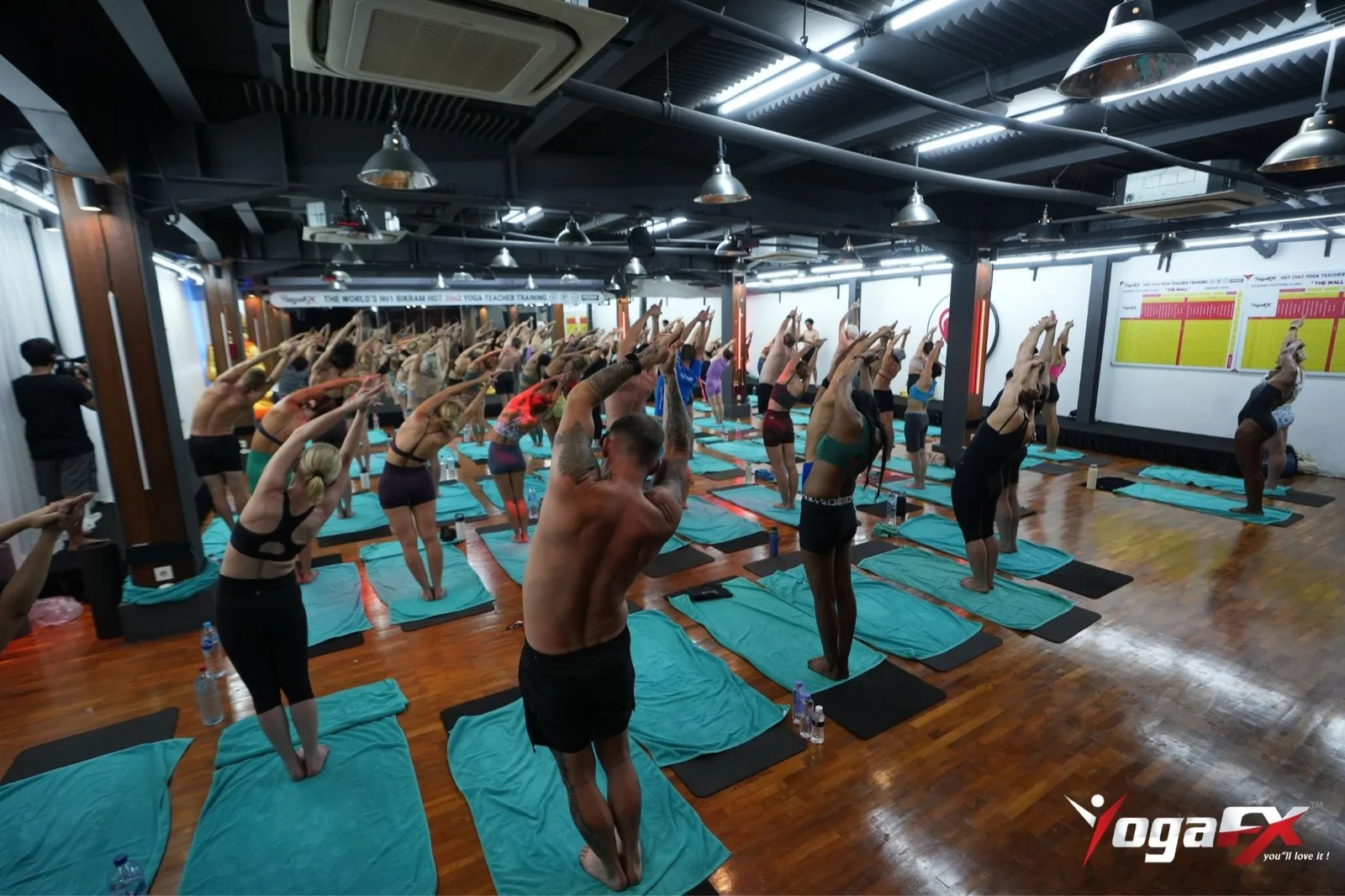
History is easier to judge once you stand in the room. So here is what a visitor meets at our studio, and which parts trace back to a physical-culture mindset.
What You Hear
The teacher speaks a scripted dialogue. There is no demonstration and no music. Because the words never change, you can stay with your own body instead of watching the room.
What You Feel
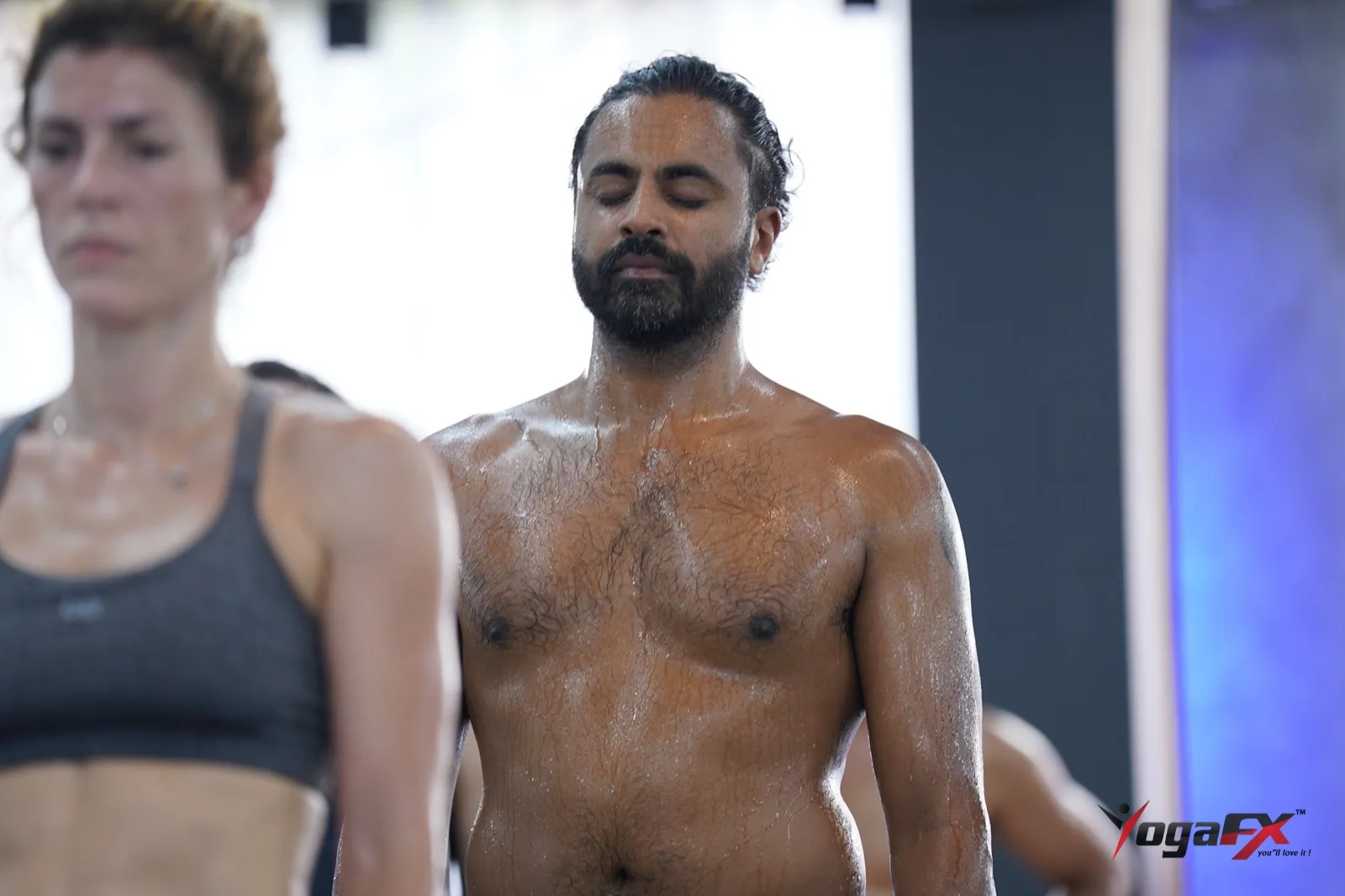
The warmth comes from the tropical air itself, about 40 degrees Celsius with 40% humidity. We do not use electric heaters. Many students say the heat arrives gradually, and the breathing exercises help them settle into it.
What Stays the Same
- The sequence. 26 postures and 2 breathing exercises, in the same order.
- The length. 90 minutes from the first breathing exercise to the last posture.
- The reason for each step. Each posture has a physical purpose a teacher can explain, which echoes the body-first thinking of Ghosh’s era.
That last point comes from how Mr. Ian teaches. He explains the physical reason before the philosophical one, and new students often find that easier to trust. If you want to see each posture in turn, our guide to all 26 postures in order walks through them.
Why We Teach Bishnu Charan Ghosh’s History With Its Limits
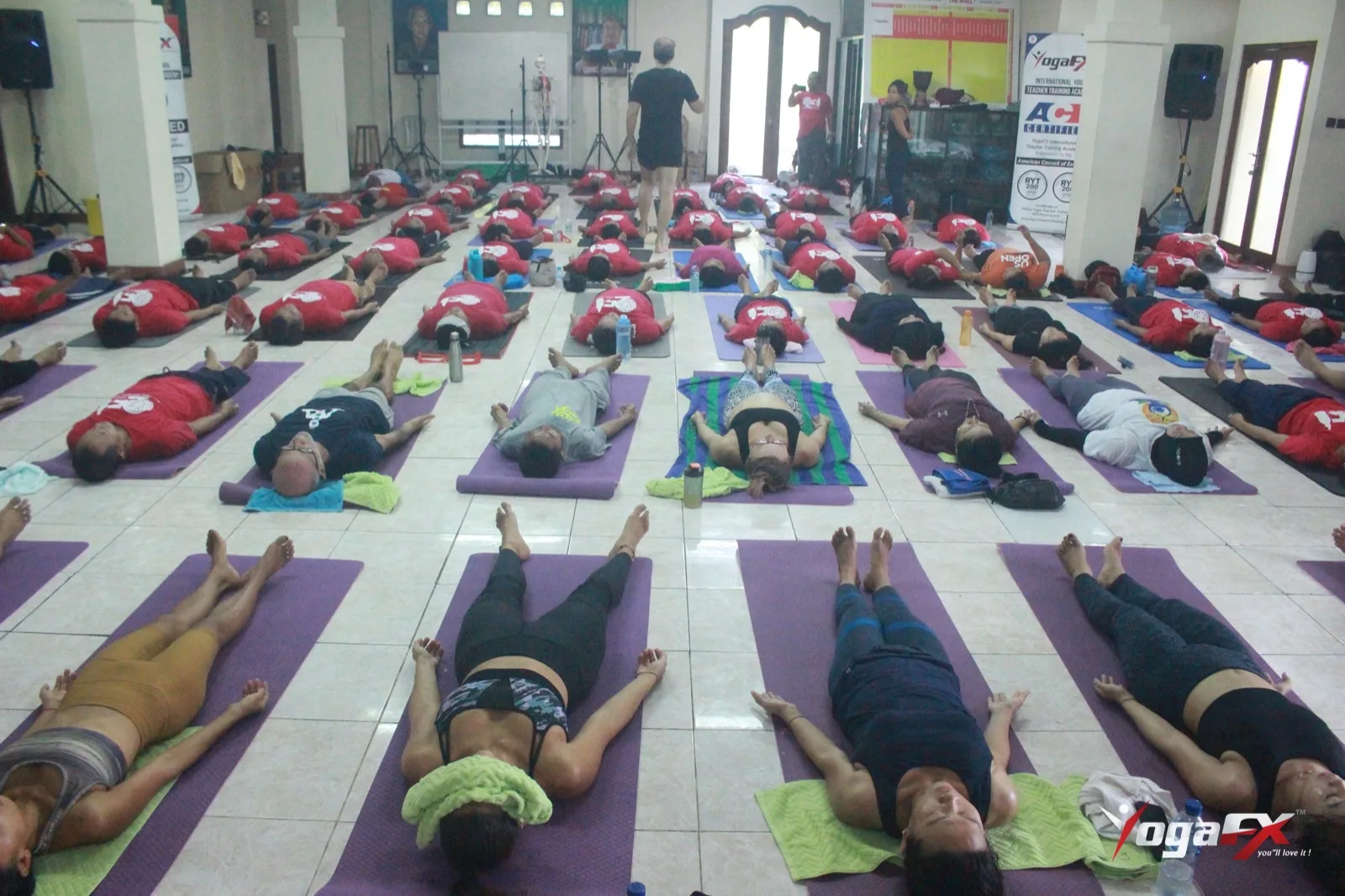
Visitors to the studio do ask where the class comes from. Our answer is short, and it is the one we give here. Bishnu Charan Ghosh is a real and documented root, but the exact chain from his gymnasium to the sequence is not fully written down.
We think that honesty helps you. It is easier to trust a class when the people running it will say “we are not sure” about the parts nobody can prove. That is also why we link every source instead of asking you to take our word for it.
A Simple Test for Any Lineage Story
Because lineage stories travel fast online, here is a test you can use on any of them:
- Ask for a date. A named year can be checked, and a vague “ancient tradition” cannot.
- Ask for a document. A book, a dated photo or an institutional record beats a retold story.
- Separate family from method. A shared surname proves a relationship. It does not prove a shared school.
When a claim passes all three checks, you can repeat it with confidence. When it fails one, say what you can support and leave the rest open. That habit makes a class feel less like a sales pitch and more like a conversation.
What Research Says About Strength Work and Heated Classes
The history of Bishnu Charan Ghosh is a question of record. The class he is linked to raises a different question: what does the research say about it? The answer is more modest than most websites suggest.
Strength Work Is a Modern Guideline Too
The US Centers for Disease Control and Prevention says adults need muscle-strengthening activity on 2 or more days a week that works all major muscle groups, plus 150 minutes of moderate aerobic activity. That is general physical-activity advice, not a claim about any yoga class. Still, it shows why a body-first, strength-minded approach is not old-fashioned.
The Heated Yoga Depression Trial
Nyer and colleagues at Massachusetts General Hospital ran an eight-week randomised trial and published it in the Journal of Clinical Psychiatry in 2023. Adults with moderate to severe depression took 90-minute Bikram yoga sessions in a 105°F room. According to the Harvard Gazette report on the trial, 59.3% of the yoga group had a 50% or greater drop in symptoms, against 6.3% of the waitlist group.
Because the result is a single trial, treat it with care. The authors say future research needs to compare heated with non-heated yoga, so the trial does not show that heat is the active ingredient. Our Bali class also uses natural tropical heat, not a heated box, so the findings do not transfer neatly.
Yoga is not a treatment. If you have a heart condition, high blood pressure or depression, or you are pregnant or taking medication, consult a healthcare professional before your first class. Bring water, arrive early and stop if you feel dizzy.
What Students Say After Practising With Us
Dates only go so far, so here are three students in their own words. Each comes from a YogaFX YouTube review, and we give first names only where the student gave one.
It was an amazing class. The best. The best.
A trainee in our YouTube review, 2018
In another 2018 review, a student in our YouTube video called the class “absolutely fantastic” and said it was the best of their whole life, adding that the teacher helped everybody stretch past their boundaries.
I’m really proud of all of us.
Laura, YouTube review, 2024
Laura said that at her January 2024 graduation ceremony after the teacher training in Bali. You can watch it below.
Visiting Bali? Try the Class Behind the History
Reading about Bishnu Charan Ghosh is useful, but a class makes it real. YogaFX has one studio open in Seminyak, at Jl. Pangkungsari Gg Jepun No.888, Kuta Utara, Seminyak, Badung, Bali 80361. It is open daily from 06:00 to 22:00.
Your first step is simple. Ask for the Free 1-Day Guest Pass, and your first class is free. Bring a towel and water, and expect 90 minutes of scripted instruction in natural heat. Our page on drop-in hot yoga classes in Bali explains how booking works.
Planning a longer stay? Studio classes and memberships are available, and the team can suggest a rhythm that fits your trip.
Your First Week in Bali Heat
Bali’s warmth is part of the class, so it helps to plan around it. Drink water through the day, and eat lightly before you practise. Because everyone’s body adapts at its own speed, our guide to heat acclimatization for hot yoga in Bali sets out three honest weeks.
You don’t need to know anything about Bishnu Charan Ghosh to take the class. Still, many visitors tell us the story makes the room feel less mysterious. They know where the postures sit in the wider history, and they can take it from there.
FAQ
Where was Bishnu Charan Ghosh born and where did he work?
Bishnu Charan Ghosh was born on 24 June 1903 in Lahore and worked mainly in Calcutta. There he founded the College of Physical Education in 1923. He died in Calcutta on 9 July 1970, aged 67, according to his Wikipedia biography, which is worth checking before you quote the dates.
Did Bishnu Charan Ghosh teach outside India?
The Wikipedia biography says Ghosh went to America in 1939 and taught at Columbia University in New York. It also records a lecture tour of Japan in 1968. Those two trips are the dated overseas events we found, so we cannot say more about what he taught there.
Did Bishnu Charan Ghosh write about yoga postures?
His first book, published in 1930, was about muscle control and barbells. A 2024 Journal of Yoga Studies paper says it contains no asana. The same paper lists a later book on yoga and health, published in 1961, so his work moved toward yoga over time.
Is a Seminyak class the same as Ghosh’s gymnasium teaching?
No source we opened says it is the same. The Seminyak class is the fixed sequence of 26 postures and 2 breathing exercises, taught in natural heat for 90 minutes. YogaFX runs independent classes, not official Bikram Choudhury Teacher Training, and credits Ghosh only as a root of the method.
Can a beginner try the class in Bali?
Yes, and you need no knowledge of Bishnu Charan Ghosh to start. The Free 1-Day Guest Pass gives you a free first class at our Seminyak studio. Bring water and a towel, and go at your own pace. If you have a heart condition, are pregnant or take medication, consult a healthcare professional first.
Still have questions? Message Mr. Ian and the YogaFX team on WhatsApp and we will answer them personally. You can also ask for your Free 1-Day Guest Pass in the same message, so your first class in Seminyak is booked at the same time.
 Mr. Ian Terry