
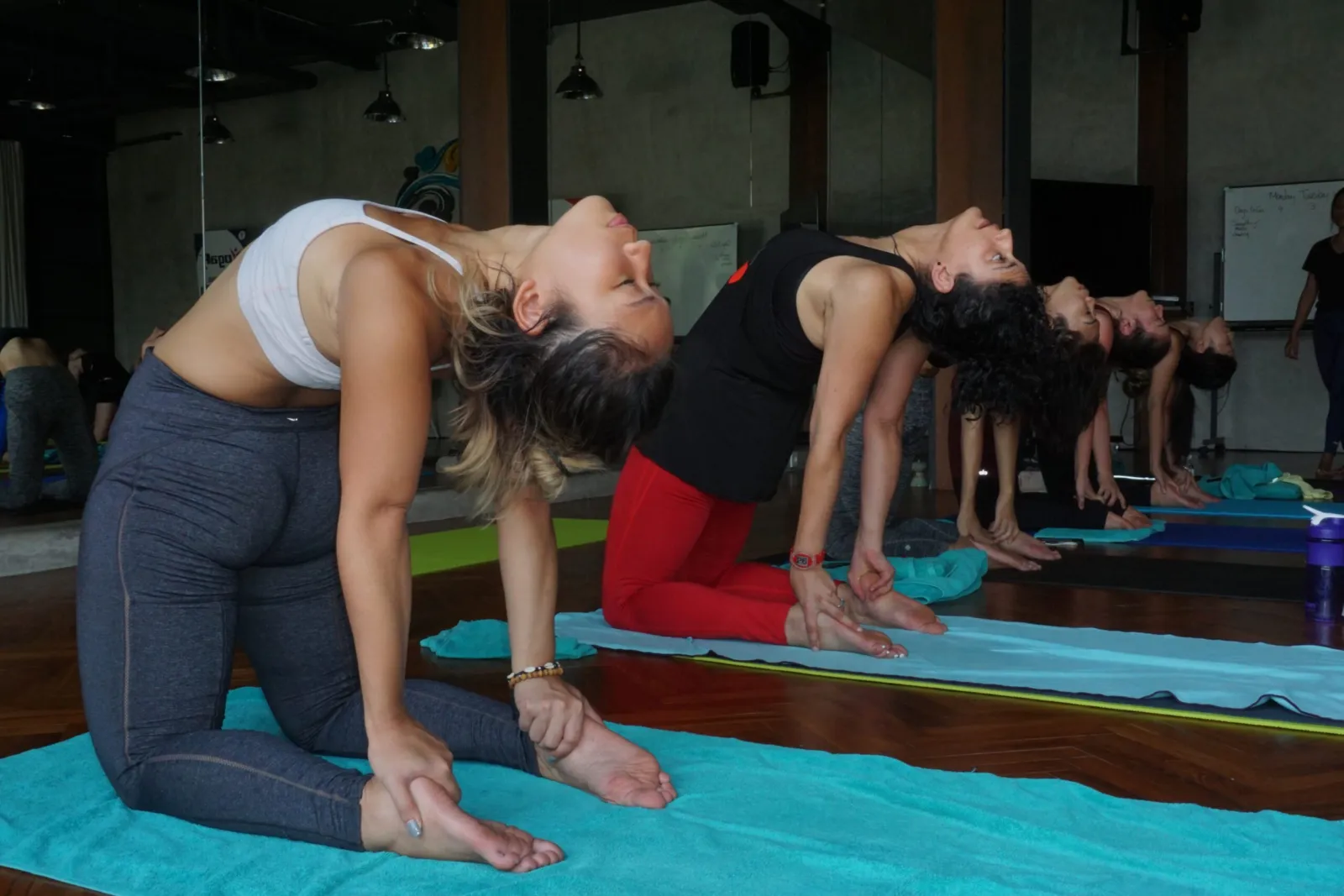
Short answer: Hot yoga in Bali is not the same as hot yoga anywhere else. That is not marketing; it is physiology. Every hot yoga studio outside of a tropical country uses electric heaters to simulate the 40°C environment the practice requires. In Bali, that heat is already here, naturally, year-round, in exactly the humid form the method was designed for.

This guide covers everything a tourist or expat needs to know about practicing hot yoga in Bali: what it is, what the science says, why the natural heat matters, which studio in Seminyak practices it authentically, and exactly what to expect in your first class.
Hot yoga in Bali is a 90-minute yoga practice conducted in the island’s natural tropical heat, approximately 40°C with high humidity, following the original Bikram 26&2 sequence of 26 postures and 2 breathing exercises. Unlike electrically heated studios worldwide, Bali’s natural climate provides the humid tropical environment Bikram yoga was specifically designed for. YogaFX, a major Hot 26&2 (Bikram) yoga teacher training academy, is based in Bali, operating the only dedicated 26&2 studio in Seminyak, with Canggu coming soon, and zero electric heaters.
What Is Hot Yoga? Definition and Origins
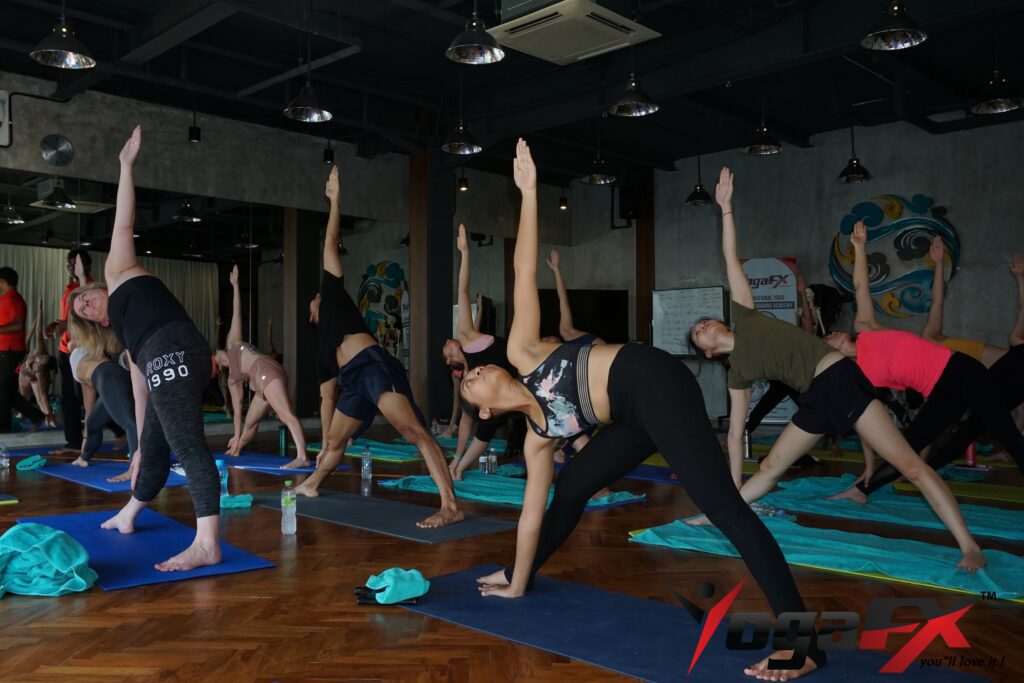
Hot yoga is any yoga practice performed in a heated environment, typically a room at 35°C to 42°C (95°F to 108°F). The category includes several distinct formats, but the original and most studied is Bikram yoga: a fixed sequence of 26 postures and 2 breathing exercises developed by Bikram Choudhury and designed to be practiced in a room that replicates tropical heat and humidity. For a plain explanation of the styles and temperatures, see what hot yoga is and what a class feels like.
Bikram Choudhury developed the method in the 1970s, drawing on traditional Hatha yoga postures and his experience practicing in the natural heat of Calcutta, India. The 26-posture sequence was designed to systematically work every major muscle group, joint, and organ system in the body: a complete physiological workout in a single 90-minute session. Discover the full benefits of practicing in natural heat.
The term ‘hot yoga’ has since expanded to include heated Vinyasa flows, hot Pilates, hot Barre, and other formats that use artificial heat as an add-on to existing styles. These differ from Bikram yoga in a critical way: the heat is incidental rather than foundational. In Bikram yoga, the heat is part of the methodology: it enables the specific physiological outcomes the 26&2 sequence was designed to produce.
| Format | Heat Source | Sequence |
|---|---|---|
| Bikram 26&2 (authentic) | Natural tropical heat or precise 40°C/40% humidity | Fixed: 26 postures, same order every class |
| Hot Vinyasa | Electric heaters | Variable: changes every class |
| Hot Pilates | Electric heaters | Pilates-based, not yoga sequence |
| Hot Barre | Electric heaters | Ballet-influenced, not yoga |
| Infrared yoga | Infrared panels (dry heat) | Variable, not Bikram specific |
Why Bali Is the World’s Best Place to Practice Hot Yoga
Bali’s geographic and climatic position makes it uniquely suited to authentic hot yoga practice, not by coincidence, but by the exact conditions the method was designed around.
The Climate Matches the Original Method
Bikram yoga was designed for tropical heat: 40°C (105°F) with approximately 40% relative humidity. This is the climate of Calcutta in summer, and it is remarkably close to Bali’s year-round ambient conditions. Bali’s southern coast maintains temperatures between 27°C and 33°C with relative humidity consistently above 70%. Older newcomers can read about easing into hot yoga after 50.
When a studio like Bikram YogaFX Bali dispenses with electric heaters and uses the island’s natural heat, the practice environment is not a simulation of the original conditions; it is the original conditions. This is a distinction that matters physiologically, not just philosophically.
Natural Humid Heat vs Electric Dry Heat
The physiological difference between humid tropical heat and electric dry heat is significant. Electric heaters, whether panel heaters, infrared panels, or forced-air systems, produce dry heat. Relative humidity in an electrically heated yoga room typically drops to 20 to 30% as the air warms.
Dry heat causes rapid surface moisture loss, which can trigger early dehydration and fatigue before the muscles are adequately warm. The body’s cooling mechanism, sweating, becomes less effective because sweat evaporates too quickly in dry air rather than contributing to sustained temperature regulation. Explore all yoga options in Bali.
Humid tropical heat allows the body to sweat continuously and regulate core temperature progressively, which is what the Bikram sequence is designed to use. The muscles warm more evenly, joints become more mobile, and cardiovascular demand is sustained rather than spiked. The result is a physiologically more complete practice, and a more comfortable one, particularly for first-timers. If you are weighing a class against a sauna session, our hot yoga vs sauna comparison shows how the two differ.
Natural humid heat vs electric dry heat
| Aspect | Natural Bali heat | Electric heaters |
|---|---|---|
| Heat source | The island’s tropical climate | Panel, infrared or forced-air heaters |
| Humidity | Bali air usually above 70% | Often drops to 20 to 30% |
| Sweating | Continuous, regulates core temperature steadily | Sweat evaporates too quickly |
| Muscles | Warm more evenly | Risk of early fatigue before muscles warm |
| Heart demand | Sustained | Spiked |
The Science of Hot Yoga: What Research Actually Shows
Bikram yoga has been the subject of more peer-reviewed research than any other hot yoga format. Three studies are particularly relevant to practitioners considering hot yoga in Bali:
🔬 San Diego State University (Pate and Buono), Alternative Therapies in Health and Medicine (2014)
- 24 adults had heart rate and energy expenditure measured through a standardised 90-minute Bikram class in a heated lab chamber
- Average calorie burn: about 286 kcal per class (range 179 to 478 kcal)
- Heart rate averaged about 72% of predicted maximum in novices and 86% in experienced practitioners, classed as light-to-moderate intensity exercise
- Study link: pubmed.ncbi.nlm.nih.gov/25141359/
🔬 Tracy & Hart, Journal of Strength and Conditioning Research (2013)
- 8-week Bikram yoga intervention with consistent practitioners
- Deadlift strength increased by 20% across the study group
- Standing balance improved by 9%
- Significant improvements in lower back and hamstring flexibility
- Study link: pubmed.ncbi.nlm.nih.gov/22592178/
🔬 Massachusetts General Hospital / Harvard Medical School, Journal of Clinical Psychiatry (2023)
- 80 adults with moderate-to-severe depression randomised into yoga group and waitlist group
- Yoga group practiced 90-minute Bikram hot yoga at 40°C for 8 weeks
- 59% of yoga participants cut their depression symptoms by half or more after 8 weeks
- Only 6% in the waitlist group saw comparable improvement
- Benefits observed with as little as one session per week
- Study link: pubmed.ncbi.nlm.nih.gov/37883245/
The consistency across these studies points to something Bikram practitioners have reported for decades: the combination of the fixed 26&2 sequence and the 40°C heat produces outcomes (strength, flexibility, cardiovascular fitness, mental health) that room-temperature yoga does not replicate. Bali’s natural heat makes those outcomes accessible without the artificial and physiologically inferior alternative of electric heating.
Hot Yoga in Bali by Area: Where to Practice
Hot yoga studios are concentrated in Bali’s southern coastal area: Seminyak, Canggu, and their surrounding sub-districts. The inland areas of Ubud and Uluwatu offer limited hot yoga options; their studio scenes are dominated by Ashtanga, Vinyasa, and traditional Hatha.
Hot Yoga in Seminyak
Seminyak has two primary hot yoga options: Jiwa Yoga on Jl. Petitenget and Bikram YogaFX Bali. Jiwa offers a Pilates-influenced Bikram-adjacent format in an electrically heated room. YogaFX Bali’s Seminyak studio offers the complete, original 26&2 Bikram sequence in all-natural Bali heat with no electric heaters.
For tourists staying in Seminyak’s hotel and villa corridor, from Double Six beach through Petitenget to Kerobokan, YogaFX is the accessible and authentic choice. The Free 1-Day Guest Pass removes the financial barrier for first-time visitors.
Hot Yoga in Canggu
Canggu has the largest concentration of yoga studios in southern Bali, but most hot yoga offerings in the area (hot Pilates, hot Barre, heated Vinyasa) use electric heating in purpose-built rooms. Bikram YogaFX Bali’s Canggu studio, coming soon, will be the only studio in the area offering the original Bikram 26&2 sequence in natural tropical heat.
For digital nomads, expats, and tourists based in Canggu, Berawa, Echo Beach, or Pererenan, the YogaFX Canggu studio, once it opens, will provide the same credentials, same method, and same natural heat as the Seminyak studio, closer to where you are.
Bikram YogaFX Bali: The Authentic Hot Yoga Studio in Seminyak
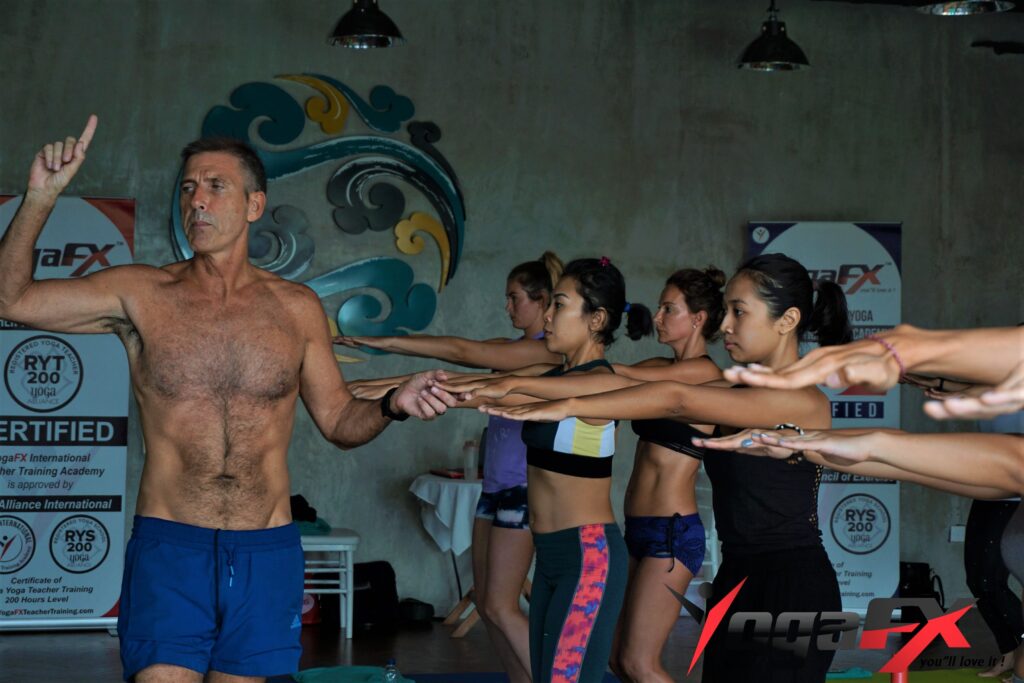
Within Bali’s hot yoga market, Bikram YogaFX Bali is in a category of its own. It is the only studio on the island’s southern coast combining three elements that no competitor offers simultaneously: the original 26&2 Bikram sequence, all-natural Bali tropical heat with zero electric heaters, and an instructor who trained for five years, from 2014 to 2019, directly with Bikram Choudhury, the founder of the Bikram Hot 26&2 method.
The Method: Original Bikram 26&2
The 26&2 sequence consists of 26 postures and 2 breathing exercises performed in a fixed order in every class. The postures are drawn from traditional Hatha yoga and selected specifically to work every major muscle group, joint, and organ system in a single session. The sequence never changes: not between classes, not between instructors, not between studios.
This consistency is the core feature of the method. Because the sequence is identical every time, each class becomes a direct measurement of progress: where you could not hold a posture last week, you hold it today. Improvements in strength, flexibility, balance, and cardiovascular fitness are visible and measurable in a way that variable-sequence yoga does not permit.
| Standing Series (Postures 1 to 12) | Floor Series (Postures 13 to 26) |
|---|---|
| Pranayama (breathing exercise) | Wind Removing Pose |
| Half Moon Pose | Sit Up |
| Awkward Pose | Cobra Pose |
| Eagle Pose | Locust Pose |
| Standing Head to Knee | Full Locust Pose |
| Standing Bow Pulling Pose | Bow Pose |
| Balancing Stick Pose | Fixed Firm Pose |
| Standing Separate Leg Stretching | Half Tortoise Pose |
| Triangle Pose | Camel Pose |
| Standing Separate Leg Head to Knee | Rabbit Pose |
| Tree Pose + Toe Stand | Head to Knee + Stretching Pose |
| Savasana (Dead Body Pose) | Spine Twisting Pose + Blowing Kapalbhati |
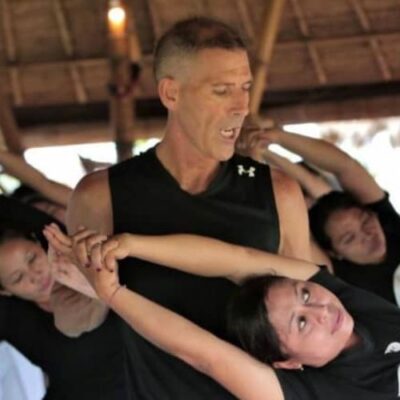
The Instructor: Mr. Ian Terry
Mr. Ian Terry is the founder and lead instructor of YogaFX Bali. His credentials within the Bikram yoga discipline are among the strongest of any instructor currently practicing in Southeast Asia:
- E-RYT 500: Yoga Alliance’s highest certification tier
- Bikram Hot Yoga Certification (YogaFX)
- Trained for five years, from 2014 to 2019, directly with Bikram Choudhury, the founder of the Bikram Hot 26&2 method
- Assisted on Bikram Choudhury’s teacher training staff, delivering the 26&2 dialogue as originally designed
- 12,000+ hours of yoga teaching worldwide · 12,000+ hours as a master trainer
- 1,500+ students trained across multiple countries
- Featured on BaliTV and ASEAN multimedia channels
- International Day of Yoga Bali 2023: 5,000+ participants
📍 YogaFX Bali: Complete Studio Reference
- Studio: Seminyak (Canggu coming soon)
- Method: Original Bikram 26&2 Hot Yoga (26 postures + 2 breathing exercises)
- Heat: ALL-NATURAL Bali tropical heat, ZERO electric heaters at the studio
- Class format: 90 minutes, 06:30 to 08:00, booking only
- Certification: Yoga Alliance Registered Yoga School (RYS), RYT 200, since 2018
- Social proof: 150 Google reviews, 50 Yoga Alliance reviews and 357 student video testimonials on YouTube
- All levels: Complete beginners to advanced practitioners, no experience required
- Studio culture: Zero chanting · Zero ego · Egos and tie-dyes left firmly at the door
- First class: Free 1-Day Guest Pass, claim via WhatsApp
- YTT: Yoga Alliance RYT 200 + Bikram Certification: $1,999 USD (very low deposit), Early Bird $1,799 for a limited number of upcoming-cohort seats
Hot Yoga Bali Class Times, Location and Booking
Classes at our Seminyak studio run from 06:30 to 08:00, booking only, and every class is the full 90-minute original 26&2 sequence. First-time visitors can claim a Free 1-Day Guest Pass on WhatsApp at +62 811 3888 330 and reserve a place before arriving.
| Detail | What to know |
|---|---|
| Studio | Jl. Pangkungsari Gg Jepun No.888, Kuta Utara, Seminyak, Bali 80361 |
| Class time | 06:30 to 08:00, booking only |
| Class format | 90 minutes: 26 postures and 2 breathing exercises |
| Heat | Natural Bali tropical heat, no electric heaters |
| First class | Free 1-Day Guest Pass, claim on WhatsApp +62 811 3888 330 |
| Second studio | Canggu, coming soon |
Because class starts at 06:30, plan your journey the evening before and aim to arrive 15 minutes early to check in and settle into the heat. Most guests staying in Seminyak, Kerobokan, Legian or Canggu reach the studio by scooter or a ride-hailing app. If you are staying further south, our guide to hot yoga near Kuta explains the easiest route.
Your First Hot Yoga Class in Bali: What to Expect
First-time hot yoga practitioners consistently describe the same experience: the first class is challenging, the second class is noticeably easier, and by the fifth to tenth class the sequence starts to feel familiar. Understanding what to expect eliminates the uncertainty that makes many first-timers hesitant.
Your first class, start to finish
- BeforeArrive 15 minutes earlyBring 1 litre of water, a mat and a large towel; no food for 2 hours.
- Standing seriesThe hardest partThe first 20 to 30 minutes are the most demanding; rest on your mat if needed.
- Floor seriesSlower and steadierSpine, flexibility and core work, ending with Kapalbhati and Savasana.
- AfterRehydrate and restDrink steadily and avoid strenuous activity for the rest of the day.
- Within 48 hoursCome back for class twoThe body adapts quickly and the second class feels much easier.
Before Class
Arrive at least 15 minutes early. This gives the body time to begin acclimatising to the room temperature before the class starts, one of the most effective things a first-timer can do. Bring at least 1 litre of water (essential, not optional), a yoga mat, and a large towel. Wear minimal, close-fitting clothing. Do not eat in the 2 hours before class.
Tell the instructor it is your first class. At YogaFX Bali, the team pays specific attention to first-timers and can provide guidance during the session.
During Class: The Standing Series
The first half of the Bikram sequence, the standing series, is the most cardiovascularly demanding. The body is working against gravity, building heat, and learning unfamiliar postures simultaneously. For most first-timers, the first 20 to 30 minutes is the most challenging point of the entire class.
The instructor delivers the entire class verbally: there is nothing to memorise. You follow the words, attempt each posture to your current ability, and use the mirror for alignment feedback. If you feel overwhelmed, sit or lie on your mat. Stay in the room.
During Class: The Floor Series
The second half of the class, the floor series, is slower and more focused on spinal strength, flexibility, and core engagement. Most practitioners find this section more manageable than the standing series. The class ends with Kapalbhati breathing and a final Savasana.
After Class
Drink water steadily after class. Avoid strenuous activity for the remainder of the day. If you are tempted to add a sauna, read about planning a sauna after class safely first. Most practitioners experience a combination of physical fatigue and mental clarity immediately after class: the ‘Bikram glow’ that regular practitioners describe as one of the primary reasons they continue the practice. The best preparation for class two is to return within 48 hours; the body adapts quickly and the second class is significantly more comfortable.
Who Is Hot Yoga in Bali For?
The answer is broader than most people expect. The zero-chanting, all-levels, fixed-sequence format of Bikram yoga at YogaFX makes it accessible to a wider range of practitioners than many other yoga styles.
| Practitioner Type | Why Hot Yoga at YogaFX Works for Them |
|---|---|
| Complete beginner | Fixed sequence taught verbally: nothing to know in advance. Modifications for every posture. Free first class. |
| Fitness-focused tourist | Measurable calorie burn (about 286 kcal on average per 90-minute class), strength and cardio conditioning in a single session. |
| Yoga practitioner from home | Authentic method in natural heat: the practice is physiologically different from home studio. Compelling for experienced yogis. |
| Expat / digital nomad | Fixed sequence = trackable weekly progress. Consistent studio = yoga home in Bali. |
| Gym-based athlete | Complementary to strength training and cardio: addresses flexibility, balance, and joint mobility that gym work neglects. |
| Practitioner with mental health focus | Harvard MGH 2023 RCT: 59% of participants cut their depression symptoms by half or more after 8 weeks of heated yoga, versus 6% on the waitlist. |
| Serious Bikram practitioner | One of the few studios globally with authenticated Bikram lineage and natural heat environment. |
Is Hot Yoga Safe in Bali’s Climate?
For most healthy adults, yes, with sensible preparation. Bali’s outdoor air already sits around 27 to 33°C with humidity usually above 70%, and visitors are often a little dehydrated from sun, travel and long flights. Drinking steadily, eating lightly and resting when you need to make a first class far more comfortable.
- If you can, give yourself a day to recover from a long flight before your first class.
- Eat a light meal 2 to 3 hours before class, or a small snack 30 to 60 minutes before. Our guide on what to eat before hot yoga has simple ideas.
- Skip alcohol the night before, and take extra care after sunburn or a stomach upset.
- Bring water and a towel, and sit or lie down on your mat if you feel dizzy or sick.
For the warning signs to watch for, see our guide on whether hot yoga is safe. This article is for general educational purposes and is not medical advice. Anyone with a heart condition, high or low blood pressure, pregnancy or another health concern should consult a healthcare professional before practising in a heated room.
FAQ
What is hot yoga in Bali?
Hot yoga in Bali is a yoga practice performed in a heated environment, typically 40°C (105°F) with high humidity. The most established format is the original Bikram 26&2 sequence: 26 postures and 2 breathing exercises in a fixed order. In Bali, and specifically at Bikram YogaFX Bali, this practice is conducted in the island’s all-natural tropical heat without electric heaters, the only environment in which the method produces its full intended physiological effect.
Is hot yoga in Bali good for beginners?
Yes. Bikram yoga requires no prior experience. The 26&2 sequence is taught entirely through verbal instruction: the instructor talks every student through each posture. Modifications are available for all 26 postures. YogaFX Bali welcomes complete beginners at every class. The Free 1-Day Guest Pass means the first class is risk-free. The most important preparation for a beginner is hydration: drink consistently throughout the day before class and bring at least 1 litre of water into the room.
Does Bikram YogaFX Bali use electric heaters?
No. Bikram YogaFX Bali uses no electric heaters at the Seminyak studio. The heat in the studio is entirely natural: Bali’s own tropical climate, which provides the humid 40°C environment the Bikram method was designed for. This distinguishes YogaFX from virtually every other hot yoga studio outside of tropical countries and from most hot yoga studios in Bali that offer electrically heated formats.
Can I do yoga teacher training at YogaFX Bali?
Yes. YogaFX offers a Yoga Alliance RYT 200 teacher training programme combining an online pre-course (self-paced, 30+ hours) with a 6-day in-person intensive in Bali at D’Djabu Boutique Hotel, Seminyak (accommodation included). The programme is led by Mr. Ian Terry (E-RYT 500, who trained for five years, from 2014 to 2019, directly with Bikram Choudhury) and awards a Yoga Alliance RYT 200 certification and Bikram Hot Yoga Certification on graduation. Full programme price: $1,999 USD, with a very low deposit. Contact via WhatsApp for the next cohort dates.
What should I bring to hot yoga in Bali?
Bring a minimum of 1 litre of water, and ideally pre-hydrate heavily throughout the day before class. Bring a yoga mat, a large towel (you will sweat substantially in natural 40°C heat), and minimal close-fitting clothing. Do not eat in the 2 hours before class. Arrive at least 15 minutes early, particularly for your first session. YogaFX provides mat hire if you do not have your own.
What is the Free 1-Day Guest Pass at YogaFX Bali?
Every first-time visitor to Bikram YogaFX Bali, at the Seminyak studio, can claim a Free 1-Day Guest Pass. This gives you access to a single 90-minute class at no cost. To claim your pass, contact the studio via WhatsApp, confirm the class schedule, and reserve your spot. Classes are booking only, so contact the studio before you arrive.
What time are hot yoga classes in Bali at YogaFX?
Classes at our Seminyak studio run from 06:30 to 08:00 and are booking only. Each class is the full 90-minute original 26&2 sequence. Message +62 811 3888 330 on WhatsApp to claim your Free 1-Day Guest Pass and reserve a place.
How hot is a hot yoga class in Bali?
The original Bikram standard is about 40°C (105°F) with around 40% humidity. At our Seminyak studio the room runs at about 40°C, heated by natural Bali tropical heat with no electric heaters, so it is hot and humid naturally.
Free Guest Pass
Ready to try hot yoga in Bali? Your first class at our Seminyak studio is free with the Free 1-Day Guest Pass. Classes run 06:30 to 08:00 and are booking only, so message us on WhatsApp at +62 811 3888 330 to reserve your place and practise the original 26&2 sequence in natural Bali heat.
 Mr. Ian Terry