
Is hot yoga safe? For most healthy adults, yes, as long as you pace yourself, arrive well hydrated and stop when your body tells you to. The main risk is heat illness, and some people should see a doctor before a first class. This guide shows who, why, and what to watch for in Bali.

We teach 90-minute classes at our Seminyak studio in natural tropical heat. Over the years, Mr. Ian Terry, E-RYT 500 and founder of YogaFX, has put more than 12,000 teaching hours into that room. So the question “is hot yoga safe?” is not abstract for us. It is one we answer at the front desk every week.
Below you will find the numbers from one well-known core temperature study, the warning signs that matter, a table of who should check with a doctor first, and a simple way to ease into your first classes. If you want the wider picture afterwards, our Hot Yoga and Your Health guide gathers every related article in one place.
Is Hot Yoga Safe? The Short Answer
Is hot yoga safe for you? It depends on three things: your health, how you prepare, and how you behave in the room. A healthy adult who drinks well, eats lightly and rests when needed is in a very different position from someone with heart disease who pushes through dizziness.
Mayo Clinic Sports Medicine puts it plainly. It says hot yoga is not for everyone, because the intensity of the workout and the hot temperatures have the potential to cause heat-related illness (Mayo Clinic Sports Medicine, “What is hot yoga?”). It also advises checking with your doctor first if you have any health concerns or are pregnant.
That advice is sensible, and it is the one we repeat. Here is the short version:
- Healthy and active? Most people do fine. Ease in, drink early and rest freely.
- Health concerns, medication or pregnancy? Ask your doctor before you book, not after the first class.
- Feeling unwell on the day? Skip it. A missed class costs you nothing.
So, is hot yoga safe in general? For a healthy adult, mostly yes. Hot yoga risks are real but manageable, and the hot yoga dangers people fear most come from ignoring the warning signs, not from the class itself.
None of this means the room is dangerous by default. It means the heat is a real load on your body, and a real load deserves a little planning.

What Happens to Your Body in a 90-Minute Class
A Hot 26&2 class lasts 90 minutes in a room of about 40°C and 40% humidity. Your heart works harder, you sweat heavily, and your core temperature climbs. That is the whole point of the heat, and it is also the reason for the caution.
One of the few studies that measured this directly was reported by the American Council on Exercise. Researchers including Emily Quandt and John Porcari recruited 20 apparently healthy volunteers, seven men and 13 women, and tracked their core temperature through a 90-minute Bikram class in a room heated to 105°F with 40 percent humidity (ACE ProSource, May 2015).
What the Core Temperature Study Found
The results are worth reading slowly:
- Core temperature rose steadily through the class for both men and women.
- The average highest core temperature was 103.2°F (about 39.6°C) for men and 102.0°F (about 38.9°C) for women.
- Seven of the 20 volunteers went above 103°F.
- Average heart rate reached about 80 percent of predicted maximum for men and 72 percent for women.
- None of the volunteers showed signs or symptoms of heat intolerance, although the article notes that the risk of heat-related illness increases at 104°F.
So the picture is mixed. Healthy volunteers coped, and nobody got ill. But the temperature rise was large enough that the lead researcher called it alarming. That is a fair summary of the whole topic: most people are fine, and the margin is not unlimited.
What a 90-minute heated class asks of your body
One more point of honesty. That study used a heated studio at 105°F. Our Seminyak room gets its heat from the Bali climate, not from heaters, at about 40°C. Natural heat is still heat, so we don’t claim it removes the caution. You can read how we run it in our guide to hot yoga in Bali.
What the Research Says: Is Hot Yoga Safe?
A 2025 systematic review of the physiological effects of hot yoga (Willmott et al.) pooled 43 studies and 942 participants. That makes it the broadest summary of the topic we know of. We could not open the full text from our end, so we name it here without a link and rely on the sources we did read for the safety details.
Is hot yoga safe according to the evidence? Probably, for healthy adults. The honest limit of this research is its size. Most hot yoga studies are small and short. A small trial is good at spotting an average effect. It is poor at counting rare events, such as one person in a few thousand becoming seriously unwell. So “no problems in the study” is reassuring, but it is not a guarantee.
That is why we lean on general heat-illness guidance as well. Both the UK National Health Service and the US Centers for Disease Control and Prevention describe the same pattern, and it applies to any hot room, a gym, a beach or a yoga studio.
The CDC explains that in heat stroke, body temperature can rise to 106°F or higher within 10 to 15 minutes (CDC NIOSH, Heat-related Illnesses). That’s rare, and it’s the reason the warning signs later in this article are not optional reading.
Who Should Avoid Hot Yoga, or Check With a Doctor First?
Mayo Clinic Sports Medicine says it is probably best to skip hot yoga if you have heart disease, problems with dehydration, heat intolerance, or a history of a heat-related illness such as heatstroke. It also says to check with your doctor first if you have health concerns or are pregnant.
A Quick Reference Table
Here is how we turn that into a practical list for people planning a class in Seminyak.
| Situation | Why heat matters | What to do before booking |
|---|---|---|
| Heart disease or high blood pressure | Heat and effort both raise the load on your heart and circulation. | Ask your cardiologist or doctor. Do not start on a guess. |
| Taking regular medication | Some medicines can affect how you handle heat and fluid. Your prescriber knows which. | Ask your prescriber about a heated class, naming the 90 minutes and 40°C. |
| Pregnant or trying to conceive | Mayo Clinic Sports Medicine advises checking with your doctor first if you are pregnant. | Speak to your doctor or midwife. Read our pregnancy article too. |
| Past heat illness or heat intolerance | Mayo lists both as reasons it is probably best to skip hot yoga. | Treat this as a no unless your doctor says otherwise. |
| Dehydration, kidney or fluid problems | Ninety minutes of heavy sweating is a real fluid load. | Get your doctor’s view first, then plan fluids with them. |
| Unwell, feverish or very tired today | Your body is already working hard to cope. | Skip today. Come back when you feel normal. |
If you take blood pressure medication, our article on hot yoga and blood pressure lists what to check before a Bali class. If you are pregnant, read our Bikram yoga and pregnancy guide before anything else.
Is hot yoga safe if you take regular medication? Only your prescriber can say. None of these rows is a permanent ban. Many people practise with their doctor’s agreement. The point is to make the decision with information, not by accident on the mat.
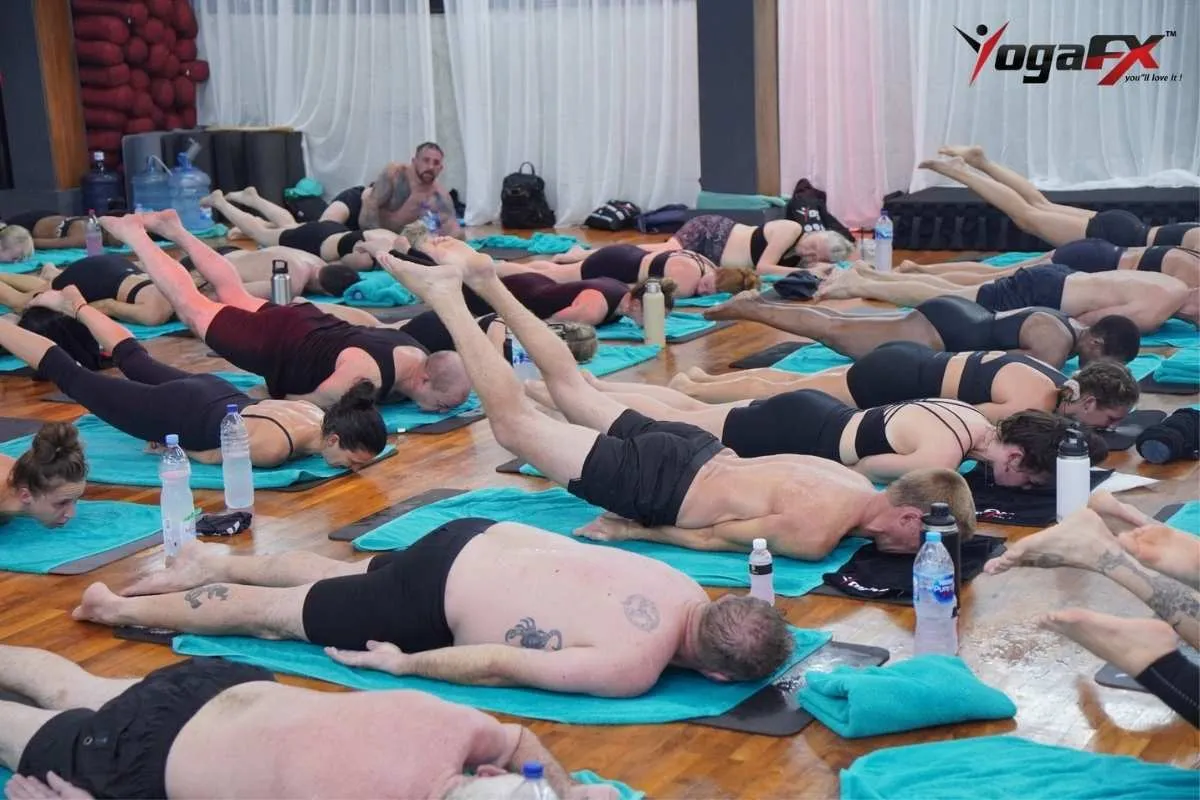
Pacing Yourself in Bali’s Tropical Humidity
Bali adds a twist that studios in cooler countries do not have. You walk in from warm, humid air, not from a cold street. That means your body is already working to cool itself before class begins, especially if you spent the morning on a scooter or at the beach.
Is Hot Yoga Safe for Beginners in Bali?
Yes, for healthy beginners who pace themselves, and pacing starts before you arrive. Here are the habits we ask new students to follow:
- Drink early. Start hydrating hours before class. Mayo Clinic Sports Medicine advises drinking plenty of water before, during and after. Our hot yoga hydration guide covers water and electrolytes in detail.
- Eat light. Have a small meal at least two hours before class. A heavy meal makes the room feel much harder.
- Tell the teacher. Mention any medical condition, medication or pregnancy before class starts.
- Take it easy at first. Your first classes are the hardest, because your body has not adapted to the heat yet. Go at about half effort and enjoy the room.
- Rest whenever you need. Lying down in Savasana is always allowed. It’s never a failure.
You don’t need to prove anything in your first week. Students who build up over a few classes tend to enjoy the practice more, and they also give their bodies time to adapt.
A simple way to ease in is to plan your first month around attendance, not intensity. Come two or three times in the first week. Stay in the room, breathe, and rest as often as you like. Add effort only after the room stops feeling like a surprise.
Normal Effort or a Warning Sign?
Breathlessness, heavy sweating, a burning thigh in Awkward pose and a tired body at the end are all normal in a first class. They are signs of effort, not danger.
Is hot yoga safe when you feel dizzy or sick? No, that is the moment to stop. Different symptoms mean something else. The NHS lists the symptoms of heat exhaustion as tiredness, dizziness, headache, nausea or vomiting, excessive sweating with pale and clammy skin, cramps, a high temperature, strong thirst and irritability (NHS, Heat exhaustion and heatstroke). Mayo Clinic Sports Medicine says to stop if you feel dizzy, lightheaded or sick in any way.
Heatstroke Is a Different Matter
Heatstroke is different again. The NHS describes it as a medical emergency. Its signs include a very high temperature, hot skin without sweating, fast breathing and a fast heartbeat, confusion and restlessness, a seizure, or loss of consciousness.
Normal effort, heat exhaustion or heatstroke?
What to Do If Heat Exhaustion Starts
What should you do if heat exhaustion starts? The NHS gives four steps. Move to a cool place, drink plenty of water, cool the skin with a spray or sponge and cool water, and fan it. It adds that heat exhaustion does not usually need emergency help if you cool down within 30 minutes. If you do not cool down, or any heatstroke sign appears, get medical help.
If you feel dizzy in class, our article what to do when you feel dizzy in hot yoga walks through the first minute step by step.
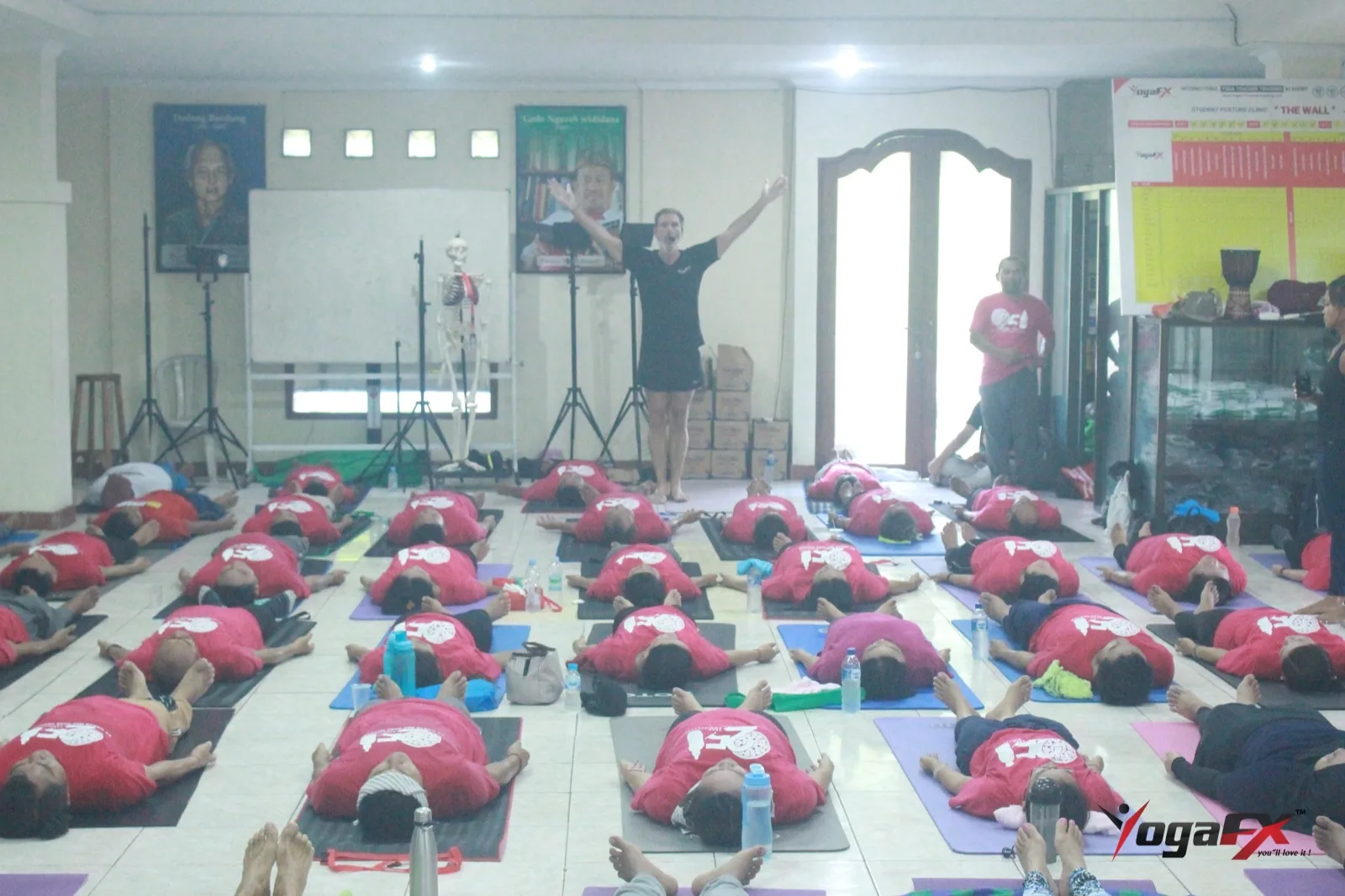
How Teachers in Our Seminyak Studio Watch the Room
Our classes follow a fixed script, and the teacher does not demonstrate the postures or play music. That means the teacher spends the class watching the room, not performing in front of it. They can see who is breathing hard, who has stopped sweating, and who needs a quiet word.
Mr. Ian Terry, E-RYT 500, trained for five years from 2014 to 2019 with the founder of the Hot 26&2 method and has taught more than 12,000 hours. His advice to new students is consistent. Arrive hydrated, tell the teacher about any condition or medication before class, and know that lying down is always acceptable.
Here is what you can expect from the team in practice:
- A quick check at the start. Tell us about injuries, medication or pregnancy and we will make sure the teacher knows.
- Permission to rest. You do not need to ask. Lie down on your towel and breathe.
- Calm, spoken guidance through the whole class, so you always know which posture comes next and how long it lasts.
- No pressure to match anyone else. Your range today is the right range.
Students tell us this matters, and we’ll take that seriously. A trainee who joined our teacher training told Yoga Alliance in 2025: “Trainer was approachable and encouraging.” (Konrad, Yoga Alliance review, 2025). That review is about our training, but it describes the tone we use in classes too.
Another student, Xuan, said in a video review in 2026: “I had so much fun with you.” (Xuan, YouTube review, 2026). You can watch the full video below. Reviews describe how a class feels. They aren’t safety evidence, so please read them alongside the research above.
Is Hot Yoga Safe for You Today? A Pre-Class Checklist
Is hot yoga safe for you today? Use this short list to decide. Print it, screenshot it or simply remember it.
- Today: Do I feel well, rested and not feverish?
- Health: Have I spoken to my doctor if I have a heart, blood pressure, fluid or heat concern, or if I am pregnant?
- Water: Have I been drinking since the morning, not just in the last ten minutes?
- Food: Did I eat a light meal at least two hours ago?
- Teacher: Have I told the teacher about anything they should know?
- Plan: Do I know I can lie down whenever I want?
So, is hot yoga safe for you today? If the answer to any of these is no, fix it first. If the first answer is no, skip today. There is another class tomorrow, and the studio is open daily from 06:00 to 22:00.
You can find us at Jl. Pangkungsari Gg Jepun No.888, Kuta Utara, Seminyak, Badung, Bali 80361. Your first class is free with our Free 1-Day Guest Pass, so you can see the room, meet the team and decide with a clear head. Message us on WhatsApp to book your free class.
FAQ
Is hot yoga safe for beginners?
For healthy beginners, usually yes, if they build up slowly. Drink early, eat lightly, tell the teacher about any condition, and rest whenever needed. Your first classes feel hardest because your body is still adapting to the heat. If you have health concerns, check with your doctor before your first class.
Who should not do hot yoga?
Mayo Clinic Sports Medicine says it is probably best to skip hot yoga with heart disease, dehydration problems, heat intolerance, or a history of heat-related illness. It also advises checking with your doctor first if you are pregnant or have other health concerns. Your own doctor knows your situation best.
Is hot yoga safe during pregnancy?
Mayo Clinic Sports Medicine advises checking with your doctor before hot yoga if you are pregnant. Please speak to your doctor or midwife first, because only they know your pregnancy and your medical history. Our separate guide on Bikram yoga and pregnancy covers the questions worth asking them before you book a class.
Is hot yoga safe for high blood pressure?
That depends on your readings and medication, so ask your doctor before booking. Heat and effort both raise the load on your circulation, and some medicines can change how you handle heat and fluid. Tell your doctor the class is 90 minutes at about 40°C so they can advise you properly.
Is hot yoga dangerous?
For most healthy people it is not, but the heat is a real load. The main danger is heat illness. Stop and cool down if you feel dizzy, sick or confused, and get medical help for hot skin without sweating. Preparing well and resting freely keeps the risk low for most students.
Still have questions? Message Mr. Ian and the YogaFX team on WhatsApp and we will answer them personally.
This article is general information only and is not medical advice. Please consult a healthcare professional before starting hot yoga or any new exercise programme, particularly if you have a health condition, take regular medication or are pregnant.
 Mr. Ian Terry