
Eagle pose (Garudasana) is the fourth posture in the Hot 26&2 class, a standing balance where you cross one leg over the other, wrap your arms and sink low on one bent leg. It feels hard because balance, compression and heat all arrive together. In Bali’s natural heat, you have to earn every second of it.

This walkthrough is for visitors and residents with a mat in Bali who want to know what happens in the room before they step in. It covers the steps, the mistakes we see most, how heat changes the pose, and what the safety guidance says. It also shares the cues our teachers use at YogaFX in Seminyak.
Eagle Pose in a Bali Hot Yoga Class: What Happens in the Room
Eagle pose arrives early, right after awkward pose and just before standing head to knee. Your legs are warm, your breath is moving and you’ve already survived one tough hold. That timing matters, because eagle pose asks for a calm mind exactly when your thighs are tired.
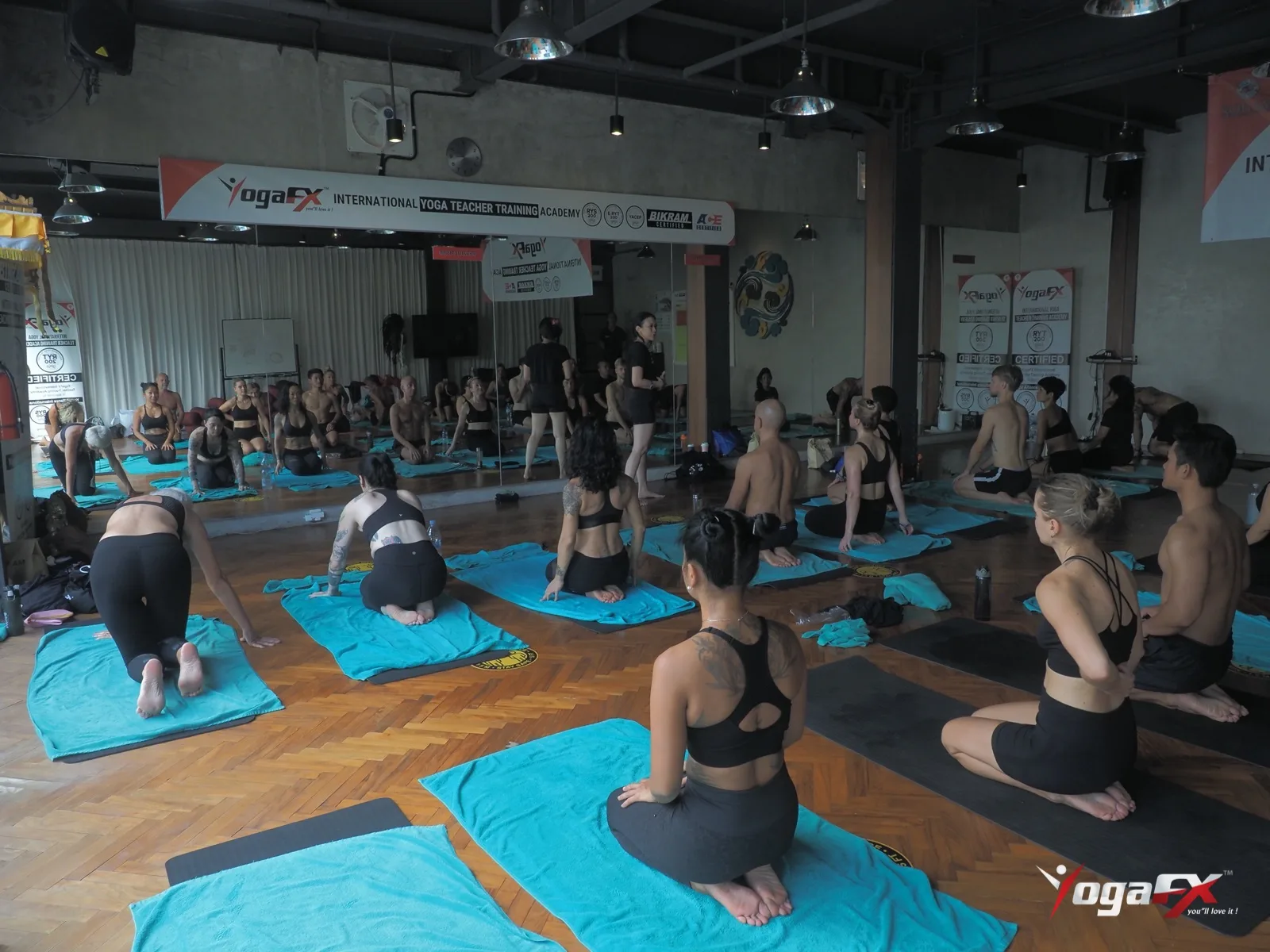
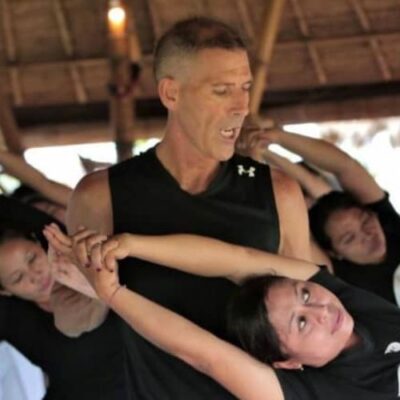
At YogaFX in Seminyak, Mr. Ian Terry, our Founder and Lead Instructor (E-RYT 500, with more than 12,000 teaching hours), teaches eagle pose from the same scripted dialogue in every class. There is no demonstration and no music. So you hear the cue, feel the shape and make your own small corrections.
That setup suits this posture well. There’s nothing to copy, so you can’t borrow balance from the person next to you. Instead, you listen and feel where your limbs are. Our own Guide to Hot 26&2 names eagle pose as one of the two postures that test proprioception the most. That word means your sense of where your body is in space.
Wrapping your arms and legs around the midline hides your limbs from your own view. As a result, your brain has to rely on feel, not sight. Three things work together to create the challenge.
- Compression. Your arms and legs wrap tightly, so your joints press together and your attention narrows to the middle of the body.
- A single-leg squat. One bent leg carries your whole weight while your hips sink low.
- A hot room. Heat lifts your heart rate and your sense of effort sooner than a cool studio does.
How to Do Eagle Pose (Garudasana) Step by Step
Here is eagle pose as we cue it in the Hot 26&2 class. Work through the steps slowly, and expect to wobble. Everyone does, including teachers.
- Stand tall, then bend both knees. Sit back as if lowering into a chair, with your weight on your heels.
- Shift onto one leg. Keep that knee bent and your standing foot flat, with all five toes pressing into the mat.
- Cross the other leg high. Lift it and bring the thigh over your standing thigh, as high as you comfortably can.
- Hook the foot if it reaches. Tuck the toes behind the standing calf. If they won’t reach, rest the toes on the mat.
- Wrap your arms. Cross one arm under the other, bend both elbows and bring your palms together with the fingers pointing up.
- Sink and lift. Lower your hips a little more, lift your elbows and keep your chest tall and your shoulders relaxed.
- Fix your gaze and breathe. Pick one spot, such as your own eyes in the mirror, and keep your breath slow until the dialogue ends the pose.
- Unwind slowly, then repeat on the other side. Take a breath between sides and let your standing leg recover.
Why the Standing Knee Stays Bent
Many beginners straighten the standing leg to feel steadier. That works against the pose. A bent standing knee lets your hips drop, keeps your weight over the foot and gives your ankle room to make small corrections. Our teaching guide describes the standing foot as the base the whole stack balances on, with the toes gripping the floor.
So think of the standing leg as a spring, not a pillar. If you’d like to see where this posture sits among the others, read our guide to all 26 postures in order.
Eagle pose at a glance in a Bali hot yoga class
The Six Most Common Eagle Pose Mistakes and Quick Fixes
After many first-timers in the room, the same errors keep turning up. Each one has a simple fix, and most of them come down to the standing leg and the gaze.
| What you do | Why it hurts the pose | What to try instead |
|---|---|---|
| Locking the standing leg straight | Your hips can’t sink, and your balance gets stiff and shaky | Bend the standing knee and sit lower, as if in a chair |
| Leaning back | Your weight leaves the standing foot | Press the standing heel down and stack your ribs over your hips |
| Dropping the elbows | Your shoulders hunch and your chest collapses | Lift the elbows and let your shoulders slide away from your ears |
| Holding your breath | Tension rises and balance suffers | Breathe slowly in and out through your nose |
| Letting your eyes wander | Every glance sends a new wobble through the body | Fix on one spot in the mirror and keep it there |
| Forcing the wrap | Pinching at the knee, hip or shoulder | Rest the toes on the mat and wrap only as far as feels comfortable |
Can’t Wrap Your Legs or Arms?
That’s normal, especially with tight hips or shoulders. Tight hips make the leg wrap hard, and tight shoulders make the arm wrap hard. So take the version you can do today. Cross the leg and rest the toes on the mat. Hug yourself with your hands on opposite shoulders instead of binding the arms.
The shape matters less than the standing leg and a steady gaze. Students often wrap further after a few weeks, because the heat keeps the joints warm and the repeated sequence gives your body a familiar pattern to build on.
Teaching Cues That Help in Eagle Pose
Posture and teaching are different skills. You can hold eagle pose comfortably and still lose your place when you have to describe it. If you’re thinking about teaching one day, notice which words help you in class. Short, clear cues work best.
- “Sit down.” This reminds you to bend the standing knee before you do anything else.
- “Heel down.” It keeps your weight from drifting onto your toes.
- “Lift your elbows.” It stops the shoulders from hunching and opens the chest.
- “Eyes on one spot.” It gives your mind a job so your body can balance.
- “Breathe out slowly.” It calms the tension that builds in a tight wrap.
- “Unwind slowly.” It protects the knee and ankle on the way out.
Notice that none of these cues asks for more force. Instead, each one asks for more attention. That’s why a fixed dialogue works so well for a balancing posture. The words arrive at a steady pace, so your mind stays busy with listening and doesn’t drift into worry about falling.
How Bali’s Natural Heat Changes Eagle Pose
Our class runs for 90 minutes at about 40 degrees C and 40% humidity, and the heat comes from the tropical climate rather than electric heaters. That changes eagle pose in three ways.
- Effort feels bigger. Your heart works harder in the heat, so a balance that feels easy in a cool room can feel fierce here.
- Grip gets slippery. Sweat makes hands and feet slick, so wipe your palms on your towel before you wrap your arms.
- Tiredness arrives sooner. If you feel dizzy or faint, unwind and rest. The pose will be there on the next breath.
The US Centers for Disease Control and Prevention lists the symptoms of overheating as muscle cramping, unusually heavy sweating, shortness of breath, dizziness, headaches, weakness and nausea, and it urges people to know the symptoms and when to seek medical care. Dizziness matters most in eagle pose, because you’re standing on one leg.
If you’re new to Bali, give your body time to adapt. Our guide to heat acclimatization for hot yoga walks through three honest weeks, and the hot yoga hydration guide explains what to drink before and after class.
What the Safety Guidance Says
The National Center for Complementary and Integrative Health, part of the US National Institutes of Health, says yoga is generally considered a safe form of physical activity for healthy people when it’s performed properly. Its fact sheet adds that the most common injuries are sprains and strains, and that serious injuries are rare. You can read it on the NCCIH yoga effectiveness and safety page.
The same page gives three warnings that matter for eagle pose. First, hot yoga has special risks related to overheating and dehydration. Second, people with preexisting injuries such as knee or hip injuries, or with balance issues, may need to modify poses. Third, pregnant women should avoid hot yoga because it can cause overheating.
As for the workload, a University of Wisconsin study (Porcari et al., 2014) measured the energy cost of a 90-minute Bikram class. It reported about 333 calories for women and 460 for men, at roughly 80% of maximum heart rate. We’re naming that study rather than linking it, because the page wouldn’t open for us.
These findings describe the whole class, not eagle pose alone, and none of them proves that eagle pose will change your body in a set time. Results vary between people. Please speak to a healthcare professional before you start a hot yoga routine if you have heart, blood pressure, knee, hip, balance or back concerns. This guide is not medical advice.
Eagle Pose Modifications for Your First Weeks
You don’t need to match the textbook shape on day one. A smaller, steadier eagle pose beats a deep one that you can’t hold. Try these changes, in this order, until the pose feels calm.
- Keep the toes on the mat. Cross the top leg but rest its toes on the floor for extra balance.
- Skip the bind. Hold opposite shoulders in a hug, or keep your hands apart with elbows bent.
- Sit higher. Choose a depth you can keep for the whole pose, then go lower over several weeks.
- Stay near a wall or edge of the room. You don’t need to touch it, but knowing it’s there helps you relax.
- Come out early. Unwind before you wobble badly, and rejoin on the next side with a fresh start.
If you’re brand new to class, our hot yoga for beginners guide covers what to bring and what to expect before you walk in. For eagle pose in particular, treat the first week as practice at staying calm.
Progress isn’t a straight line, so treat the pattern below as a rough guide and not a promise.
- Week one. Find your standing leg. Keep the knee bent and the gaze steady.
- Week two. Notice where you wobble first, and use the table above to adjust.
- Week three. Try the leg hook or the arm wrap, but only as far as feels comfortable.
- Week four. Hold your chosen version with a calmer face, and notice that the effort feels less like an emergency.
Where Eagle Pose Sits in the Standing Series
Eagle pose isn’t a stand-alone trick. It sits in a fixed order, and the postures on either side shape how it feels. Unlike an eagle pose yoga flow that drops the posture anywhere, a set sequence has a quiet advantage: you meet the same posture in the same place every time you come back.
| Posture | Place in the class | Main challenge |
|---|---|---|
| Awkward pose (Utkatasana) | Posture 3 | A deep held squat that tires the thighs |
| Eagle pose (Garudasana) | Posture 4 | Balance and compression on one bent leg |
| Standing head to knee | Posture 5 | Balance, focus and a locked standing leg |
Notice the contrast. Awkward pose builds a fire in your thighs, and eagle pose then asks you to stay calm and balanced while they’re still warm. Standing head to knee follows and asks for a locked standing leg, which is the opposite of the soft knee you use in eagle pose.
Our own Guide to Hot 26&2 also lists eagle pose among the standing postures with the strongest cardiovascular demand, together with awkward pose and standing head to knee. That’s our teaching view, not a medical claim, and it fits what students feel in the room.
Planning Eagle Pose Practice Around a Bali Stay
Many readers find us while planning a trip, and many others live nearby. The plan differs a little for each, but the goal is the same: arrive for class rested, hydrated and ready to be a beginner.
- Visitors. If you’re in Bali for a week or two, book your first class early in the stay, so the heat feels familiar by the end of the trip.
- Residents and expats. A regular weekly rhythm teaches more than an occasional heroic class. Ask at the front desk about memberships once you’ve tried a class.
- Anyone returning after a break. Start with a simpler eagle pose and rebuild your balance before you chase the full wrap.
Our classes run at the Seminyak studio, and a second studio in Canggu is coming soon. If you’re staying elsewhere on the island, plan the trip to Seminyak like any other morning errand.
What Students Say About the Hot Room
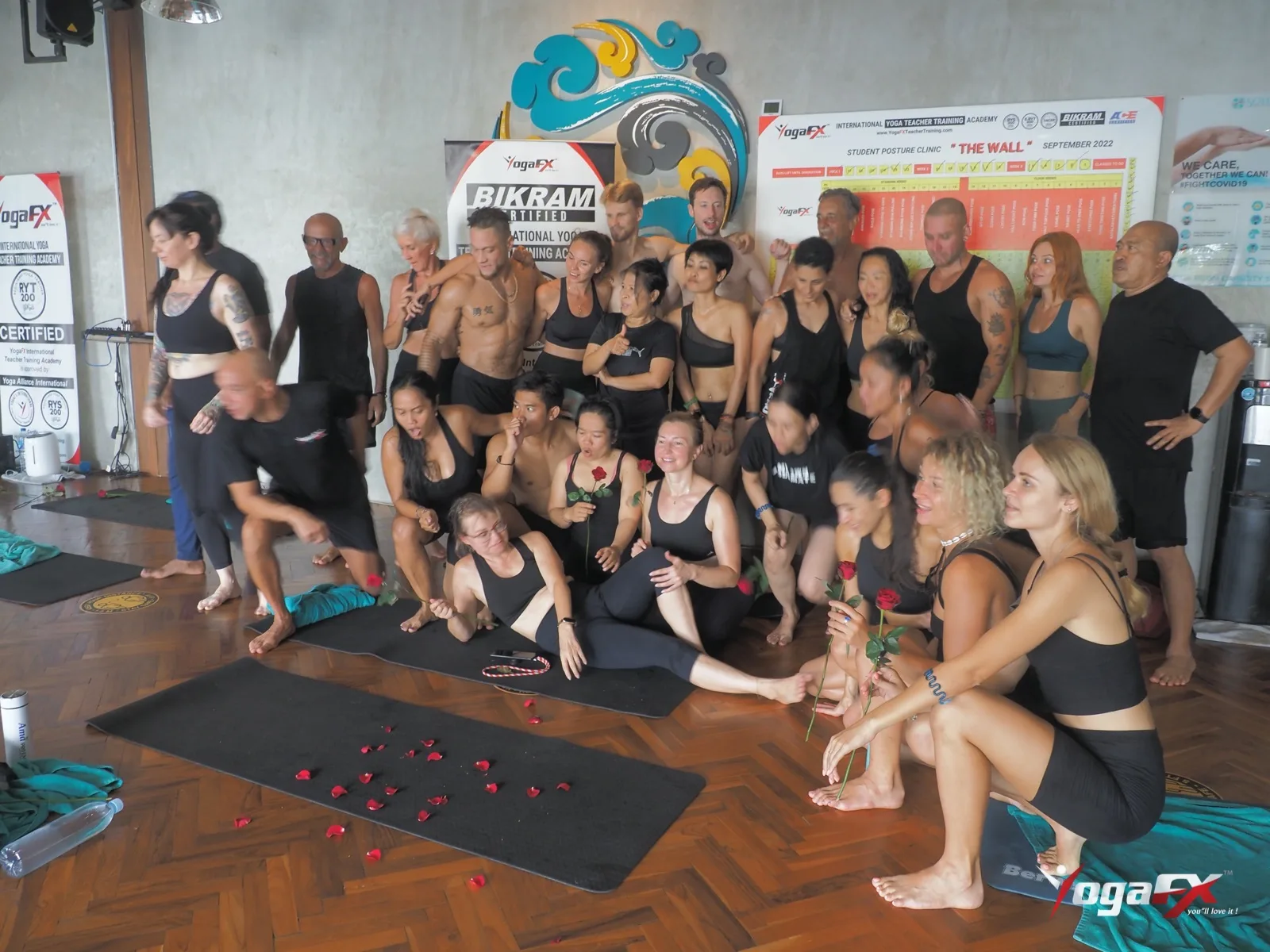
Eagle pose is famous for making people laugh, groan and keep going. These YogaFX students describe how the hot room feels after the work is done.
“Amazing Yoga, amazing teacher, I got so much benefits”
Volla, Google review, 2020
Volla left that review years ago, and it still sums up what many students tell us. Dior, a trainee, shared a longer reflection in a video review.
“This has been wonderful and I am very grateful for this experience and for meeting every single individual here”
Dior, YouTube review, 2024
Dior’s video review, from one of our teacher trainings.
Try Eagle Pose at YogaFX Seminyak
The best way to understand eagle pose is to stand in it, in the heat it was built for. Our studio is at Jl. Pangkungsari Gg Jepun No.888, Kuta Utara, Seminyak, Badung, Bali 80361, and it’s open from 06:00 to 22:00 every day. Every class is 90 minutes, taught from the scripted dialogue.
Mr. Ian Terry trained for five years, from 2014 to 2019, with the founder of the Bikram Hot 26&2 method. That background shapes how we cue a balance like this one, with the standing leg first and the breath second. We teach what we call Original Hot 26&2 Yoga, and we teach it the same way every day.
Ready to try it? Claim our Free 1-Day Guest Pass, where the first class is free. Tell the teacher it’s your first time, and ask them to remind you to keep your standing knee bent.
FAQ
What is eagle pose in yoga?
Eagle pose, called Garudasana in Sanskrit, is a standing balance where you cross one leg over the other, wrap your arms and sink on one bent leg. In the Hot 26&2 class it is posture 4 of 26. It tests balance, focus and concentration, which is why it feels so demanding.
Why is eagle pose so hard?
Eagle pose asks for balance, compression and a single-leg squat at the same time. Your arms and legs wrap around the midline, so you can’t rely on sight to steady yourself. In a hot room, your heart rate climbs sooner too. A bent standing knee and a steady gaze help.
What if I can’t wrap my legs in eagle pose?
That is common with tight hips. Cross the top leg and rest the toes on the mat instead of hooking the calf. Keep the standing knee bent and the gaze steady. The wrap often deepens over several weeks, but the standing leg matters more than the shape.
How do you modify eagle pose for beginners?
Sit a little higher, keep the toes of the top leg on the mat and hug your shoulders instead of binding your arms. Fix your eyes on one spot and breathe slowly. If your knee or hip feels pinched, unwind. Ask your doctor first if you have joint concerns.
What are the eagle pose benefits?
Eagle pose is mainly a balance, focus and body-awareness posture. It also asks your legs and hips to work hard in a deep bend. Research on its health effects is limited, so treat it as practice, not treatment, and speak to a healthcare professional about any medical concern.
Still have questions? Message Mr. Ian and the YogaFX team on WhatsApp and we will answer them personally.
 Mr. Ian Terry