
Proprioception exercises are movements that train your sense of where your body is without looking. You already do six of them in a Seminyak 26 and 2 class: Awkward, Eagle, Standing Head to Knee, Standing Bow Pulling, Balancing Stick and Tree. This guide shows what each one asks of you and what to notice.

We wrote it from the floor of our Seminyak studio. Mr. Ian Terry, our Founder and Lead Instructor (E-RYT 500, 12,000+ teaching hours), leads the class through a fixed script, and that script is the reason these postures work as body-awareness practice. Nobody demonstrates, so you learn each position by feeling it, and that makes every class a set of proprioception exercises.
What proprioception exercises train on a studio floor
Cleveland Clinic defines it simply: proprioception is your body’s ability to sense its own position and movements. It is why you can touch your nose with your eyes closed, or stand up from a chair without checking where your feet are.
Proprioception is related to balance, but it isn’t the same thing. Balance is the outcome: you stay upright. Proprioception is one of the inputs: your joints and muscles report where they are, so your brain can correct small errors before you wobble.
In a YogaFX class, three details make that input hard to ignore:
- The script, not a demonstration. The teacher describes where your weight, hips and hands should go. You cannot copy a picture, so you build the posture from the inside.
- Natural tropical heat. The Seminyak room is warmed by Bali’s climate, not electric heaters, with the class set at 40 degrees C and 40% humidity. Your skin is damp, your towel is wet and the floor is slick, so your feet have to work.
- Ninety minutes without music. With no playlist to hide in, you hear the cues and your own breathing, and small balance errors are easy to notice.
This article is part of our hot yoga health guide, which brings together the research on benefits, safety and the heat.
The proprioception exercises you already do, posture by posture
Here are the six postures where these proprioception exercises do the most work. For each one, we name the part of the body you cannot see and give one cue to try. If you want the full walkthrough of a posture, follow the link.
1. Awkward Pose: feel your heels
You sit back as if into a chair (Utkatasana), knees together, arms reaching forward. Your thighs burn, so most students stop noticing their feet. That is the proprioception exercise inside the posture. Where is your weight? If it drifts onto your toes, the posture falls forward. Our Awkward Pose walkthrough covers the leg burn and the common mistakes.
2. Eagle Pose: find the standing leg
One leg wraps around the other (Garudasana) and your arms wrap in front of your face. You cannot see most of your own body. Your standing leg has to stay steady while the other leg is wrapped around it. It is a good first lesson in body awareness. Read the Eagle Pose class walkthrough for the step-by-step.
3. Standing Head to Knee: lock the knee by feel
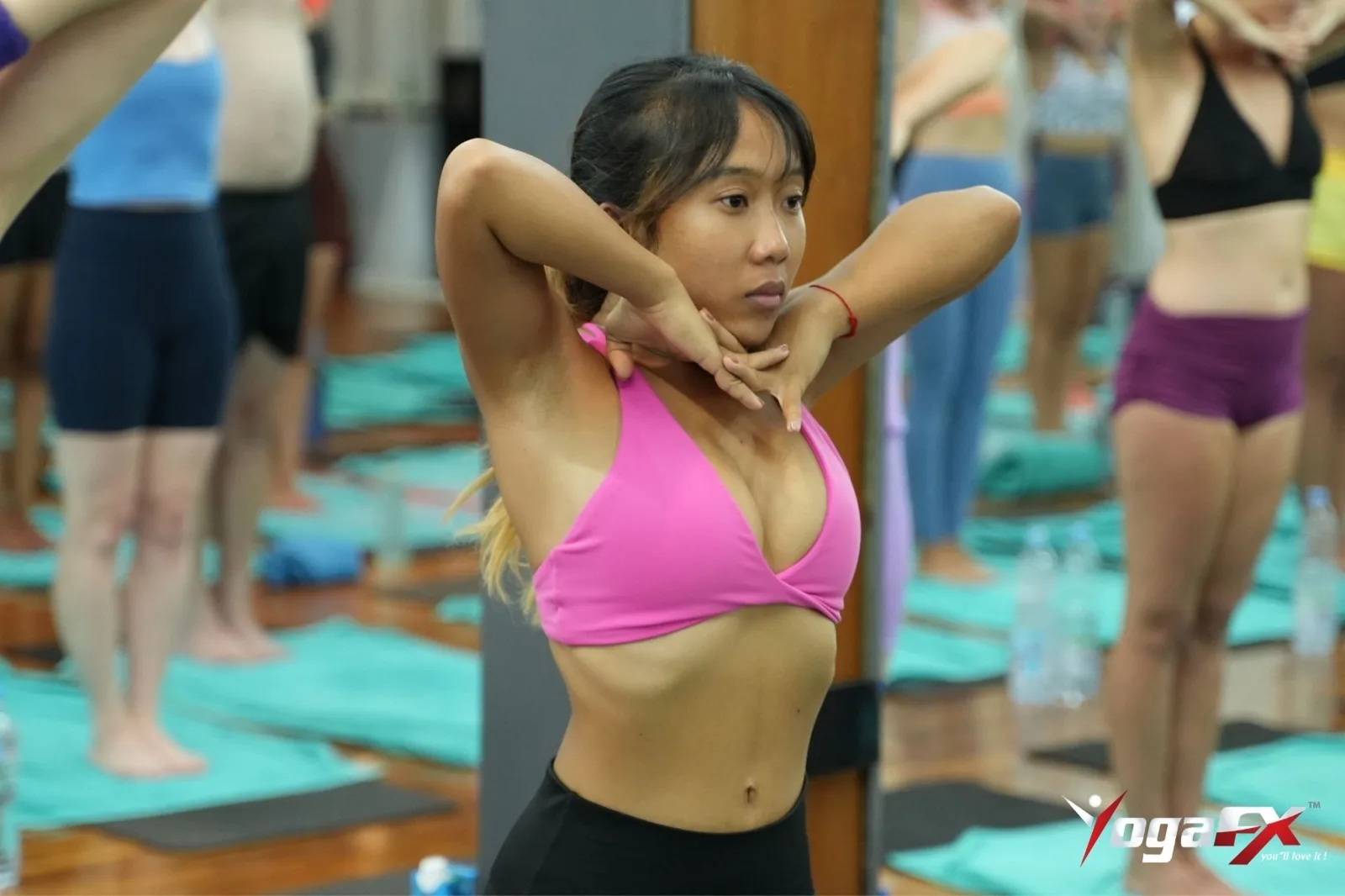
You stand on one leg, lift the other, hold the foot and bring the forehead toward the knee. The standing knee must stay locked. Nothing tells you it has softened except the sensation in the joint itself. See how we teach the posture in Standing Head to Knee for Bali students.
4. Standing Bow Pulling: sense the kick
You hold your back foot, kick it into your hand and hinge forward at the same time. The pull and the kick must match, or you tip. You are balancing two opposing forces you cannot watch. Our Standing Bow Pulling guide explains the cues we use in Seminyak.
5. Balancing Stick: build the line
Balancing Stick asks you to stand on one leg, lean forward and extend the other leg behind you until your body forms one long line, arms stretched past your ears. Your eyes see the mirror, but your hips, ribs and fingertips decide whether the line is straight. Expect to correct yourself several times per attempt. Those corrections are the exercise.
6. Tree Pose: quiet the small wobble
In Tree you stand on one leg with the other foot against your thigh and your hands joined overhead. Much of the steadying happens in tiny adjustments at the foot and ankle. Slow, steady breathing helps you notice them. Our Tree Pose tips for Bali heat go through it.
Quick reference: six proprioception exercises in the 26 postures
| Posture | What you must feel | Body part to notice | One cue to try |
|---|---|---|---|
| Awkward Pose | Weight on heels vs toes | Hips behind the knees | Keep your knees together and sit back |
| Eagle Pose | Standing leg under a twist | Knee and ankle of the standing leg | Stay on the standing leg, not on the wrap |
| Standing Head to Knee | Locked standing knee | Quadriceps and knee | Lock the knee first, then bend forward |
| Standing Bow Pulling | Kick against the hand | Back, hip and standing foot | Kick and hinge together |
| Balancing Stick | Body line and hip level | Hips and ribs | Square the hips before you reach |
| Tree Pose | Ankle micro-corrections | Standing foot and ankle | Breathe slowly and stop gripping |
Common mistakes that hide the proprioception work
The postures only work as proprioception exercises if you let them. Five habits get in the way, and all of them are easy to fix once you spot them:
- Staring at one spot in the mirror and forgetting everything else. A fixed gaze helps you balance, but pair it with a check of the standing foot.
- Gripping with the toes. It feels like control, yet it hides the smaller signals from the rest of the foot.
- Holding your breath. Tension spreads, and the standing leg stiffens.
- Chasing depth. Pulling the foot higher in Standing Bow before the line is stable teaches you nothing about position.
- Giving up after the first wobble. The wobble is the information. Reset, breathe and try again.
Teachers in the room can see these habits from the outside. A quiet correction in the script, such as a reminder to soften the toes, often changes the whole posture.
Class practice versus balance-board drills
Gym proprioception exercises use wobble boards, foam pads and single-leg reaches. They are useful, and a physical therapist can set them up for an injury. A 26 and 2 class works differently from those proprioception exercises. The surface is stable, but the sequence is long, the cues are precise and you hold each balance while tired and sweating.
Neither replaces the other. If you’re rehabilitating a joint, follow your therapist. If you want a regular practice that happens to include a lot of one-leg work, the class fits. Many students do both.
A simple way to track your progress over four weeks
Proprioception is hard to measure, so make your proprioception exercises concrete. Pick one posture per week and keep a short note after class. You are not scoring yourself. You are collecting evidence that your body is learning.
- Week 1, Awkward Pose: note whether your weight sits on your heels or toes at the start and at the end.
- Week 2, Eagle Pose: note how long you hold before the standing leg shakes, and which part of the foot is working.
- Week 3, Standing Head to Knee: note whether the standing knee stays locked all the way down.
- Week 4, Balancing Stick: note how many corrections you make and where they happen.
After four weeks, read the notes back. Most people see a pattern: fewer corrections, or corrections that start earlier. That is position sense improving, even when the posture looks the same from outside.
If a posture feels worse in some weeks, that is normal. Sleep, hydration, food and stress all change how steady you feel. Come back to it next class.
What the research says about proprioception exercises and balance
The best evidence we found does not come from yoga, and we want to be clear about that. A 2020 randomized controlled trial in Archives of Physical Medicine and Rehabilitation tested proprioceptive exercise in a Spanish nursing home. Both groups had 12 weeks of standard physical therapy. The experimental group also did a proprioceptive program twice a week, 24 sessions of 55 minutes.
That group improved more than the control group on the Timed Up and Go, the Tinetti balance and gait test, one-leg stance and the Morse Fall Scale. The final sample was only 42 older adults, so treat it as a promising result, not a promise.
On the yoga side, a 2025 systematic review of Bikram and hot yoga research by Willmott and colleagues pooled 43 studies and 942 participants. We could not open the full text for this article, so we do not lean on it for proprioception. And no study we found has tested the 26 and 2 sequence specifically for proprioception.
What this means for you: balancing on one leg is a recognised way to train position sense, and the six proprioception exercises above ask you to do exactly that, repeatedly, for 90 minutes. That is a reasonable argument. It is not proof. If you have a balance disorder, nerve damage or a past injury, ask your doctor before you start.
How the Seminyak room changes what you notice
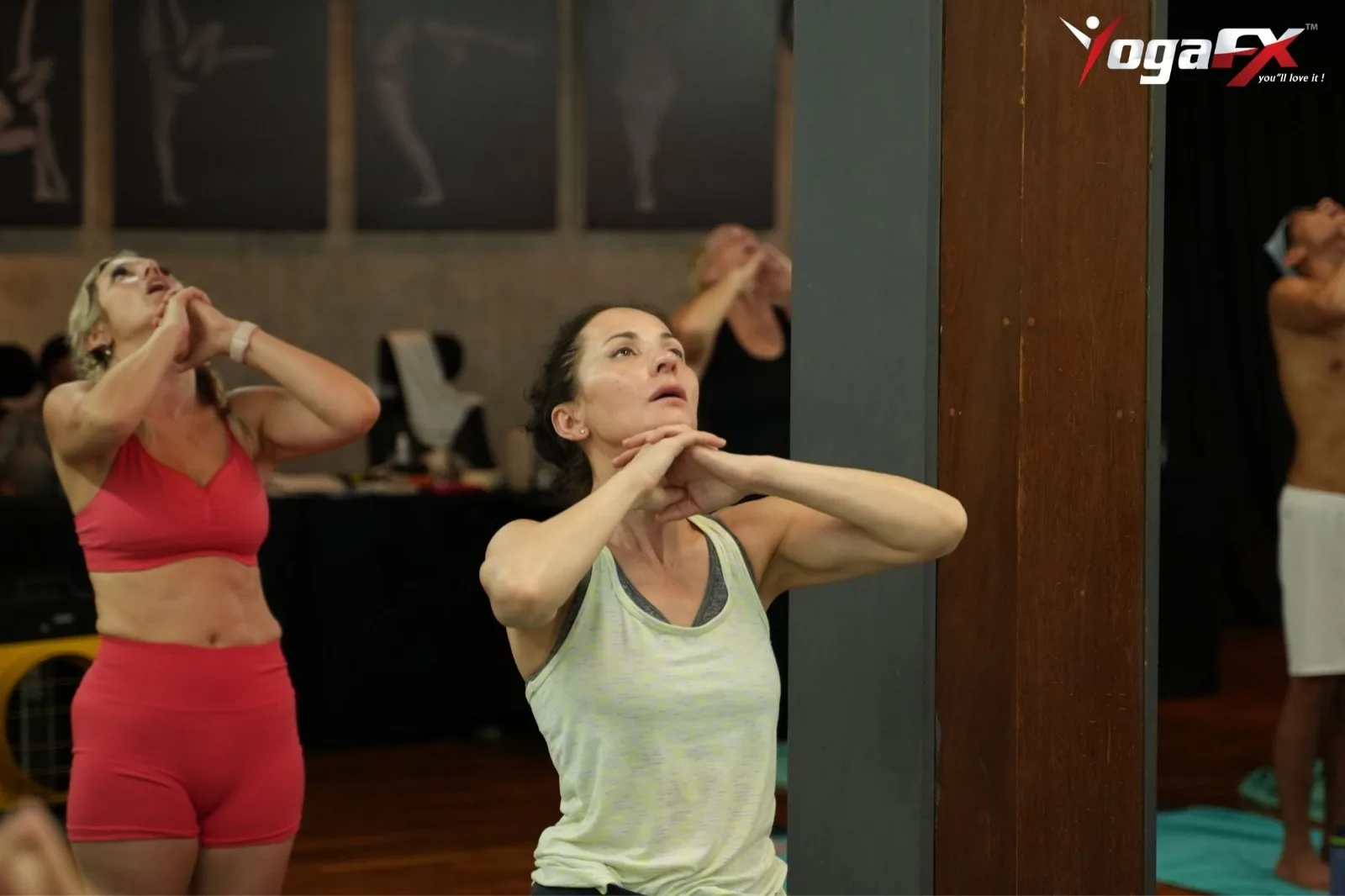
Heat doesn’t give you better proprioception. What it does is change how the practice feels. In our hot 26 and 2 class in Bali, sweat pools under your standing foot. The floor gets slick and the towel shifts. Your foot has to keep making small adjustments, and you feel them.
If your balance feels off in week one, use the mirror for feedback and stay close to the wall. Our advice is to treat the first class as practice, not performance.
If the teacher-training angle interests you, our sister site’s guide to how the 26&2 postures train balance looks at how future teachers learn to cue body awareness.
What students say about learning to feel the posture
We keep the reviews we quote exactly as students wrote them, or close to it. Three that fit this topic:
- Marion, Google review, 2024: “You are teaching almost from the start of the course and your confidence increases daily.”
- Dewa, Google review, 2024: a beginner who wrote that Mr Ian taught him slowly and that he would come again. Slow cueing is what makes a one-leg posture possible for a first-timer.
- Lars, YouTube review, 2026: he said the week was “more than I expected” and that he struggled on the mat at moments. His video is below.
Which of these proprioception exercises should a beginner start with? Tree and Eagle, because you can stay close to the wall and the floor does the supporting. Add Balancing Stick last, once you trust your standing leg.
Five ways to practise proprioception in your next class
You don’t need a balance board to practise proprioception exercises. You need attention. Try these in order, one per class:
- Close your attention, not your eyes. In Eagle, ask where your standing knee is pointing before you look at the mirror.
- Name your weight. In Awkward, say to yourself “heels” or “toes” every few breaths.
- Check the lock. In Standing Head to Knee, feel the standing knee before you fold, and again halfway down.
- Count your corrections. In Balancing Stick, count how many times you adjust. The number should drop over weeks.
- Soften your grip. In Tree, loosen your toes and breathe out slowly. The wobble often settles.
Give each posture two or three weeks before you judge it. Small gains in awareness are real, but they’re quiet.
Who should check first
This practice is not right for everyone. Talk to a healthcare professional before you start if any of these apply:
- You have a balance disorder, dizziness or vertigo.
- You have nerve damage or numbness in your feet or legs.
- You are pregnant, have a heart condition or take medication that affects blood pressure.
- You are recovering from a knee, ankle or hip injury.
This article is general information, not medical advice. Tell the teacher about any injury before class.
Try it in Seminyak on a free guest pass
The easiest way to test proprioception exercises like these is to feel them. Your first class at YogaFX is free with the Free 1-Day Guest Pass. We are open 06:00 to 22:00 every day at Jl. Pangkungsari Gg Jepun No.888, Kuta Utara, Seminyak, Badung, Bali 80361.
Tell the teacher you are new and ask where to stand. A spot near the wall is a good choice for a first class. Bring a towel and water.
FAQ
What do proprioception exercises do for your body?
They train the system that tells your brain where your joints and muscles are. With practice, you notice small errors, such as a drifting knee or a tilted hip, earlier. That can make movement feel steadier, though the best trial evidence we found comes from older adults in a nursing home, not yoga students.
Is Eagle Pose a proprioception exercise?
Yes, in the sense that it asks you to feel your position without seeing it. Your arms and one leg are wrapped, so you rely on sensation in the standing foot and knee. No study has tested Eagle alone for this purpose, so we call it a good fit, not a treatment.
Can beginners do proprioception exercises in a hot yoga class?
Yes, with sensible choices. Stand near the wall, use the mirror for feedback and keep your knees soft until the posture feels stable. Tell the teacher you are new, rest whenever you need to and bring water. If you feel dizzy, sit down and stop.
Are proprioception exercises safe in a hot room?
Heat adds risk to any balance work. Dizziness, a heart condition, blood pressure problems or pregnancy are reasons to ask a healthcare professional first. Drink water, move slowly and leave the posture at the first sign of faintness. Tell your teacher about any injury before class starts.
What is the difference between proprioception and kinesthesia?
The terms overlap. Kinesthesia usually means your sense of movement, while proprioception means your sense of position. Cleveland Clinic describes proprioception as your body’s ability to sense its own position and movements, so many sources treat movement sense as part of it. For class purposes, you can use them together.
Still have questions? Message Mr. Ian and the YogaFX team on WhatsApp and we will answer them personally.
 Mr. Ian Terry