
The standing bow pulling pose (Dandayamana-Dhanurasana) is a one-legged balance where you hold one foot behind you, kick it back and up, and reach your other arm forward. In our Seminyak hot room it asks for focus more than flexibility. The kick, not the pull, makes the shape.

This guide is for visitors planning a Bali stay and for residents who want to know what the pose asks before their first class. It covers the steps, five beginner versions, the cues we use at YogaFX in Seminyak and what the safety guidance says about balancing in the heat. We keep it calm and practical, because this pose rewards patience far more than force.
Standing Bow Pulling Pose in a Seminyak Hot Class: What You Hear and Feel
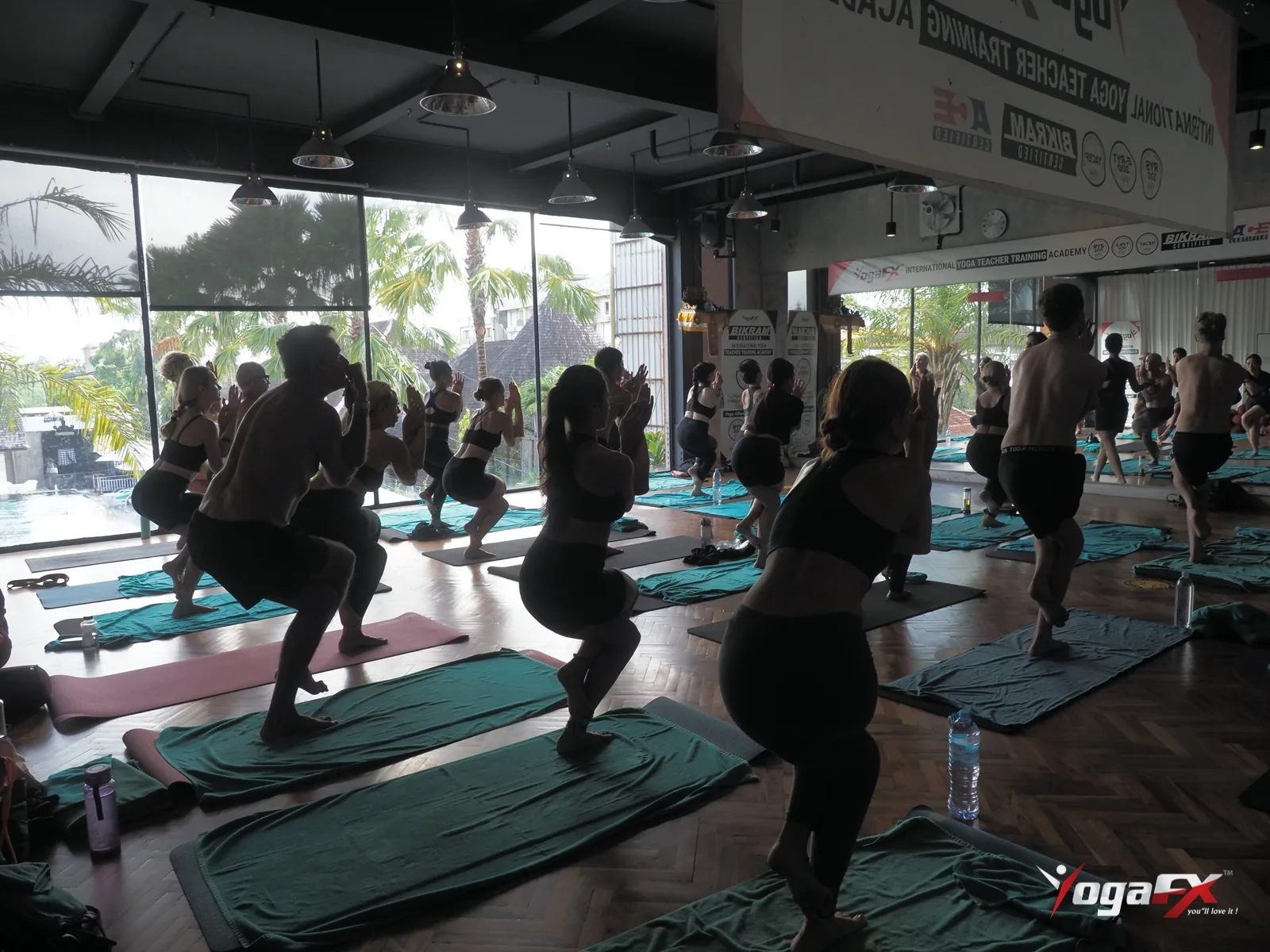
Our teachers count it as posture 6 when the opening breathing exercise is number 1. Some lists count only the postures and call it the fifth. Either way, it arrives right after standing head to knee, so your legs are warm and your balance has already been tested once.
At YogaFX in Seminyak, Mr. Ian Terry, our Founder and Lead Instructor (E-RYT 500, with more than 12,000 teaching hours), teaches the standing bow pulling pose from the same scripted dialogue as every other posture. There is no demonstration and no music. So you listen, feel the shape and make small corrections yourself.
That setup suits a balance posture. Nobody in front of you can lend you their steadiness, so your attention has to come from your own standing foot. The room helps too. Our class runs for 90 minutes at about 40 degrees C and 40% humidity, and the heat comes from Bali’s tropical climate, not from electric heaters.
Three things make the pose demanding at the same time:
- Balance on one straight leg. The standing leg carries your whole weight while the other leg leaves the floor.
- A kick and a reach in opposite directions. The foot goes back and up while the free arm goes forward, so your body has to hold a long, tilted line.
- Heat. It lifts your heart rate and your sense of effort sooner than a cool studio does.
Standing Bow is one of the balancing postures in the standing series. For the whole sequence, see our complete Bikram yoga guide.
How to Do the Standing Bow Pulling Pose Step by Step
Here is the shape as we cue it in the Hot 26&2 class. Move slowly and expect a wobble. Everyone has one, including teachers.
- Stand tall on one foot. Spread your toes and press the standing foot evenly into the floor.
- Straighten the standing leg. Lift your kneecap and let the thigh muscles switch on.
- Pick up the other foot. Bend that knee and take the foot from the outside with the same-side hand.
- Raise the free arm. Lift it beside your ear with the fingers pointing up and your shoulders relaxed.
- Kick back and up. Push the held foot into your hand, as if the hand were a wall. The hand holds on, and the leg does the work.
- Tip forward as the leg rises. Reach the free arm forward and keep your chest open. Fix your eyes on one spot in the mirror.
- Breathe, then release slowly. Lower the leg with control, take a breath and repeat on the other side.
If you want a second step-by-step breakdown with its own practice plan, read this seven-step guide on our sister site. It covers the same posture from a different angle.
Why the Kick Matters More Than the Pull
Beginners often yank the foot toward their head with the arm in the standing bow pulling pose. That tends to collapse the chest and twist the hips. A better picture is drawing a bow: the force comes from the push between the two sides, not from a hard pull on one of them. So think of the foot pressing into the hand, and let the hand stay quiet.
Why the Standing Knee Stays Straight
The standing leg is the base of the whole posture. In class, the cue is to keep that knee straight and press the foot down, so the thigh muscles share the load. If your knee tends to push back past straight, keep a small softness in it and tell your teacher. A comfortable base beats a rigid one.
Zone 3 and Zone 4 Effort: Why This Pose Feels Harder Than It Looks
Our heart rate zones guide explains how effort builds across a hot class. In our teaching view, the standing bow pulling pose sits in the harder middle of that range, around zones 3 and 4. That is what we see in the room, not a lab measurement, and it varies from person to person.
Several things push the effort up:
- The standing leg. Thigh and hip muscles work hard to keep one leg straight under your full weight.
- The kicking leg. Pushing the foot back and up against your own hand uses the glutes and the back of the thigh.
- The long tilted line. Your back muscles hold the torso forward while your eyes stay still.
- Concentration. Holding a steady gaze while your leg shakes is tiring in its own way.
That is why a short hold of the standing bow pulling pose can feel long. A pose that looks calm from the outside can still leave you breathing hard.
Heat adds to the load. The US Centers for Disease Control and Prevention lists muscle cramping, unusually heavy sweating, shortness of breath, dizziness, headaches, weakness and nausea as signs that your body is too hot. You can read the full list on its heat and your health page. Dizziness matters most here, because you are balancing on one leg. If it starts, lower the foot, stand tall and rest.
If you are new to Bali, give your body time to adjust. Our guide to heat acclimatization for hot yoga walks through the first three weeks.
Five Beginner Versions of the Standing Bow Pulling Pose
You do not need the full standing bow pulling pose on day one. A smaller, steadier version beats a deep one that you cannot hold. Work through the versions below in order, and stay with each one for a few classes.
| Version | What you do | Who it suits | What to listen for |
|---|---|---|---|
| 1. Hold and tip a little | Hold the foot, kick gently and keep your torso nearly upright | Your first class in the heat | Standing leg first, then the kick |
| 2. Soft standing knee | Keep a tiny bend in the standing leg while you balance | Tight hamstrings or a knee that pushes back | Press the foot down and stay steady |
| 3. Half reach | Reach the free arm halfway forward and keep your eyes level | When the forward tilt makes you wobble | Eyes on one spot, breath slow |
| 4. Longer tilt | Tip further forward and kick the foot higher | After a few weeks of regular classes | Kick into the hand, not pull |
| 5. Rest and reset | Lower the foot, stand tall and breathe | Dizziness, cramping or a shaky knee | Sit out the rest of the pose, rejoin next side |
Many first-timers rush from version 1 to version 4 because the photos look impressive. Resist that. In our experience, students who stay with the simpler versions for a few classes build a steadier base and enjoy the pose more.
Five Cues That Help in the Standing Bow Pulling Pose
Holding the standing bow pulling pose and describing it are different skills. If you ever think about teaching, notice which words help you in class. Short, clear cues work best, and these five come up again and again in our Seminyak room.
- “Lock the standing leg.” It reminds you to straighten the knee and press the foot into the floor before you do anything else.
- “Kick, don’t pull.” It sends your effort into the back leg, not into a tug on the foot.
- “Reach forward first.” It lengthens the spine before you tip, so your chest stays open.
- “Eyes on one spot.” It gives the mind a job, so your body can balance.
- “Breathe slowly.” It calms the tension that builds in a long hold.
Notice that no cue asks for more strain. Each one asks for more attention. A steady stream of words keeps your mind busy with listening, so it stops rehearsing the fall.
Three Common Wobbles and Quick Fixes
- Hips twist open. Square them toward the mirror and shorten the kick a little.
- Chest collapses. Reach forward before you tip, and keep your breastbone lifting.
- The standing foot grips and slides. Wipe your foot and hands on your towel, then spread the toes and press down.
Standing bow pulling pose at a glance in a Seminyak hot class
What Research and Safety Guidance Say About Balancing in the Heat
Research on this one posture is thin, so we lean on guidance for yoga as a whole.
The National Center for Complementary and Integrative Health, part of the US National Institutes of Health, says yoga is generally considered safe for healthy people when it is performed properly, under the guidance of a qualified instructor. It adds that the most common injuries are sprains and strains, and that serious injuries are rare.
The same NCCIH yoga effectiveness and safety page carries three warnings that matter for this pose. First, hot yoga has special risks related to overheating and dehydration. Second, people with balance issues or existing injuries may need to modify poses. Third, pregnant people should avoid hot yoga because it can cause overheating.
On balance itself, the NCCIH page cites a 2014 review in which 11 of 15 studies, covering 688 participants, showed improvement in at least one outcome related to balance. That is a finding about yoga practice in general, not about the standing bow pulling pose, and it does not promise a result for you.
A 2013 study by Tracy and Hart also looked at strength, flexibility and body composition in Bikram practice. We are naming it without a link, because the page would not open for us when we checked.
None of this is medical advice, and results vary. Please speak to a healthcare professional before you start a hot yoga routine if you have heart, blood pressure, knee, hip, balance or back concerns.
From Class Balance to the Competition Stage
Balance postures such as the standing bow pulling pose have another life outside the hot room. Our guide to competitive yoga, explained by a yogasana champion lists steadiness on one leg with a steady gaze as what matters in postures such as this one. The standing bow pulling pose appears in that guide alongside eagle pose.
The pose also appears in our yoga championship story, which mentions a student who was still fighting with Dandayamana-Dhanurasana early in her training. That detail rings true. Almost everyone fights with this pose at first.
Planning Your First Standing Bow Pulling Pose During a Bali Stay
Many readers searching for the standing bow pulling pose find us while planning a trip, and many others live nearby. The plan differs a little for each group, but the goal is the same: arrive rested, hydrated and ready to be a beginner.
- Visitors. If you are in Bali for a week or two, book your first class early in the stay, so the heat feels familiar by the end of the trip.
- Residents and expats. A steady weekly rhythm teaches more than an occasional heroic class. Ask at the front desk about memberships once you have tried a class.
- Returning after a break. Start with version 1 or 2 from the table above and rebuild your balance before you chase the longer tilt.
Our classes run at the Seminyak studio, and a second studio in Canggu is coming soon. If this is your first hot class, our hot yoga for beginners guide covers what to bring and what to expect. You can also see where this pose sits among the others in our guide to all 26 postures in order.
What Our Students Say About the Hot Room
The standing bow pulling pose is famous for making people laugh, groan and keep going. These YogaFX students describe what the room and the team feel like.
“Awesome training experience. Ian and his team are great and the event was really well organised.”
Chris, Google review, 2024
“The teacher training experience really helped me become more confident.”
Yayuk, Google review, 2024 (translated)
“I meet many friends and very much enjoy the training.”
Prana, Google review, 2019
Chris, Yayuk and Prana wrote about teacher training, but the same warmth shows up in our regular classes, where nobody expects a perfect balance.
Try the Standing Bow Pulling Pose at YogaFX Seminyak
The best way to understand the standing bow pulling pose is to stand in it, in the heat it was built for. Our studio is at Jl. Pangkungsari Gg Jepun No.888, Kuta Utara, Seminyak, Badung, Bali 80361, and it is open from 06:00 to 22:00 every day. Every class lasts 90 minutes and follows the scripted dialogue.
Mr. Ian Terry trained for five years, from 2014 to 2019, with the founder of the Bikram Hot 26&2 method. That background shapes how we cue a balance like this one, with the standing leg first and the breath second. We teach what we call Original Hot 26&2 Yoga, and we teach it the same way every day.
Ready to try it? Claim our Free 1-Day Guest Pass, where the first class is free. Tell the teacher it is your first time, and ask for a reminder to kick into your hand instead of pulling.
FAQ
What is the standing bow pulling pose in yoga?
The standing bow pulling pose is a one-legged balance. You hold one foot behind you, kick it back and up, and reach the other arm forward while the standing leg stays straight. In our Hot 26 and 2 class it is posture 6, counting the opening breathing exercise as number 1.
What is the Sanskrit name for the standing bow pulling pose?
The Sanskrit name is Dandayamana-Dhanurasana. Dandayamana means standing, dhanu means bow and asana means pose. Some studios call it standing bow pose. In the Hot 26 and 2 class, it is the posture that follows standing head to knee, and it is taught from a scripted dialogue.
Is the standing bow pulling pose the same as dancer pose?
They share a shape. In both, you hold the back foot and reach the other arm forward. The class version stresses a straight standing leg, a strong kick into the hand and a forward tilt. Dancer pose is often taught with a more upright chest. Teachers and studios differ, so follow your own teacher.
How do beginners modify the standing bow pulling pose?
Keep your torso nearly upright and kick gently. Keep a tiny softness in the standing knee if it pushes back past straight. Reach the free arm halfway and fix your eyes on one spot. If you feel dizzy, lower the foot and rest. Ask your doctor first if you have joint or balance concerns.
What are the benefits of the standing bow pulling pose?
The pose is mainly a balance and focus practice, and it asks your legs, hips and back to work hard. Research on this single posture is limited, so treat it as practice, not treatment. Speak to a healthcare professional about any medical concern before you start hot yoga.
Still have questions? Message Mr. Ian and the YogaFX team on WhatsApp and we will answer them personally.
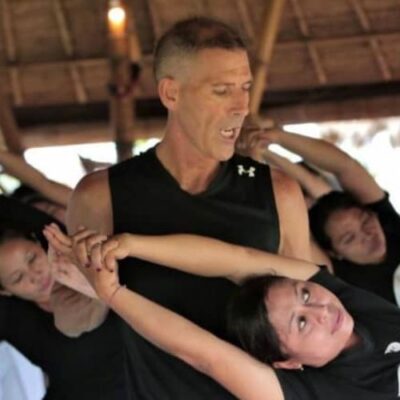 Mr. Ian Terry