
Hot vinyasa vs Bikram comes down to one question: do you want a class that changes, or one that never does? Hot vinyasa is a flow your teacher builds fresh every time. Bikram, taught at YogaFX as Original Hot 26&2 Yoga, is the same 26 postures and 2 breathing exercises for 90 minutes, every class.

If you have read the forum threads, you have seen both sides argue it out. One side says flow is harder because it moves more. The other says only the fixed class lets you measure progress. Both have a point, so this guide sorts out which claims hold up. It is written for men choosing between the two in Bali, but the logic works anywhere.
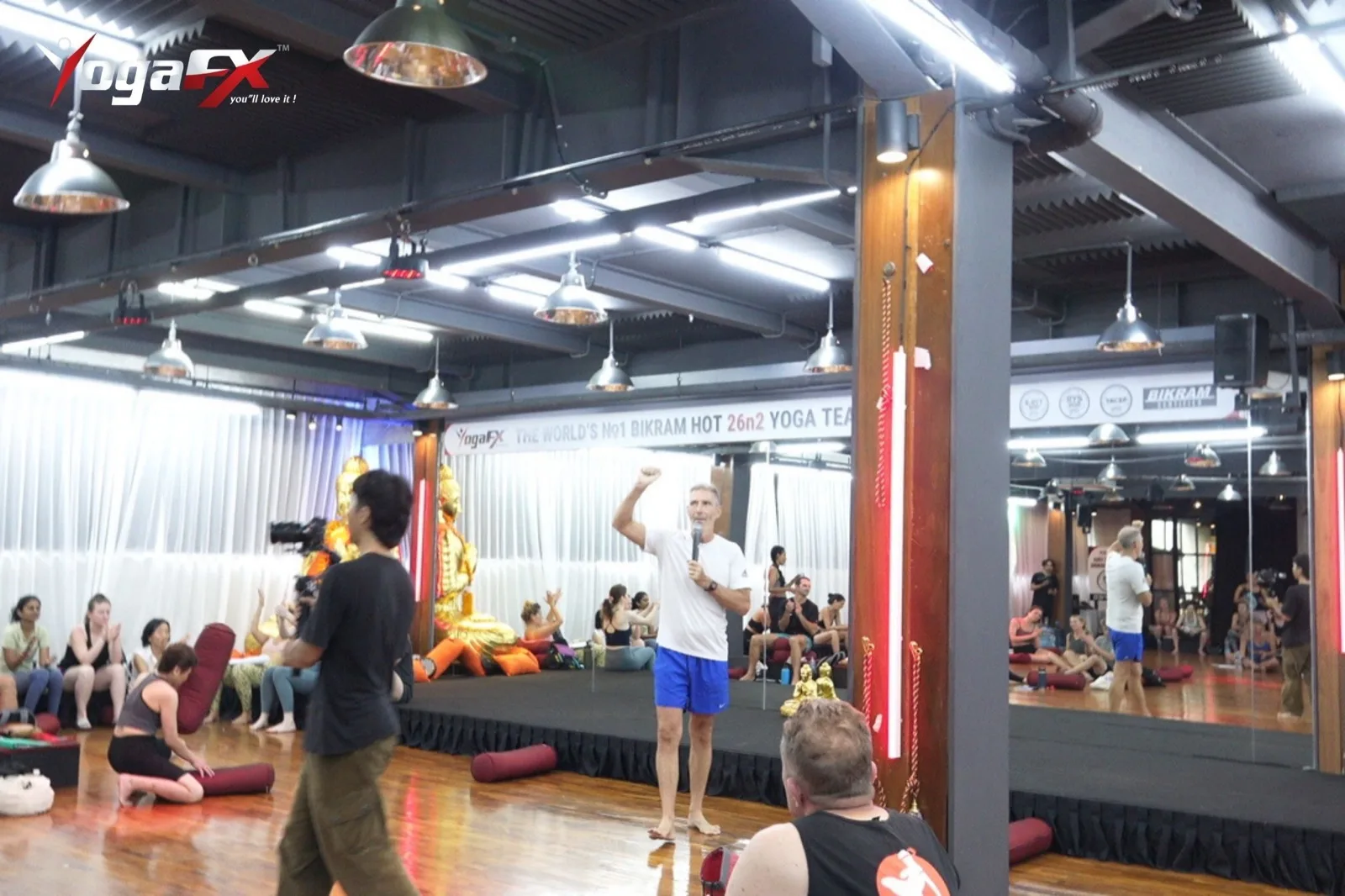
Mr. Ian Terry, E-RYT 500, has taught more than 12,000 hours and trained for five years, from 2014 to 2019, with the founder of the method. That is why our Seminyak and Canggu studios teach the 26&2. We will still be fair to flow, because good teachers run it too.
Hot Vinyasa vs Bikram: Flow Versus Fixed in Plain Words
Both classes happen in a warm room, and both make you sweat. After that, they split. A hot vinyasa teacher links postures to the breath and builds a new sequence for each class. So many add a playlist. The studio sets the room temperature, so it varies from place to place.
A 26&2 class works the other way round. The teacher follows a scripted dialogue. There is no music and no demonstration. The room sits at 40°C and 40% humidity, and the order of postures never changes.
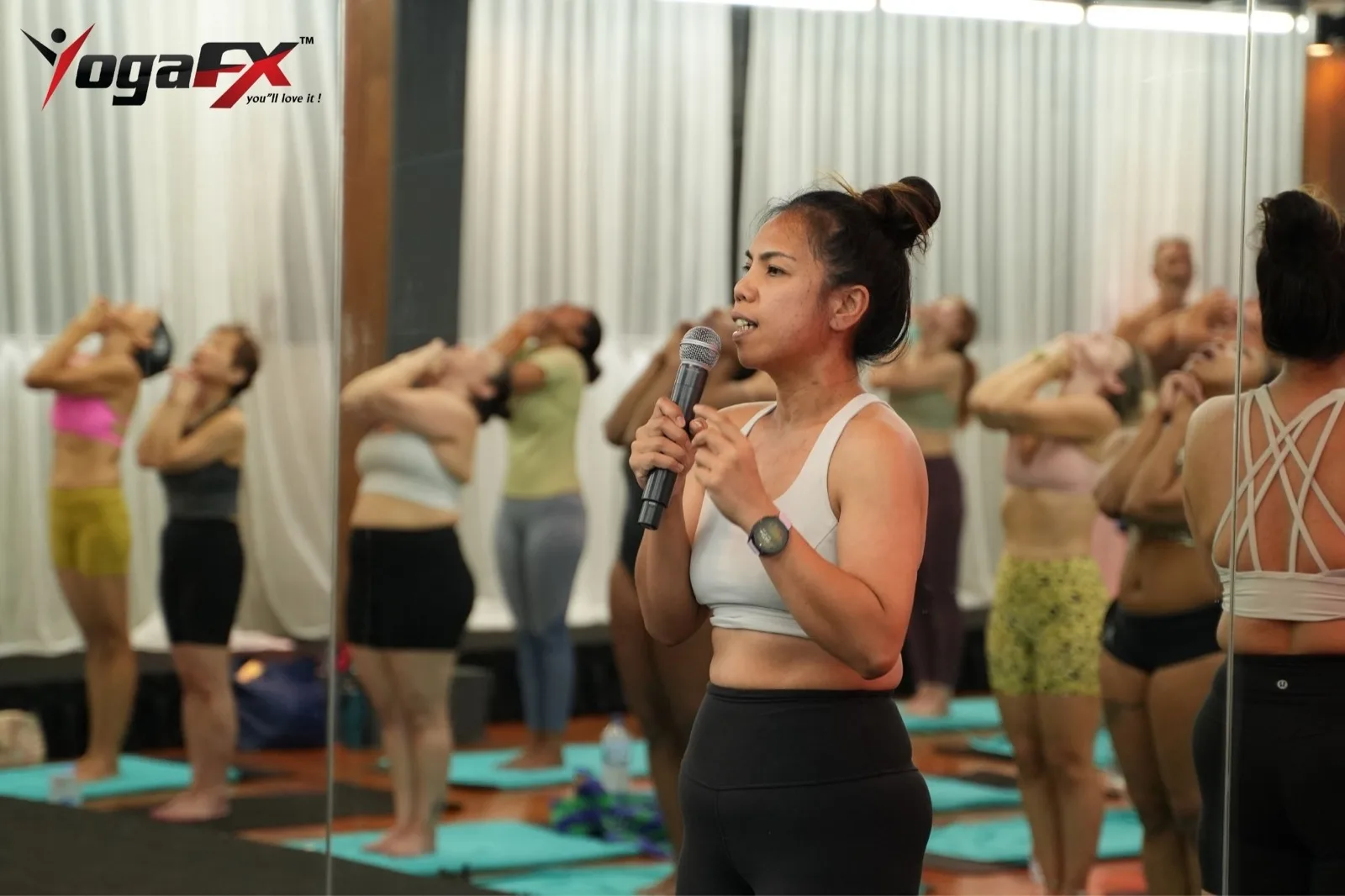
So the real difference is not the heat. It is whether the class reflects the teacher’s choices on the day or a repeatable standard. In the hot vinyasa vs Bikram debate, that is the whole story, and here’s how it plays out when you pick a class.
Choose hot vinyasa if you want:
- Variety. Every class is new, so boredom is rare.
- Music and pace. A playlist and a steady flow suit people who like to keep moving.
- More upper-body work. Flow classes often repeat plank and push-up style transitions.
Choose the 26&2 if you want:
- A benchmark. The same postures in the same order let you compare this week with last month.
- Spoken guidance. The teacher talks you through every posture, so you never need to copy a demo.
- Fewer decisions. You show up, follow the voice, and leave.
Neither side of the hot vinyasa vs Bikram question is better in every way. They train you differently, because one changes and the other does not.
What the Forum Threads Get Right and Wrong
Search hot vinyasa vs Bikram and you’ll land on threads where the same three claims keep coming back. Here’s how each one holds up.
“Bikram is just hot yoga with a script”
Half right. The script is real, so it matters. Hot yoga is an umbrella term for any yoga in a heated room, including flow, power and sculpt classes. The 26&2 is one specific method inside that umbrella, with a fixed sequence, a fixed room and a fixed dialogue. Our guide to Bikram yoga vs hot yoga walks through the split.
“Hot vinyasa is harder because it moves more”
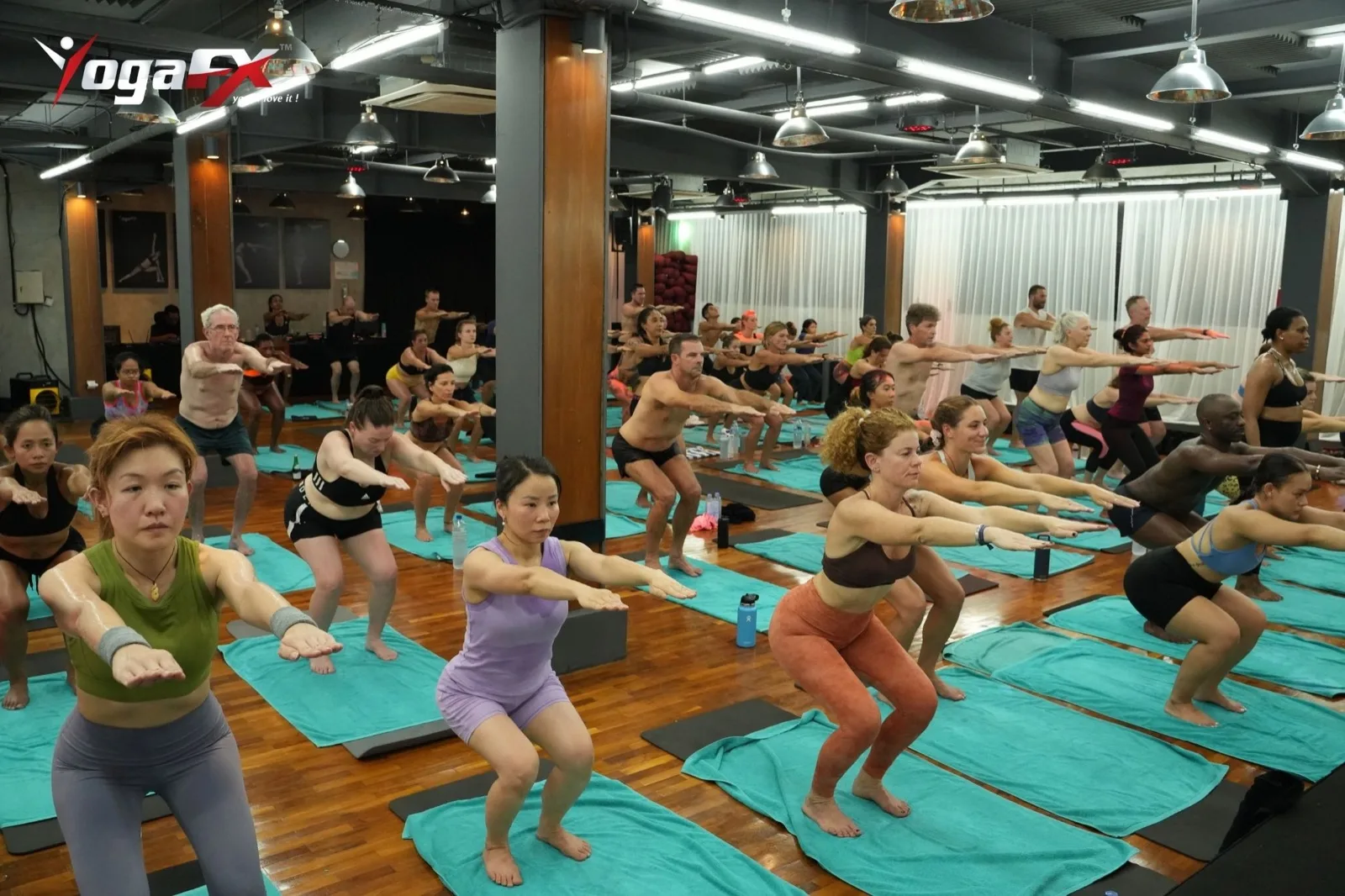
Not always, because movement and effort are different things. For instance, a flow class can feel fast and still ask little of your legs. A 26&2 class looks still, yet it asks you to hold Awkward Pose, Standing Bow Pulling Pose and Eagle Pose in the heat. In flow, the difficulty depends on the teacher. In the 26&2, it depends on you.
“The 26&2 is too slow for me”
Fair concern, especially for men who train hard elsewhere. The postures are held, not flowed through, so the pace feels different. However, holding a posture in 40°C heat is its own kind of work, and many men are surprised by how demanding it is. For a plain-spoken first-class guide, read hot yoga for beginners in Bali.
Hot Vinyasa vs Bikram, Decision by Decision
This table puts the two formats side by side on the choices that matter once you’re standing in the room. It answers the hot vinyasa vs Bikram question one decision at a time.
| Decision | Hot vinyasa | Original Hot 26&2 at YogaFX | What it means for you |
|---|---|---|---|
| Sequence | New flow each class, built by the teacher | 26 postures and 2 breathing exercises, same order | Flow rewards variety. The 26&2 rewards repetition. |
| Room | Set by each studio, so it varies | 40°C and 40% humidity | Ask a flow studio for its temperature before you book. |
| Teaching style | Demonstration, cues, often music | Scripted dialogue, no demonstration, no music | Spoken guidance suits beginners who dislike copying. |
| Heat source | Varies by studio | Natural tropical heat in our Bali studios | Our heat comes from Bali’s climate, not electric heaters. |
| Class length | Set by the studio | 90 minutes | The 26&2 is a bigger block of time, so plan around it. |
| Tracking progress | Hard, because the class changes | Simple, because the class repeats | A fixed class gives you a clear benchmark. |
Notice how often the left column says “varies”. That isn’t a criticism. It’s simply how flow works, because every studio and every teacher makes different choices.
How Hot Is Hot Vinyasa, and How Hot Is the 26&2?
Ask ten hot vinyasa studios for their room temperature and you may get ten answers. There is no single standard for flow. For example, one studio runs a gently warm room. Another aims for something close to a 26&2 room. So the label “hot” tells you very little.
The 26&2 removes the guesswork. The target is 40°C and 40% humidity, and it does not move. In our Bali studios, the heat is natural tropical heat, not electric heaters. Our guide to Bali natural heat yoga explains how that feels in practice.
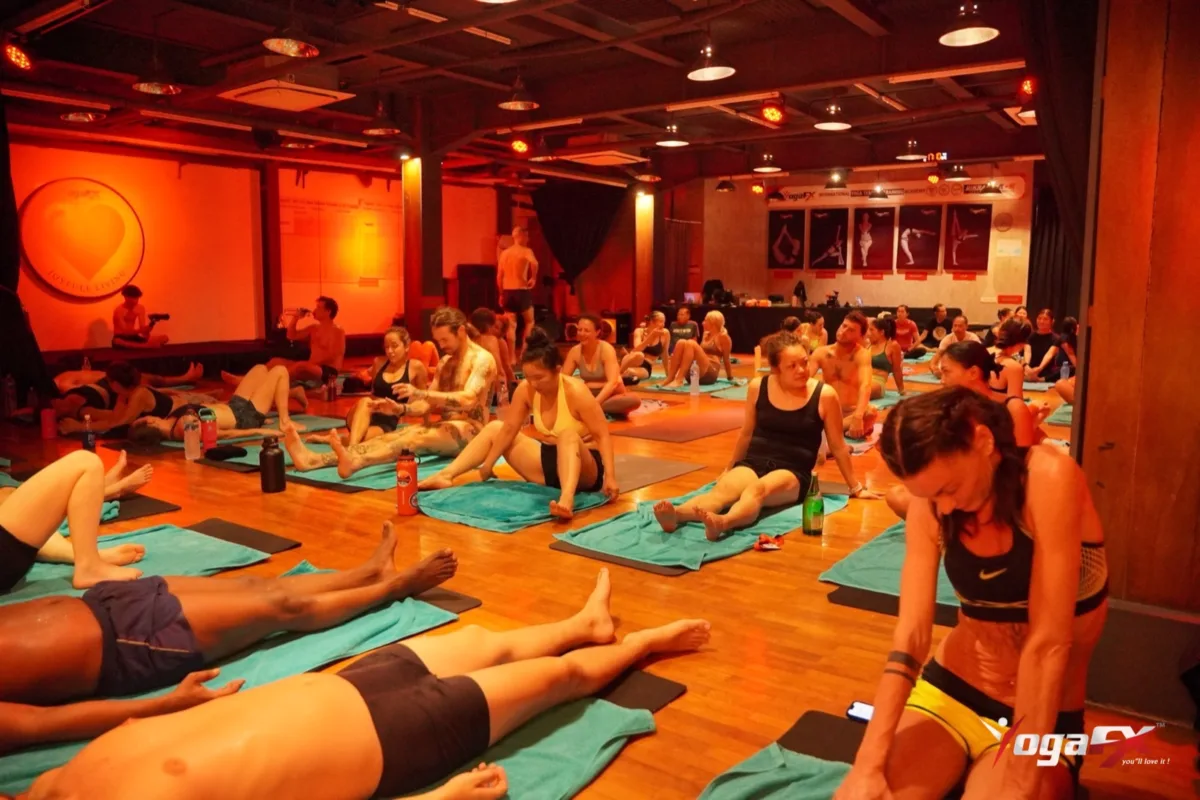
Why does that matter for your choice? Because a stable room makes it easier to compare how you feel from one class to the next. Change the temperature, and you no longer know whether the class got easier or the room got cooler.
Before any heated class
- Drink water through the day, not only before class.
- Eat light before you go.
- Bring a towel and a water bottle.
- Rest on your towel whenever you need to, because nobody is keeping score.
The Same Class Every Time: What Never Changes
Repeatability is the quiet advantage of the 26&2. For example, these parts stay fixed, whichever teacher you get.

That is why a student can check progress posture by posture. You can watch your forward bend deepen over a season, because the class around it stays still.
What the Research Says About Hot Vinyasa vs Bikram
Here is the honest picture. The studies below looked at the fixed Bikram class, not flow. None of them settles hot vinyasa vs Bikram head to head, so nobody can fairly say one wins on health.
Calories and heart rate
A 2014 University of Wisconsin study (Porcari and colleagues) measured a 90-minute Bikram class. Women burned about 333 calories and men about 460, with heart rate near 80% of maximum. That is a solid workout, so don’t write it off. We have no trusted measurement for hot vinyasa to set beside it, so we will not guess.
Strength and flexibility
In 2013, Tracy and Hart studied a Bikram programme and reported gains in flexibility, body composition and about a 20% increase in posterior chain strength. That fits what the postures ask for, since Locust Pose and Bow Pose load the back of the body.
Mood
At Massachusetts General Hospital, a randomized trial gave adults with moderate to severe depression eight weeks of 90-minute Bikram classes in a 105°F room. In the Harvard Gazette’s report on the trial, 59% of the yoga group had a symptom drop of 50% or more, against 6.3% of the waitlist group. The trial appeared in the Journal of Clinical Psychiatry.
The wider review
A 2025 systematic review by Willmott and colleagues pooled 43 studies and 942 participants. It points to benefits for flexibility and well-being. So read it as encouraging, not final.
Yoga can support care, but it does not replace it. Please consult a healthcare professional before using hot yoga for any health condition. Heat adds risk, so talk to your doctor first if you are pregnant or have a heart condition.
Hot Yoga vs Hot Power Yoga and Hot Yoga Sculpt
Hot yoga is an umbrella, and hot vinyasa is only one branch. When people compare hot yoga vs hot power yoga, they usually mean a fixed 26&2 class against a faster, strength-led flow. Hot power yoga takes the vinyasa idea and turns up the pace, so you get more lunges, planks and chair holds.
Is hot power yoga a good workout? For muscular endurance and a raised heart rate, it can be. It’s still a flow class, though, so the workload changes with the teacher. That makes it hard to know whether you improved or simply had an easier week.
Hot yoga sculpt goes one step further. It adds light hand weights and short cardio bursts to a heated flow. Think of it as a yoga class crossed with a circuit session. It suits gym-goers who want conditioning, although it sits furthest from traditional yoga.
The hot 26 vs hot flow question then becomes simple. If you want to measure the same class over months, choose the 26&2. If you want a changing session, choose a flow, power or sculpt class instead.
Hot Vinyasa vs Bikram: Which Man Should Pick Which Class?
The answer depends on who is asking. So here’s how we’d steer four common cases.
- The desk worker with tight hips. Start with the 26&2, because held postures and spoken guidance suit someone stiff and new, and the repeat class shows progress.
- The surfer or lifter who hates standing still. Try hot vinyasa for movement, and then add one 26&2 class a week as a mobility benchmark.
- The man over 40 coming back after a break. Start with the fixed class and the voice that guides you, and go only as far as your own range allows.
- The traveller with ten days. Take the free guest pass and see whether Seminyak or Canggu fits your route.
Five Mistakes When Moving From Flow to the 26&2
Plenty of men arrive from flow classes. Because the habits differ, these are the slips we see most often.
- Waiting for the demo. The teacher will not demonstrate. Listen to the dialogue instead.
- Chasing depth too early. Work to your own range, not the range of the person beside you.
- Skipping water. Drink before class and sip between postures.
- Leaving the room. Rest on your towel when you need to, and stay in the room.
- Judging after one class. The first class is mostly about learning the order, so the second is where it starts to settle.
Why Our Bali Studios Teach the 26&2
In the hot vinyasa vs Bikram choice, we’ve made ours. At YogaFX, we teach the Original Hot 26&2 in Seminyak and Canggu. Our studio hours run from 06:00 to 22:00 every day, so a fixed class fits around work, surf and travel. The script is the same at both studios.

Mr. Ian Terry, E-RYT 500, sets our teaching standard. He is a Master Trainer of the Republic of Indonesia Yogasana Sports Federation, and he has taught over 12,000 hours. When he says the dialogue matters, he speaks from five years of training with the method’s founder.
If you want the room-temperature version of this comparison, our Bali guide to Bikram yoga vs vinyasa covers it. For a longer, research-led take, see our sister site’s comparison of Bikram and vinyasa yoga.
What Students Say About the Teaching
None of these three reviewers were comparing formats. Still, what they describe is what a scripted class depends on: a teacher who stays with you.
Loved the journey we went on together. Ian helped us internally grow and look at ourselves. He built a beautiful community. Forever grateful.
Siobhan, Google review, 2025
Your passion for educating all students is extraordinary.
Elvia, Google review, 2023
Mr Ian Terry is truly exceptional. His expertise, passion, and dedication to the practice of Bikram yoga are evident in every class.
Septa, Google review, 2024
These come from our Google reviews, where we hold 150 reviews from students.
How to Try Both Without Wasting a Month
You don’t have to pick a side today. Hot vinyasa vs Bikram is easier to settle with a two-week test than with any thread.
- Week one, three 26&2 classes. Book them on non-consecutive days and note how you feel afterwards.
- Week one, one flow class. Choose a hot vinyasa class at another studio and note the room temperature.
- Week two, repeat the 26&2. See whether the same posture feels different the second time.
- Decide by what you would do again. The class you keep booking is the right one.
Your first 26&2 class with us is free. Claim a free 1 day guest pass and we will book you into Seminyak or Canggu.
FAQ
Is Bikram vinyasa?
No. Bikram is a fixed sequence of 26 postures and 2 breathing exercises, taught through a scripted dialogue for 90 minutes. Vinyasa links postures to the breath in a flow that changes each class. Some studios blend the names, so ask whether the class follows the 26&2 order before you book.
Is hot vinyasa yoga for beginners?
It can be, if the studio labels the class as beginner friendly. Even so, changing sequences and quick transitions are harder to follow when you are new. Many beginners find the 26&2 easier to start, because the teacher talks you through each posture and the order never changes.
What is the difference between hot vinyasa and hot 26?
Hot vinyasa is a flow the teacher builds fresh each class, often with music, in a room set by the studio. Hot 26, or Original Hot 26&2, is a fixed 90-minute class at 40°C with 26 postures and 2 breathing exercises, guided by a script.
Is hot vinyasa a good workout?
It can be. Flow classes keep you moving and can raise your heart rate, but the workload depends on the teacher. Because every class is different, progress is harder to track. A fixed 26&2 class gives you a steady benchmark to compare against.
Does hot vinyasa burn more calories than Bikram?
We cannot say. A 2014 University of Wisconsin study measured about 333 calories for women and 460 for men in a 90-minute Bikram class. We have no trusted measurement for hot vinyasa to compare, so any figure you see for flow is an estimate.
Still have questions? Message Mr. Ian and the YogaFX team on WhatsApp and we will answer them personally.
 Mr. Ian Terry