Hot yoga in Bali is not the same as hot yoga anywhere else. That is not marketing — it is physiology. Every hot yoga studio outside of a tropical country uses electric heaters to simulate the 40°C environment the practice requires. In Bali, that heat is already here, naturally, year-round, in exactly the humid form the method was designed for.
This guide covers everything a tourist or expat needs to know about practicing hot yoga in Bali: what it is, what the science says, why the natural heat matters, which studios in Seminyak and Canggu practice it authentically, and exactly what to expect in your first class.
Hot yoga in Bali is a 60 or 90-minute yoga practice conducted in the island’s natural tropical heat — approximately 40°C with high humidity — following the original Bikram 26&2 sequence of 26 postures and 2 breathing exercises. Unlike electrically heated studios worldwide, Bali’s natural climate provides the humid tropical environment Bikram yoga was specifically designed for. Bikram YogaFX Bali operates the only dedicated 26&2 studios in Seminyak and Canggu with zero electric heaters.
What Is Hot Yoga? Definition and Origins
Hot yoga is any yoga practice performed in a heated environment — typically a room at 35°C to 42°C (95°F to 108°F). The category includes several distinct formats, but the original and most studied is Bikram yoga: a fixed sequence of 26 postures and 2 breathing exercises developed by Bikram Choudhury and designed to be practiced in a room that replicates tropical heat and humidity.
Bikram Choudhury developed the method in the 1970s, drawing on traditional Hatha yoga postures and his experience practicing in the natural heat of Calcutta, India. The 26-posture sequence was designed to systematically work every major muscle group, joint, and organ system in the body — a complete physiological workout in a single 90-minute session. Discover the full benefits of practicing in natural heat.
The term ‘hot yoga’ has since expanded to include heated Vinyasa flows, hot Pilates, hot Barre, and other formats that use artificial heat as an add-on to existing styles. These differ from Bikram yoga in a critical way: the heat is incidental rather than foundational. In Bikram yoga, the heat is part of the methodology — it enables the specific physiological outcomes the 26&2 sequence was designed to produce.
| Format | Heat Source | Sequence |
|---|---|---|
| Bikram 26&2 (authentic) | Natural tropical heat or precise 40°C/40% humidity | Fixed — 26 postures, same order every class |
| Hot Vinyasa | Electric heaters | Variable — changes every class |
| Hot Pilates | Electric heaters | Pilates-based, not yoga sequence |
| Hot Barre | Electric heaters | Ballet-influenced, not yoga |
| Infrared yoga | Infrared panels (dry heat) | Variable — not Bikram specific |
Why Bali Is the World’s Best Place to Practice Hot Yoga
Bali’s geographic and climatic position makes it uniquely suited to authentic hot yoga practice — not by coincidence, but by the exact conditions the method was designed around.
The Climate Matches the Original Method
Bikram yoga was designed for tropical heat: 40°C (105°F) with approximately 40% relative humidity. This is the climate of Calcutta in summer — and it is remarkably close to Bali’s year-round ambient conditions. Bali’s southern coast maintains temperatures between 27°C and 33°C with relative humidity consistently above 70%.
When a studio like Bikram YogaFX Bali dispenses with electric heaters and uses the island’s natural heat, the practice environment is not a simulation of the original conditions — it is the original conditions. This is a distinction that matters physiologically, not just philosophically.
Natural Humid Heat vs Electric Dry Heat
The physiological difference between humid tropical heat and electric dry heat is significant. Electric heaters — panel heaters, infrared panels, or forced-air systems — produce dry heat. Relative humidity in an electrically heated yoga room typically drops to 20–30% as the air warms.
Dry heat causes rapid surface moisture loss, which can trigger early dehydration and fatigue before the muscles are adequately warm. The body’s cooling mechanism — sweating — becomes less effective because sweat evaporates too quickly in dry air rather than contributing to sustained temperature regulation. Explore all yoga options in Bali.
Humid tropical heat allows the body to sweat continuously and regulate core temperature progressively, which is what the Bikram sequence is designed to use. The muscles warm more evenly, joints become more mobile, and cardiovascular demand is sustained rather than spiked. The result is a physiologically more complete practice — and a more comfortable one, particularly for first-timers.
The Science of Hot Yoga: What Research Actually Shows
Bikram yoga has been the subject of more peer-reviewed research than any other hot yoga format. Three studies are particularly relevant to practitioners considering hot yoga in Bali:
🔬 University of Wisconsin — Experimental Physiology (2014)
- Participants wore heart rate monitors and metabolic devices through full 90-minute Bikram classes
- Average calorie burn: 333 kcal (women, avg. 68 kg) and 460 kcal (men, avg. 82 kg)
- Active participants burned up to 600+ kcal at 85–92% maximum heart rate
- Heart rate averaged ~80% maximum across the full session — equivalent to brisk walking to moderate cycling
- Study link: pubmed.ncbi.nlm.nih.gov/24700459/
🔬 Tracy & Hart — Evidence-Based Complementary and Alternative Medicine (2013)
- 8-week Bikram yoga intervention with consistent practitioners
- Deadlift strength increased by 20% across the study group
- Standing balance improved by 9%
- Significant improvements in lower back and hamstring flexibility
- Study link: pubmed.ncbi.nlm.nih.gov/23438366/
🔬 Massachusetts General Hospital / Harvard Medical School — Journal of Clinical Psychiatry (2023)
- 80 adults with moderate-to-severe depression randomised into yoga group and waitlist group
- Yoga group practiced 90-minute Bikram hot yoga at 40°C for 8 weeks
- ~60% of yoga participants reduced depression symptoms by 50% or more
- 44% achieved full remission from depression
- Only 6.3% in the waitlist group saw comparable improvement
- Benefits observed with as little as one session per week
- Study link: pubmed.ncbi.nlm.nih.gov/37883245/
The consistency across these studies points to something Bikram practitioners have reported for decades: the combination of the fixed 26&2 sequence and the 40°C heat produces outcomes — strength, flexibility, cardiovascular fitness, mental health — that room-temperature yoga does not replicate. Bali’s natural heat makes those outcomes accessible without the artificial and physiologically inferior alternative of electric heating.
Hot Yoga in Bali by Area: Where to Practice
Hot yoga studios are concentrated in Bali’s southern coastal area — Seminyak, Canggu, and their surrounding sub-districts. The inland areas of Ubud and Uluwatu offer limited hot yoga options; their studio scenes are dominated by Ashtanga, Vinyasa, and traditional Hatha.
Hot Yoga in Seminyak
Seminyak has two primary hot yoga options: Jiwa Yoga on Jl. Petitenget and Bikram YogaFX Bali. Jiwa offers a Pilates-influenced Bikram-adjacent format in an electrically heated room. YogaFX Bali’s Seminyak studio offers the complete, original 26&2 Bikram sequence in all-natural Bali heat with no electric heaters.
For tourists staying in Seminyak’s hotel and villa corridor — from Double Six beach through Petitenget to Kerobokan — YogaFX is the accessible and authentic choice. The Free 1-Day Guest Pass removes the financial barrier for first-time visitors.
Hot Yoga in Canggu
Canggu has the largest concentration of yoga studios in southern Bali, but most hot yoga offerings in the area — hot Pilates, hot Barre, heated Vinyasa — use electric heating in purpose-built rooms. Bikram YogaFX Bali’s Canggu studio is the only studio in the area offering the original Bikram 26&2 sequence in natural tropical heat.
For digital nomads, expats, and tourists based in Canggu, Berawa, Echo Beach, or Pererenan, the YogaFX Canggu studio provides the same credentials, same method, and same natural heat as the Seminyak studio — closer to where you are.
Bikram YogaFX Bali: The Authentic Hot Yoga Studio in Seminyak and Canggu
Within Bali’s hot yoga market, Bikram YogaFX Bali is in a category of its own. It is the only studio on the island’s southern coast combining three elements that no competitor offers simultaneously: the original 26&2 Bikram sequence, all-natural Bali tropical heat with zero electric heaters, and an instructor with direct, documented Bikram Choudhury lineage spanning 5 training events between 2012 and 2019.
The Method: Original Bikram 26&2
The 26&2 sequence consists of 26 postures and 2 breathing exercises performed in a fixed order in every class. The postures are drawn from traditional Hatha yoga and selected specifically to work every major muscle group, joint, and organ system in a single session. The sequence never changes — not between classes, not between instructors, not between studios.
This consistency is the core feature of the method. Because the sequence is identical every time, each class becomes a direct measurement of progress: where you could not hold a posture last week, you hold it today. Improvements in strength, flexibility, balance, and cardiovascular fitness are visible and measurable in a way that variable-sequence yoga does not permit.
| Standing Series (Postures 1–12) | Floor Series (Postures 13–26) |
|---|---|
| Pranayama (breathing exercise) | Wind Removing Pose |
| Half Moon Pose | Sit Up |
| Awkward Pose | Cobra Pose |
| Eagle Pose | Locust Pose |
| Standing Head to Knee | Full Locust Pose |
| Standing Bow Pulling Pose | Bow Pose |
| Balancing Stick Pose | Fixed Firm Pose |
| Standing Separate Leg Stretching | Half Tortoise Pose |
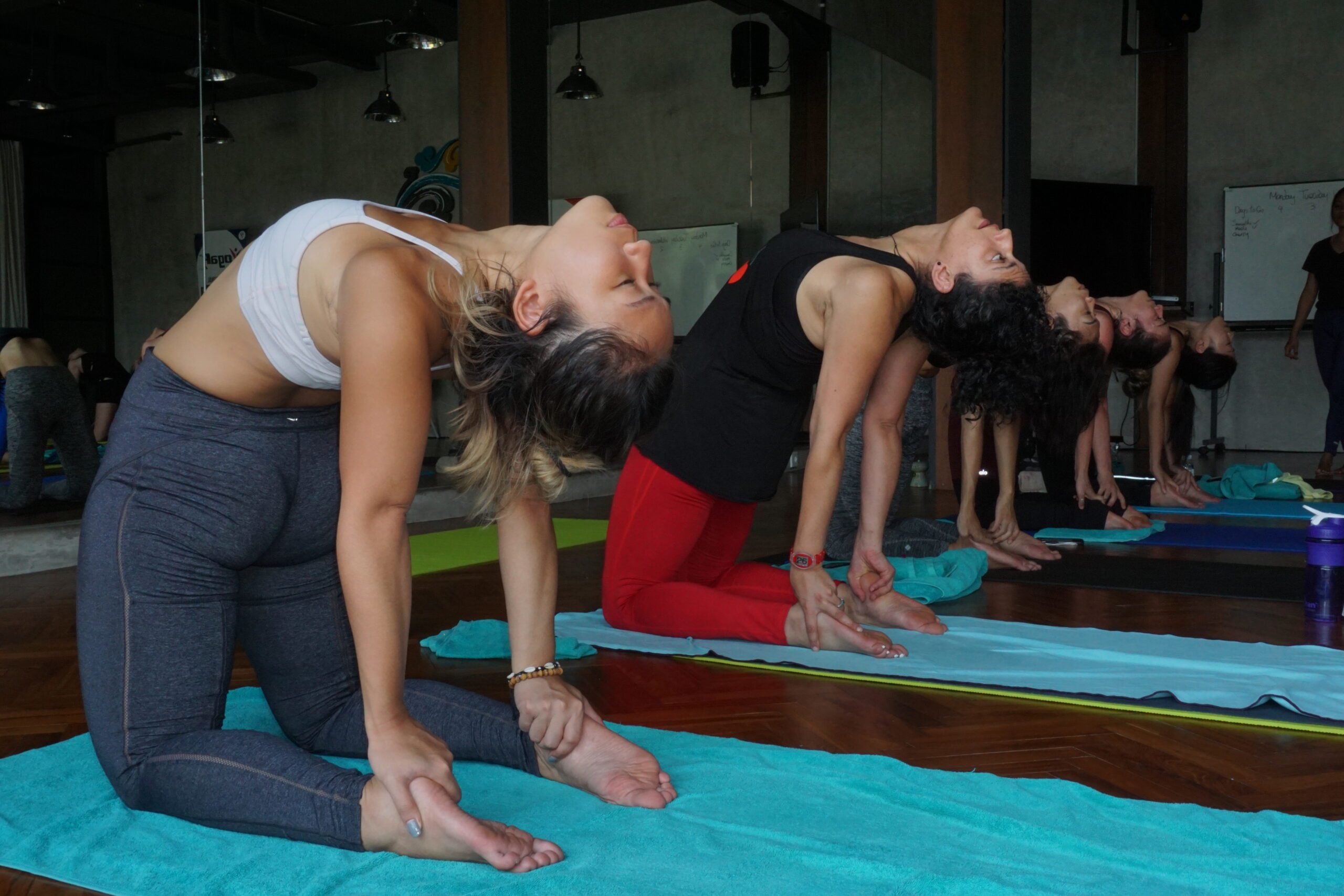
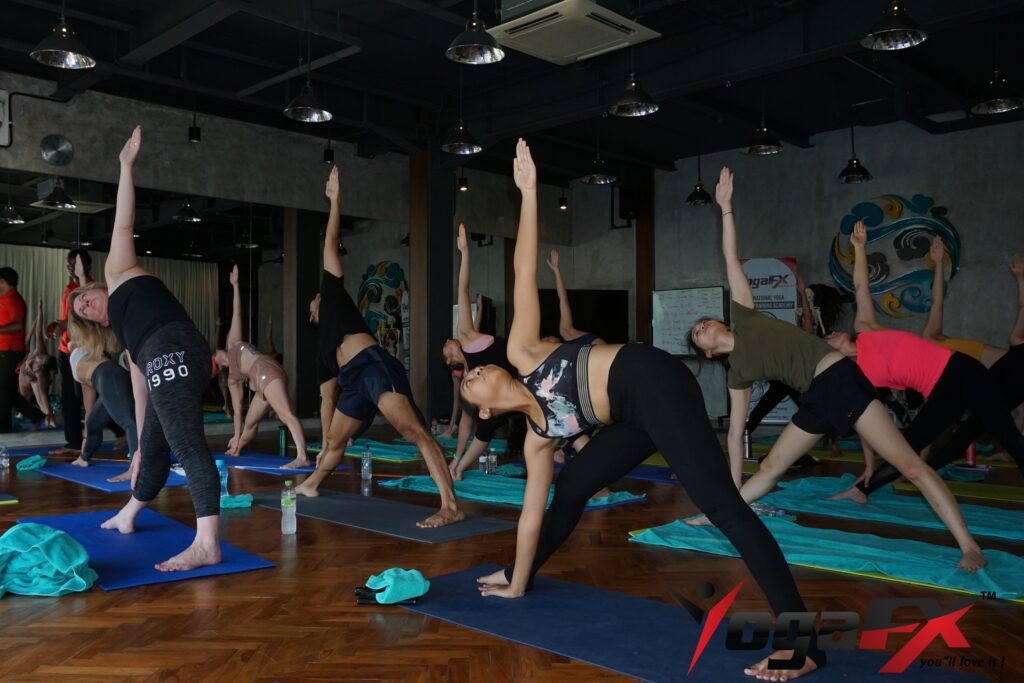
| Triangle Pose | Camel Pose |
| Standing Separate Leg Head to Knee | Rabbit Pose |
| Tree Pose + Toe Stand | Head to Knee + Stretching Pose |
| Savasana (Dead Body Pose) | Spine Twisting Pose + Blowing Kapalbhati |
The Instructor: Mr. Ian Terry
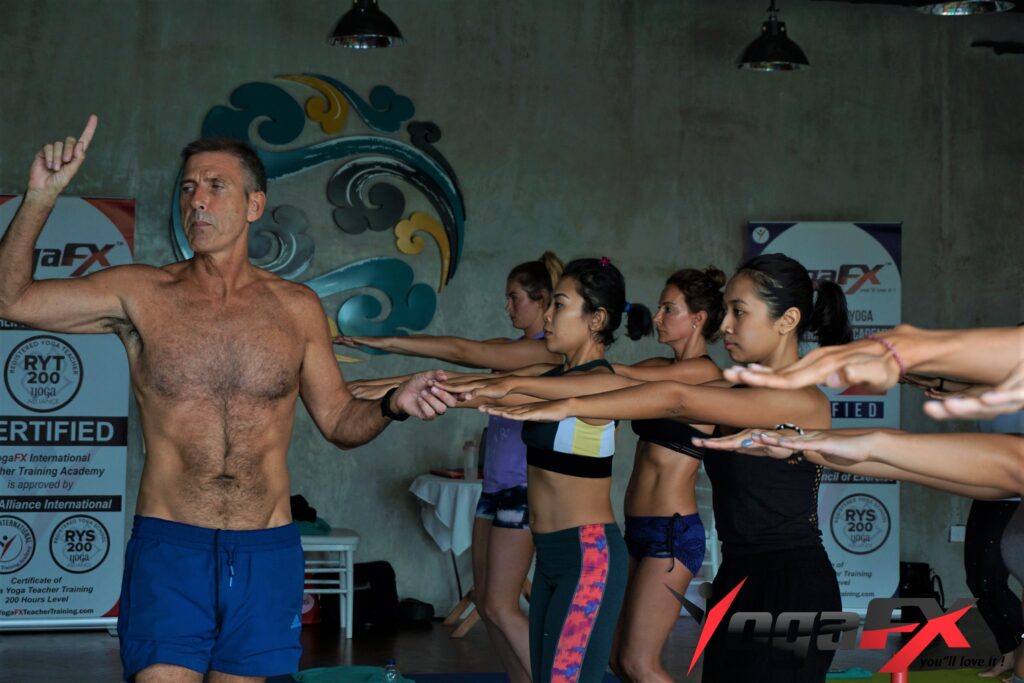
Mr. Ian Terry is the founder and lead instructor of YogaFX Bali. His credentials within the Bikram yoga discipline are among the strongest of any instructor currently practicing in Southeast Asia:
- E-RYT 500 — Yoga Alliance’s highest certification tier
- Bikram Hot Yoga Certification (YogaFX)
- 5 direct training events with Bikram Choudhury: Los Angeles 2012, Los Angeles 2015, Thailand 2016, India 2017, Beijing 2018
- 5 years as assistant teacher under Bikram Choudhury — delivering the 26&2 dialogue as originally designed
- 10,000+ hours of yoga teaching worldwide · 10,000+ hours as a master trainer
- 1,000+ students trained across multiple countries
- Featured on BaliTV and ASEAN multimedia channels
- International Day of Yoga Bali 2023 — 5,000+ participants
📍 YogaFX Bali — Complete Studio Reference
- Studios: Seminyak (founding studio) and Canggu
- Method: Original Bikram 26&2 Hot Yoga — 26 postures + 2 breathing exercises
- Heat: ALL-NATURAL Bali tropical heat — ZERO electric heaters at both studios
- Class formats: 60-minute (efficient) and 90-minute (traditional) — both available daily
- Certification: Yoga Alliance Registered Yoga School (RYS) — RYT 200 — since 2018
- Social proof: 5 stars Google (88+ reviews) · 5 stars Facebook (180+ reviews) · ~400 total 5-star reviews
- All levels: Complete beginners to advanced practitioners — no experience required
- Studio culture: Zero chanting · Zero ego · Egos and tie-dyes left firmly at the door
- First class: Free 1-Day Guest Pass — claim via WhatsApp
- YTT: Yoga Alliance RYT 200 + Bikram Certification — $1,999 USD (deposit: $349)
Your First Hot Yoga Class in Bali: What to Expect
First-time hot yoga practitioners consistently describe the same experience: the first class is challenging, the second class is noticeably easier, and by the fifth to tenth class the sequence starts to feel familiar. Understanding what to expect eliminates the uncertainty that makes many first-timers hesitant.
Before Class
Arrive at least 15 minutes early. This gives the body time to begin acclimatising to the room temperature before the class starts — one of the most effective things a first-timer can do. Bring at least 1 litre of water (essential — not optional), a yoga mat, and a large towel. Wear minimal, close-fitting clothing. Do not eat in the 2 hours before class.
Tell the instructor it is your first class. At YogaFX Bali, the team pays specific attention to first-timers and can provide guidance during the session.
During Class: The Standing Series
The first half of the Bikram sequence — the standing series — is the most cardiovascularly demanding. The body is working against gravity, building heat, and learning unfamiliar postures simultaneously. For most first-timers, the first 20–30 minutes is the most challenging point of the entire class.
The instructor delivers the entire class verbally — there is nothing to memorise. You follow the words, attempt each posture to your current ability, and use the mirror for alignment feedback. If you feel overwhelmed, sit or lie on your mat. Stay in the room.
During Class: The Floor Series
The second half of the class — the floor series — is slower and more focused on spinal strength, flexibility, and core engagement. Most practitioners find this section more manageable than the standing series. The class ends with Kapalbhati breathing and a final Savasana.
After Class
Drink water steadily after class. Avoid strenuous activity for the remainder of the day. Most practitioners experience a combination of physical fatigue and mental clarity immediately after class — the ‘Bikram glow’ that regular practitioners describe as one of the primary reasons they continue the practice. The best preparation for class two is to return within 48 hours — the body adapts quickly and the second class is significantly more comfortable.
Who Is Hot Yoga in Bali For?
The answer is broader than most people expect. The zero-chanting, all-levels, fixed-sequence format of Bikram yoga at YogaFX makes it accessible to a wider range of practitioners than many other yoga styles.
| Practitioner Type | Why Hot Yoga at YogaFX Works for Them |
|---|---|
| Complete beginner | Fixed sequence taught verbally — nothing to know in advance. Modifications for every posture. Free first class. |
| Fitness-focused tourist | Measurable calorie burn (330–600 kcal/90 min), strength and cardio conditioning in a single session. |
| Yoga practitioner from home | Authentic method in natural heat — the practice is physiologically different from home studio. Compelling for experienced yogis. |
| Expat / digital nomad | Fixed sequence = trackable weekly progress. Consistent studio = yoga home in Bali. |
| Gym-based athlete | Complementary to strength training and cardio — addresses flexibility, balance, and joint mobility that gym work neglects. |
| Practitioner with mental health focus | Harvard MGH 2019 RCT: ~60% reduction in moderate-to-severe depression symptoms after 8 weeks. |
| Serious Bikram practitioner | One of the few studios globally with authenticated Bikram lineage and natural heat environment. |
FAQ
What is hot yoga in Bali?
Hot yoga in Bali is a yoga practice performed in a heated environment — typically 40°C (105°F) with high humidity. The most established format is the original Bikram 26&2 sequence: 26 postures and 2 breathing exercises in a fixed order. In Bali, and specifically at Bikram YogaFX Bali, this practice is conducted in the island’s all-natural tropical heat without electric heaters — the only environment in which the method produces its full intended physiological effect.
Is hot yoga in Bali good for beginners?
Yes. Bikram yoga requires no prior experience. The 26&2 sequence is taught entirely through verbal instruction — the instructor talks every student through each posture. Modifications are available for all 26 postures. YogaFX Bali welcomes complete beginners at every class. The Free 1-Day Guest Pass means the first class is risk-free. The most important preparation for a beginner is hydration: drink consistently throughout the day before class and bring at least 1 litre of water into the room.
Does Bikram YogaFX Bali use electric heaters?
No. Bikram YogaFX Bali uses no electric heaters at either the Seminyak or Canggu studio. The heat in both studios is entirely natural — Bali’s own tropical climate, which provides the humid 40°C environment the Bikram method was designed for. This distinguishes YogaFX from virtually every other hot yoga studio outside of tropical countries and from most hot yoga studios in Bali that offer electrically heated formats.
Can I do yoga teacher training at YogaFX Bali?
Yes. YogaFX offers a Yoga Alliance RYT 200 teacher training programme combining an online pre-course (self-paced, 30+ hours) with a 6-day in-person intensive in Bali at D’Djabu Boutique Hotel, Seminyak (accommodation included). The programme is led by Mr. Ian Terry — E-RYT 500, 5× Bikram Choudhury training — and awards a Yoga Alliance RYT 200 certification and Bikram Hot Yoga Certification on graduation. Full programme price: $1,999 USD (deposit: $349 USD). Contact via WhatsApp for the next cohort dates.
What should I bring to hot yoga in Bali?
Bring a minimum of 1 litre of water — ideally pre-hydrate heavily throughout the day before class. Bring a yoga mat, a large towel (you will sweat substantially in natural 40°C heat), and minimal close-fitting clothing. Do not eat in the 2 hours before class. Arrive at least 15 minutes early, particularly for your first session. YogaFX provides mat hire if you do not have your own.
What is the Free 1-Day Guest Pass at YogaFX Bali?
Every first-time visitor to Bikram YogaFX Bali — at both the Seminyak and Canggu studios — can claim a Free 1-Day Guest Pass. This gives you access to any single class (60-minute or 90-minute) at no cost. To claim your pass, contact the studio via WhatsApp, confirm the class schedule, and reserve your spot. Walk-ins are welcome but advance contact is recommended to guarantee availability.