
Hot yoga is one of the most studied yoga formats in peer-reviewed research – more than any other style. The combination of the fixed Bikram 26&2 sequence and the 40°C humid heat environment has made it an unusually measurable subject for clinical research.

The benefits documented are not anecdotal; they are quantified, replicated, and published in indexed journals. If you’re comparing the class against a passive sauna session, our hot yoga vs sauna comparison covers exactly how the two differ in calorie burn and physical exertion.
This guide covers 17 specific benefits of hot yoga supported by research, with the distinction between what the heat adds, what the sequence adds, and what the combination of both delivers – particularly in the natural tropical heat of Bali, where no electric heaters are required.
If you are unsure whether “hot yoga” and “Bikram yoga” mean the same thing, our Bikram yoga vs hot yoga comparison covers exactly where the two terms overlap and where they don’t.
Hot yoga delivers 17 documented benefits including improved cardiovascular fitness, strength gains of up to 20%, accelerated flexibility, significant calorie burn (about 333–460 kcal per 90 minutes), mental health improvements with 59% of participants cutting depression symptoms by half or more after 8 weeks, versus 6% on the waitlist (Harvard 2023), improved sleep quality, improved heat tolerance, and bone density preservation. These benefits are maximised in natural tropical humid heat – the environment Bikram yoga was designed for and available year-round in Bali.
Physical Benefits of Hot Yoga
1. Significant Calorie Burn in a Single Session
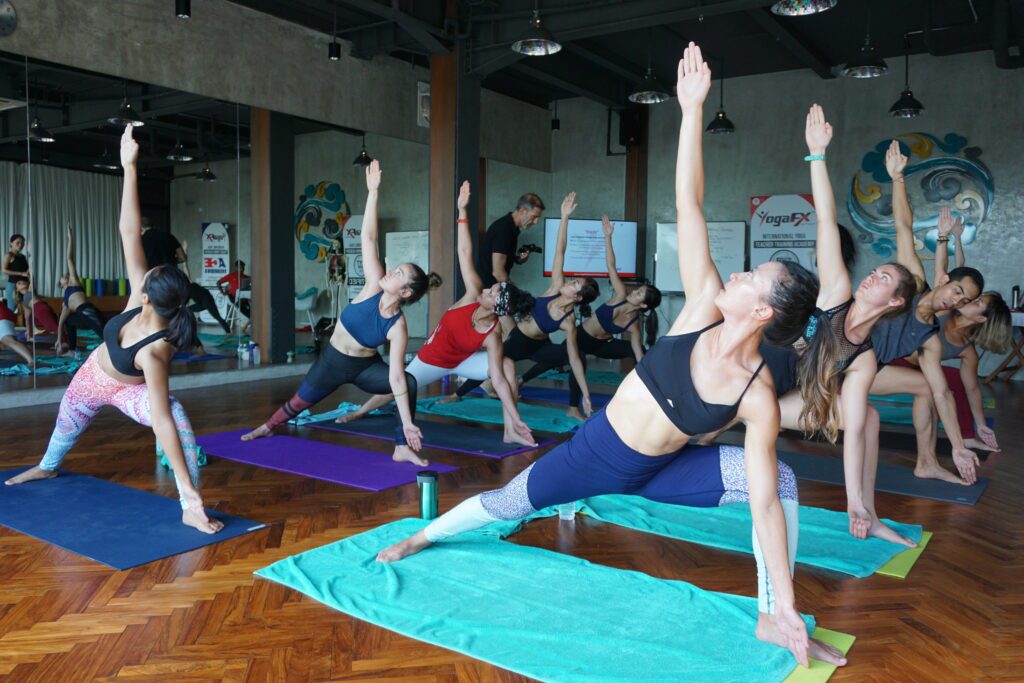
The 2014 University of Wisconsin study published in Experimental Physiology measured calorie expenditure during full 90-minute Bikram classes using portable metabolic devices. Results: 333 kcal for women (avg. 68 kg) and 460 kcal for men (avg. 82 kg), with heart rate around 80% of maximum. The heat elevates calorie burn by increasing cardiovascular demand – the body expends energy both to perform the postures and to regulate core temperature simultaneously.
2. Measurable Strength Increases
The Tracy and Hart (2013) study found a 20% increase in deadlift strength after 8 weeks of consistent Bikram yoga practice. This outcome is directly attributable to the fixed sequence – because the same postures are performed in the same order every class, the muscular demand is progressive and cumulative in a way that variable-sequence yoga practices cannot replicate. The standing series in particular builds significant leg, core, and posterior chain strength.
3. Accelerated Flexibility
Heat increases the extensibility of collagen and elastin – the proteins in tendons, ligaments, and fascia. At 40°C, connective tissue achieves a greater range of motion with lower injury risk than at room temperature. Practitioners consistently report flexibility improvements in hot yoga that exceed what months of room-temperature practice produced. The Tracy and Hart (2013) study documented significant improvements in lower back and hamstring flexibility after 8 weeks.
4. Improved Cardiovascular Fitness
Hot yoga maintains heart rate at approximately 80% of maximum throughout a 90-minute session – equivalent to moderate cycling. The cardiovascular demand comes from two sources: the physical demands of the standing series and the thermoregulatory work of the body managing core temperature in a 40°C environment. Consistent practice over 8–12 weeks produces measurable improvements in resting heart rate, VO2 max, and cardiovascular efficiency.
5. Core Strength and Spinal Integrity
The Bikram 26&2 sequence systematically targets the spinal column through both extension (backbends: Cobra, Locust, Full Locust, Bow, Camel) and flexion (Rabbit, Head-to-Knee). This alternating compression and decompression of the spine – performed consistently in every class – builds deep core strength and improves spinal mobility in ways that unidirectional training does not. Practitioners with chronic lower back issues frequently report significant improvement with consistent hot yoga practice.
6. Balance and Proprioception
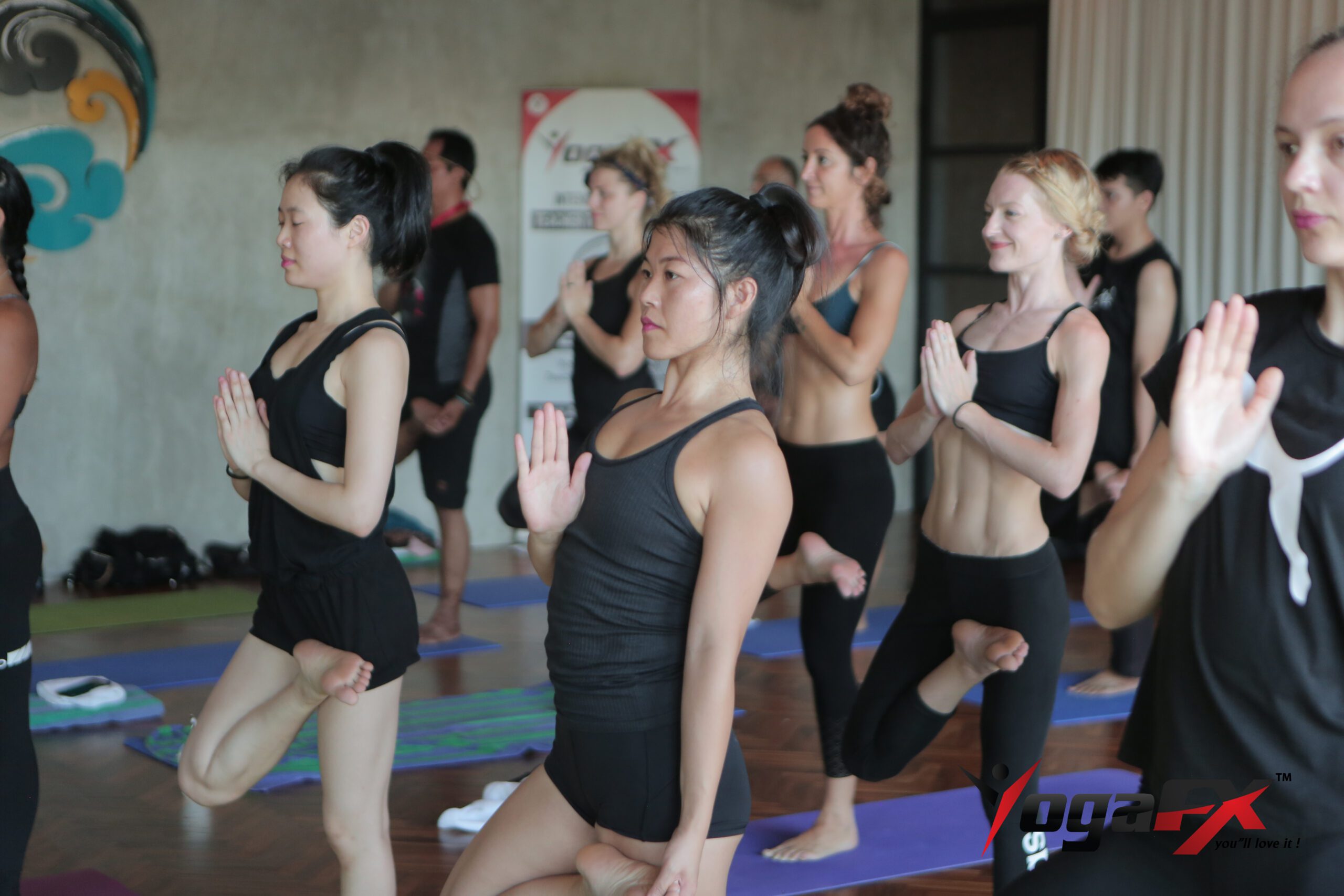
The standing series requires sustained single-leg balance in challenging postures – Standing Head to Knee, Standing Bow Pulling, Balancing Stick, Tree Pose, and Toe Stand. Performing these in a heated room with elevated heart rate creates a proprioceptive challenge that directly improves balance. The Tracy and Hart (2013) study measured a 9% improvement in standing balance after 8 weeks – a clinically meaningful outcome, particularly for practitioners over 40.
7. Weight Management and Body Composition
Regular hot yoga practice – 3–4 sessions per week over 8+ weeks – produces measurable changes in body composition: reduced body fat percentage and increased lean muscle mass. The calorie burn per session (about 333–460 kcal) combined with the strength-building effects of the fixed sequence creates a dual mechanism for body composition improvement that neither pure cardio nor pure strength training replicates independently. For a closer look at what the research specifically shows on Bikram yoga and weight loss, including realistic timelines, see our dedicated breakdown of the body composition research.
8. Improved Heat Tolerance and Sweat Efficiency
A 90-minute Bikram class in natural 40°C humid heat trains the body’s thermoregulatory system directly. With consistent practice, the sweat response becomes faster to trigger and more efficient at cooling the body, and resting core temperature regulation improves as heat acclimatisation builds over several weeks.
Natural humid heat produces a more sustained sweat response than dry electric heat, since the higher ambient humidity slows evaporation and keeps the cooling mechanism engaged for longer through the class.
Practitioners consistently report needing less recovery time in hot, humid conditions outside the studio after a few weeks of regular practice, a practical sign of genuine physiological adaptation to heat. As with any heavy-sweat activity, replacing fluids and electrolytes before and after class is essential.
9. Improved Joint Mobility
The Bikram sequence systematically moves every major joint in the body through its full range of motion – hips, knees, ankles, shoulders, wrists, and spine. The heat increases synovial fluid viscosity reduction, allowing joints to move more freely. Practitioners with joint stiffness, early-stage arthritis, or reduced mobility from sedentary work frequently report significant improvement in joint mobility within weeks of regular practice.
10. Bone Density Preservation
Weight-bearing yoga postures – particularly the standing series in Bikram yoga – stimulate bone remodelling through mechanical loading. Research on yoga and bone density, including a 2016 study published in Topics in Geriatric Rehabilitation, found that consistent yoga practice can maintain or improve bone mineral density, particularly in the spine and hips. This is especially relevant for practitioners over 40 and post-menopausal women for whom bone density preservation is a primary health concern.
11. Improved Metabolism
The combination of elevated heart rate, muscular engagement across all major groups, and the thermoregulatory work of hot yoga elevates resting metabolic rate – the rate at which the body burns calories at rest. This metabolic elevation persists after the session (excess post-exercise oxygen consumption, or EPOC), meaning the calorie-burning effects of a hot yoga class extend beyond the session itself.
Mental and Psychological Benefits

12. Clinically Documented Reduction in Depression
The most significant recent development in hot yoga research is the 2023 randomised controlled trial from Massachusetts General Hospital and Harvard Medical School, published in the Journal of Clinical Psychiatry. The study enrolled 80 adults with moderate-to-severe depression. The yoga group practiced 90-minute Bikram hot yoga at 40°C for 8 weeks.
🔬 Harvard MGH / Journal of Clinical Psychiatry (2023) – Key Findings
- 59% of yoga group participants cut their depression symptoms by half or more after 8 weeks
- Only 6% of the waitlist control group saw comparable improvement
- Benefits observed with as little as one session per week
- Physiological mechanism: heat increases core body temperature, dilates blood vessels, and triggers thermoregulatory responses consistent with whole-body hyperthermia research on mood disorders
- Study link: pubmed.ncbi.nlm.nih.gov/37883245/
13. Stress Reduction and Cortisol Regulation
The sustained meditative focus required by the Bikram sequence – following verbal instruction, maintaining postures in heat, staying present despite physical challenge – activates the parasympathetic nervous system and reduces cortisol output. Practitioners consistently report lower baseline stress levels with regular hot yoga practice. This stress reduction effect is amplified by the heat, which triggers the body’s heat shock protein response – a cellular repair mechanism also associated with stress resilience.
14. Improved Sleep Quality
Regular hot yoga practice is associated with improved sleep quality across multiple mechanisms: the physical fatigue from a demanding session promotes deeper sleep onset, the cortisol reduction from consistent practice normalises the circadian cortisol rhythm, and the thermoregulatory response to heat exposure (core temperature elevation followed by gradual cooling) mirrors the body’s natural sleep preparation process. Practitioners frequently report improved sleep as one of the first noticeable benefits of a regular hot yoga practice.
15. Mental Focus and Concentration
Maintaining balance postures – Standing Head to Knee, Standing Bow, Tree Pose – in a room at 40°C requires sustained concentration that few other physical practices demand. Over time, this concentration training transfers to cognitive performance outside the studio. Many practitioners report improved focus, attention, and mental clarity as consistent benefits of regular hot yoga practice.
16. Anxiety Reduction
The breath-focused, present-moment demands of the Bikram sequence function as a moving meditation – the mind cannot focus on external anxieties while simultaneously managing the physical and thermal demands of the practice. A 2018 review in the Journal of Alternative and Complementary Medicine found consistent evidence for yoga’s anxiety-reducing effects across styles. Our guide to whether hot yoga is good for anxiety and stress covers how it may help and when the heat can backfire. The hot yoga addition creates an accelerated version of this effect through the intensity of the thermal and physical demand.
17. Improved Body Awareness and Proprioception
The consistent mirror-feedback practice of Bikram yoga – every posture performed while watching your own alignment – develops body awareness and kinaesthetic intelligence that extends beyond the studio. Practitioners report improved posture, more intuitive movement patterns, and a stronger mind-body connection after consistent practice. This proprioceptive improvement is one of the most practical long-term benefits for practitioners who spend significant time in sedentary work environments.
Curious how many of these 17 benefits already apply to you, or where your biggest opportunity for improvement is? Our Bikram Yoga Health Scorecard turns this research into a quick personal self-assessment.
Why Natural Bali Heat Maximises These Benefits
Every benefit listed above was documented in research conducted in controlled hot yoga environments at 40°C with humidity. The critical variable – often overlooked in hot yoga marketing – is that most studios globally simulate this environment using electric heaters, which produce dry heat at low humidity.
At Bikram YogaFX Bali, both the Seminyak and Canggu studios use no electric heaters. The practice environment is Bali’s own natural tropical climate – approximately 40°C with relative humidity consistently above 70%. This is not a simulation.
It is the original environment for which the Bikram sequence was designed, and the specific conditions under which the research documented above was conducted. For the full breakdown of exactly how hot the room gets and why it’s produced this way, see our guide on how hot Bikram yoga actually is.
The practical consequence: every benefit on this list is available more fully, more comfortably, and more sustainably in natural Bali tropical heat than in an electrically heated studio elsewhere. This is one of the primary reasons practitioners who have practiced Bikram yoga at home and then practice at YogaFX Bali consistently describe the experience as categorically different – better, more effective, more comfortable – than what they are accustomed to.
FAQ
What are the main benefits of hot yoga?
The main documented benefits of hot yoga include significant calorie burn (about 333–460 kcal per 90 minutes), 20% strength increase after 8 weeks, accelerated flexibility from heat, sustained cardiovascular conditioning, mental health improvements including 59% of participants cutting depression symptoms by half or more after 8 weeks, versus 6% on the waitlist (Harvard 2023), improved sleep quality, stress reduction, and improved heat tolerance. These benefits are maximised in natural tropical humid heat – the environment Bikram yoga was designed for, available naturally at YogaFX Bali.
Is hot yoga better than regular yoga for weight loss?
Hot yoga burns more calories per session than most regular yoga styles – about 333–460 kcal per 90-minute Bikram class versus 200–400 kcal for a comparable Vinyasa session. The additional burn comes from thermoregulation – the cardiovascular work of managing core temperature in a heated environment. For weight management specifically, hot yoga’s combination of calorie burn, lean muscle building, and metabolic rate elevation makes it more effective than room-temperature yoga for body composition change.
How quickly do you see the benefits of hot yoga?
Most practitioners notice improved flexibility and heat tolerance within 3–5 classes. Sleep improvements and stress reduction are typically reported within 2 weeks of regular practice. Measurable strength and cardiovascular improvements develop over 6–8 weeks of consistent practice (3–4 sessions per week) – the timeframe used in the Tracy and Hart (2013) study that documented 20% strength gains. Mental health improvements were observed in the Harvard 2023 study within 8 weeks.
Are there any risks to hot yoga?
Hot yoga is safe for most healthy adults when practiced with appropriate hydration and heat acclimatisation. The primary risks are dehydration and overexertion in the first few sessions before heat tolerance develops. Pre-hydrating heavily throughout the day before class, bringing at least 1 litre of water into the room, arriving 15 minutes early to acclimatise, and resting in Savasana when needed eliminates most risk. Practitioners with cardiovascular conditions, high blood pressure, or pregnancy should consult a doctor before starting hot yoga. For a fuller breakdown of who should take extra caution and what counts as a normal versus concerning symptom, see our dedicated guide to hot yoga safety.