
Hot yoga vs infrared sauna is a choice between moving and resting in heat. A 90-minute class at our Seminyak studio is a full workout, warmed by Bali’s natural tropical air with no electric heaters. An infrared sauna warms you with panels while you sit still. Choose class to train, and choose the sauna to rest.

Hot Yoga vs Infrared Sauna: The Short Answer
If you want to build strength, balance and flexibility, take the class. If you want quiet, passive warmth after a long day, the sauna is a fair choice. That’s the whole hot yoga vs infrared sauna decision for most people, and the rest of this guide shows why.
I am Mr. Ian Terry, E-RYT 500, and I have taught more than 12,000 hours. I teach the Bikram Hot 26&2 method here in Bali, so I will be upfront about my angle. I like heat and I like rest. I just do not think they do the same job. Put simply, a sauna is something that happens to you, and a class is something you do.
Here is the difference in four lines:
- Who makes the heat. In a sauna, panels do. In our class, your own muscles do, in a room warmed by the Bali climate.
- What you do. You sit still in a sauna. In class you hold 26 postures and two breathing exercises for 90 minutes.
- Who guides you. A sauna has a timer. A class has a teacher and a scripted dialogue.
- What it builds. A sauna gives you rest. A class gives you a skill you can improve every week.
Many people reach this page because a studio near them sells "hot yoga" with infrared panels on the ceiling. It is a fair thing to wonder about, so we cover it below. If you are still comparing heat options in general, our wider guide on hot yoga against a traditional sauna is a good companion read.
How an Infrared Sauna Heats You, and How Bali Does It Instead
Start with the mechanics, because they explain almost everything else. A traditional sauna heats the air, and the hot air heats you. An infrared sauna uses radiant panels that warm your body more directly, so the air in the cabin is usually cooler than in a traditional sauna. Either way, you sit and the heat is delivered to you.
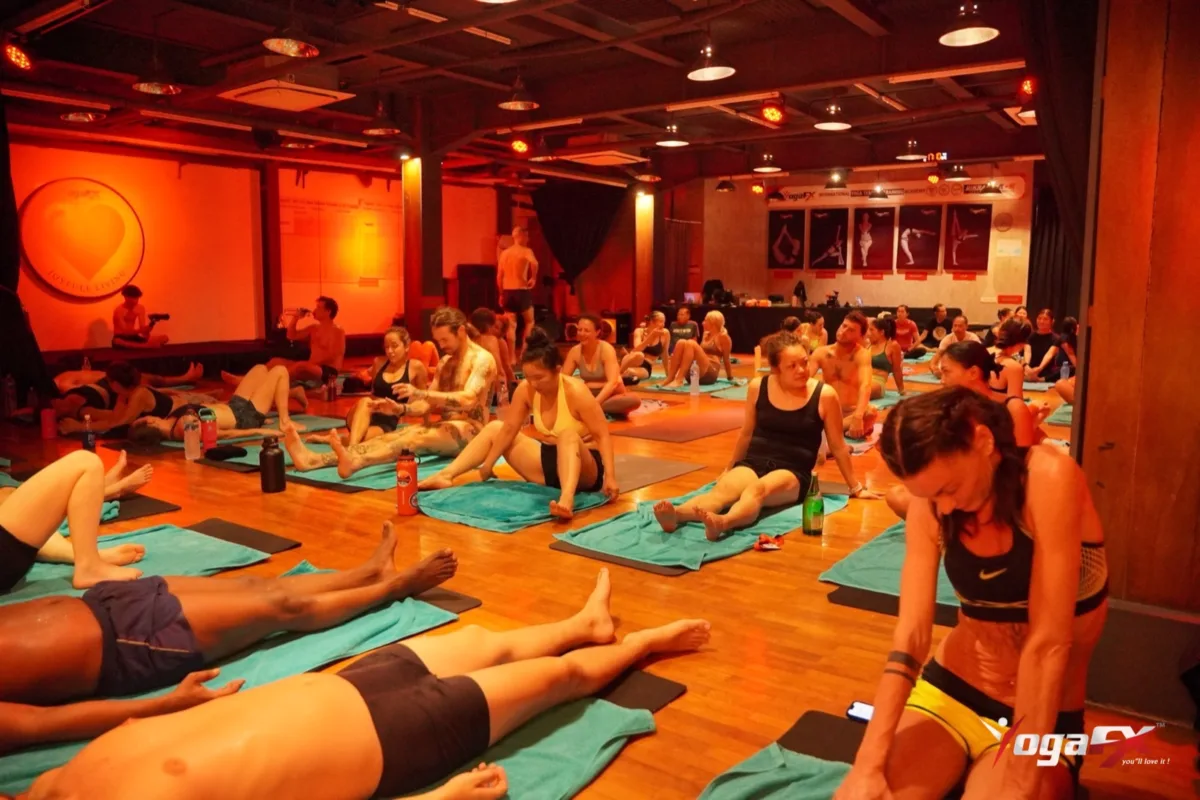
A class in Bali works the other way round. The room is warm and humid because the island is warm and humid. Most of the heat you feel is the heat you make by moving. Our class is built around about 40°C and 40% humidity, and the tropical air carries a large share of that work without any heater on the wall.
We go deeper on this in our guide to how natural heat works in a Bali yoga room. For the exact numbers behind the class, we explain how hot Bikram yoga really is in a separate guide.
Why humidity matters more than the panel
Humidity is the quiet difference. In humid air your sweat does not vanish at once, and it cools you slowly as it evaporates. That slow cooling keeps a 90-minute class workable. Dry radiant heat feels comfortable at first because it warms the skin quickly. During a class, though, you make your own heat and need your cooling to keep up.
This is also why the number on a thermometer is a poor guide. Two rooms can both read 40°C and feel completely different. In any hot yoga vs infrared sauna comparison, ask about humidity and about how the heat is produced before you compare two options.
Hot Yoga vs Infrared Sauna: Five Differences You Can Feel
Here is the hot yoga vs infrared sauna comparison in one place. The middle column covers infrared-panel yoga studios, because many readers meet that format when they search for this topic.
| Factor | Infrared sauna | Infrared-panel yoga studio | Natural-heat class in Bali |
|---|---|---|---|
| Where the heat comes from | Radiant panels around the cabin | Radiant panels on the ceiling or walls | Bali’s tropical air plus the heat you make |
| What you do | Sit or lie still | Flow or sculpt classes, which vary by teacher | Fixed 26 postures and 2 breathing exercises |
| Humidity | Not part of the design | Usually not managed | Humid by nature of the island |
| Guidance | A timer | A teacher, with a different class each time | A teacher and a scripted dialogue |
| Day-to-day consistency | Set by the dial | Set by the dial | Shifts a little with the weather |
| Best for | Rest and passive warmth | Variety and a drier room | Building a practice |
One row deserves a closing note. The last line of the middle row is not a criticism. Some people prefer a drier, gentler room, and that is a perfectly good reason to pick it. The point is only that the three options are different things, so they shouldn’t be compared as if they were one.
The same logic holds for steam. Our guide to hot yoga vs a steam room in Bali looks at how humidity changes the picture there.

What the Research Measured: Active Heat vs Passive Heat
Research is where this debate gets interesting. In 2020, Bradley Lambert and colleagues at Houston Methodist published a crossover study in the International Journal of Exercise Science. You can read the abstract on the journal’s open page at Western Kentucky University.
Each of 16 seasoned yoga practitioners (14 women and 2 men) completed the same Bikram-style sequence in two rooms. One was heated to 40°C (105°F) and the other sat at 23.3°C (74°F), with humidity at 40% in both. The results:
- Energy cost did not differ. Mean oxygen use, peak oxygen use, heart rate and calories were similar in the heat and in the cooler room.
- Fat use rose in the heat. The respiratory exchange ratio was 0.89 in the heat and 0.95 at room temperature, which points to more fat as fuel.
- Hip flexibility improved more. Hip abduction increased by 6.6 degrees in the heat, against 2.3 degrees at room temperature.
- An inflammation marker rose. Serum IL-6 increased after the heated session only. The authors treated this as a topic for further study.
Keep two limits in mind. Only 16 people took part, all of them experienced. And both sessions were yoga. Nobody in that study sat in an infrared cabin. So for hot yoga vs infrared sauna, the study cannot tell you which is "better". It can only show that the movement, not the heat alone, carries the workload.
That fits what Houston Methodist said when it summarised the study for the public: neither session was a substitute for cardio, because the aerobic workload was modest. We cover the effort side in our guide on whether hot yoga counts as cardio. If you want a calorie figure, a University of Wisconsin-La Crosse study led by Porcari and colleagues in 2014 measured about 333 calories for women and 460 for men in a 90-minute class, at around 80% of maximum heart rate.
What the sauna research says
To be fair to saunas, they have real research behind them. A 2018 review in Mayo Clinic Proceedings by Laukkanen and colleagues looked at sauna bathing and heart health, and it is a good starting point if you want to read further. Much of that work looks at traditional saunas, though, so it is risky to assume the same results for infrared panels. Harvard Health’s December 2025 piece on sauna and heart health puts it bluntly: clear evidence that sauna use promotes cardiac health remains elusive. It also notes that infrared saunas heat your body directly rather than the air around it.
Heated yoga has its own early evidence. A Harvard-affiliated Massachusetts General Hospital trial by Nyer and colleagues, published in 2023, found that 59% of people in a heated yoga programme had a drop of 50% or more in depression symptoms after eight weeks, compared with 6.3% on a waitlist. That study used yoga, not sauna time, and it does not prove the same result for everyone. If you live with depression, anxiety or a heart condition, speak with a healthcare professional before you change your routine.
What Is Infrared Hot Yoga, and Is It the Same Thing?
"Infrared hot yoga" is a real category. Studios fit radiant panels in the ceiling or walls, then teach flow, sculpt or vinyasa classes underneath. The label "hot yoga" is loose, and it covers any heated room. Our comparison of Bikram yoga vs hot yoga explains why the name alone tells you very little.
Before you book any heated class, ask three things:
- How is the room heated? Panels, electric heaters or the natural climate each feel different.
- What is the humidity? A dry room and a humid room are two different workouts.
- Is the sequence fixed? A fixed sequence lets you track progress. A changing class gives variety instead.
None of this makes infrared classes bad, and it does not settle hot yoga vs infrared sauna by itself. They can be pleasant, and some students love them. But research done in one kind of room applies to that kind of room. The Lambert study, for example, measured a humid 40°C room, so you cannot assume a panel-heated studio gives the same result.
If you want the full prime guide on this comparison from our teacher training site, Mr. Ian’s hot yoga vs infrared sauna breakdown covers the temperature ranges and the heat mechanics in more depth.

Why Natural Bali Heat Changes the Comparison
Most articles on hot yoga vs infrared sauna are written for readers in cold cities. There, the heater is the whole point of the room. Bali is different. The island is already warm and humid, so a class here is shaped by the weather as much as by the teacher.
That has three practical effects. First, the room does not need a panel to reach a workable temperature. Second, the heat changes a little with the season and the time of day. Third, you get a gentler on-ramp, because the tropical air eases you in rather than hitting you with a dial turned to maximum.
If you are visiting, treat your first few days like a short adaptation. Drink water before class, arrive early and rest between postures. Our guide to your first hot yoga class in Bali walks through what to expect, and choosing between morning and evening classes depends on how your body handles heat.
Hot yoga vs infrared sauna: what the class feels like
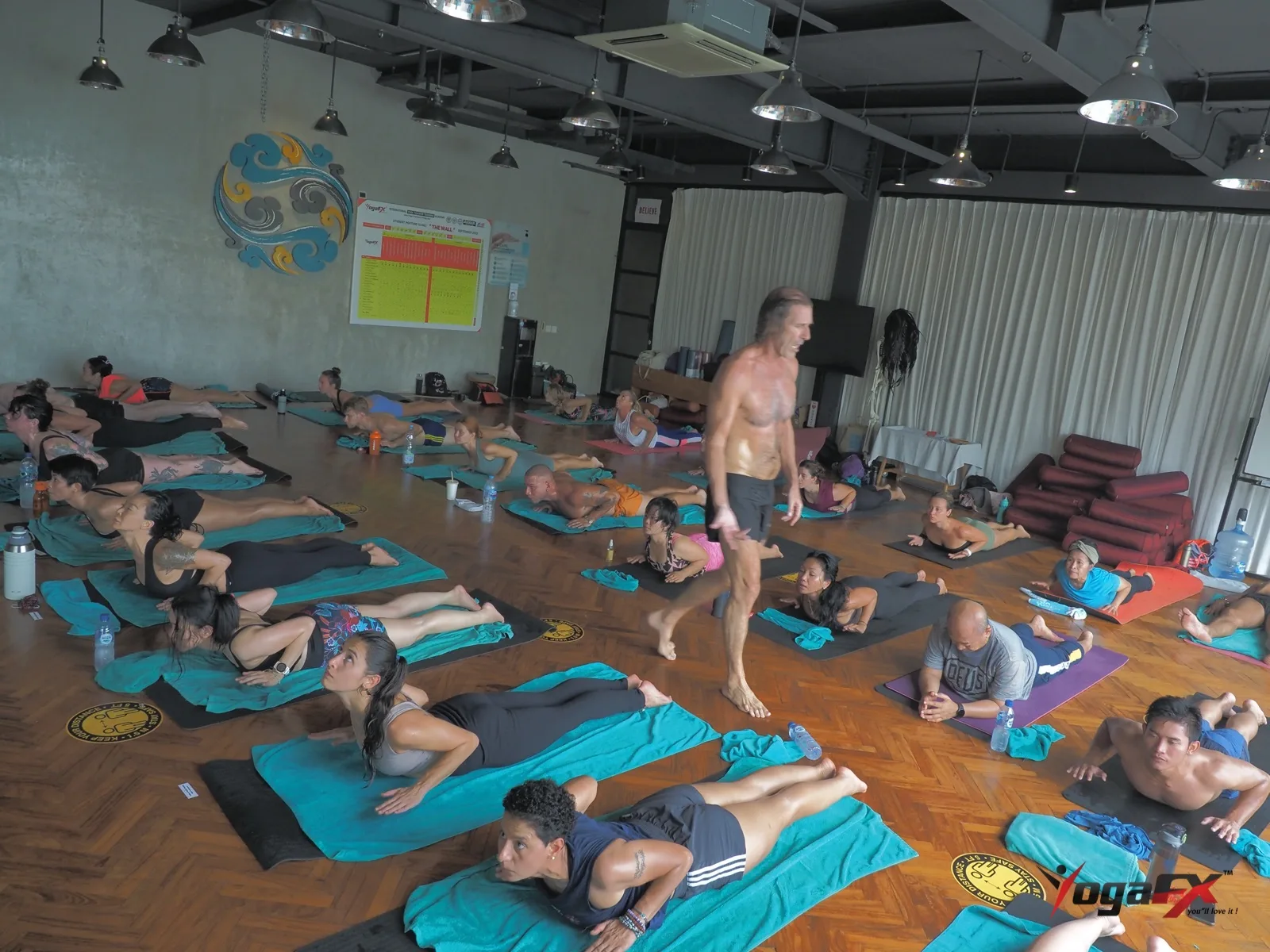
In a sauna you are waiting for the timer. In class you are busy. A teacher speaks the scripted dialogue, the room moves together, and your attention has to stay on the next instruction. That focus is a big part of the experience, and it is something no panel can supply.
There is also a social side. A class is a shared effort with a room full of people, and a sauna is usually a solo hour. Neither is wrong. They just meet different needs.
Hot Yoga vs Infrared Sauna: Which One Should You Choose?
Match the tool to the goal. Here is how I would settle hot yoga vs infrared sauna for a friend:
- You want fitness, flexibility and a skill to build. Choose a class. The postures give you something to progress.
- You want to unwind and your doctor is happy with heat. An infrared sauna is a reasonable pick. Keep sessions short.
- You are a surfer, runner or gym-goer with tight hips. Class, because the research above links heated yoga with more hip range of motion.
- You want both. Do class first, rehydrate well, and leave the sauna for another day if you feel drained.
If you are thinking about a sauna after class, read our plan for sauna after hot yoga first. It sets out a safe order for a Bali wellness day.
And if you are curious about the sweat itself, note that sweating is how your body cools down. It’s not a way to flush anything out, and nobody should chase it as a goal.
Safety: Heat Asks for Respect
Both sides of the hot yoga vs infrared sauna choice are heat exposure, so both deserve care. Sauna use is generally viewed as safe for healthy adults, but dehydration is a real risk, and you should leave at once if you feel dizzy or nauseated. The same rule works in class: if you feel faint, sit down and tell your teacher.
- Drink water before and after, and sip during class if needed.
- Skip the sauna or the class if you are unwell, or if a doctor has advised against heat.
- Check with a healthcare provider first if you are pregnant, or if you have a heart, blood pressure or other medical condition.
Our guides to hot yoga safety and side effects go through who should take extra care. This article is general education, not medical advice, so please consult a healthcare professional about your own situation.
What YogaFX Students Say About the Effort
Students feel the difference between warm-room rest and a full class within a day or two, which is the heart of hot yoga vs infrared sauna. Here is what three of them said in public reviews.
"It was the most challenging course I’ve ever done in my life."
Adam, YouTube review, 2024
"If you are looking to take an honest look at yourself, do some very hard work, and come out a changed person for the better, this is the program for you."
Matt, Google review, 2025
Manou, in a YouTube review from 2025, described something special happening on the mat: in Locust pose they could not lift a leg to 45 degrees at first, and with the teachers’ help it went well past 90. They said they cried. (Paraphrased from the spoken review.)
Notice the words: challenging, hard work, effort. Nobody describes a sauna session that way, and that’s the point of the class.
Feel the Room Yourself at YogaFX Bali
The easiest way to settle hot yoga vs infrared sauna is to take a class. Our Seminyak studio is open from 06:00 to 22:00 every day, and our Canggu studio is coming soon. YogaFX has trained more than 1,500 graduates from over 80 countries since 2017, and every class follows the same scripted format that Mr. Ian teaches.
If you want to train as a teacher later, our teacher training in Bali is built on the same method. For classes, the drop-in schedule and options are here.
Not sure yet? Contact us to claim your free guest pass and try one class before you decide whether a panel or the Bali air suits you.
FAQ
What is infrared hot yoga, and how is it different from a Bali natural-heat class?
Infrared hot yoga uses radiant panels to warm a studio, usually with flow or sculpt classes. A Bali natural-heat class relies on the tropical climate and follows a fixed sequence of 26 postures and two breathing exercises. The heat source, humidity and class format all differ.
Is an infrared sauna better than hot yoga for recovery?
They help in different ways. A sauna offers passive warmth and rest, while a class gives gentle movement and a guided practice. Research on infrared saunas is still limited, so neither is proven better. If you feel unwell or sore in a worrying way, ask a healthcare professional.
Is infrared hot yoga safe?
Any heated class carries heat risks such as dehydration and dizziness. Drink water, rest when you need to, and leave the room if you feel faint. Pregnant people, and anyone with a heart or blood pressure condition, should check with a healthcare provider before trying infrared or any other hot class.
Can I use a sauna after a hot yoga class?
Some healthy people do, but both raise your heart rate and fluid loss. Rehydrate first, keep the sauna short, and stop if you feel dizzy or nauseated. On a tired day, skip it. Check with a healthcare provider if you have a medical condition.
Do I need to get used to Bali’s heat before my first class?
Many visitors need a few days to settle in. Arrive early, drink water beforehand, and rest between postures when you need to. Bali’s humid air eases you in more gently than a dial set to maximum. If you feel dizzy, sit down and tell your teacher.
Still have questions? Message Mr. Ian and the YogaFX team on WhatsApp and we will answer them personally.
 Mr. Ian Terry