
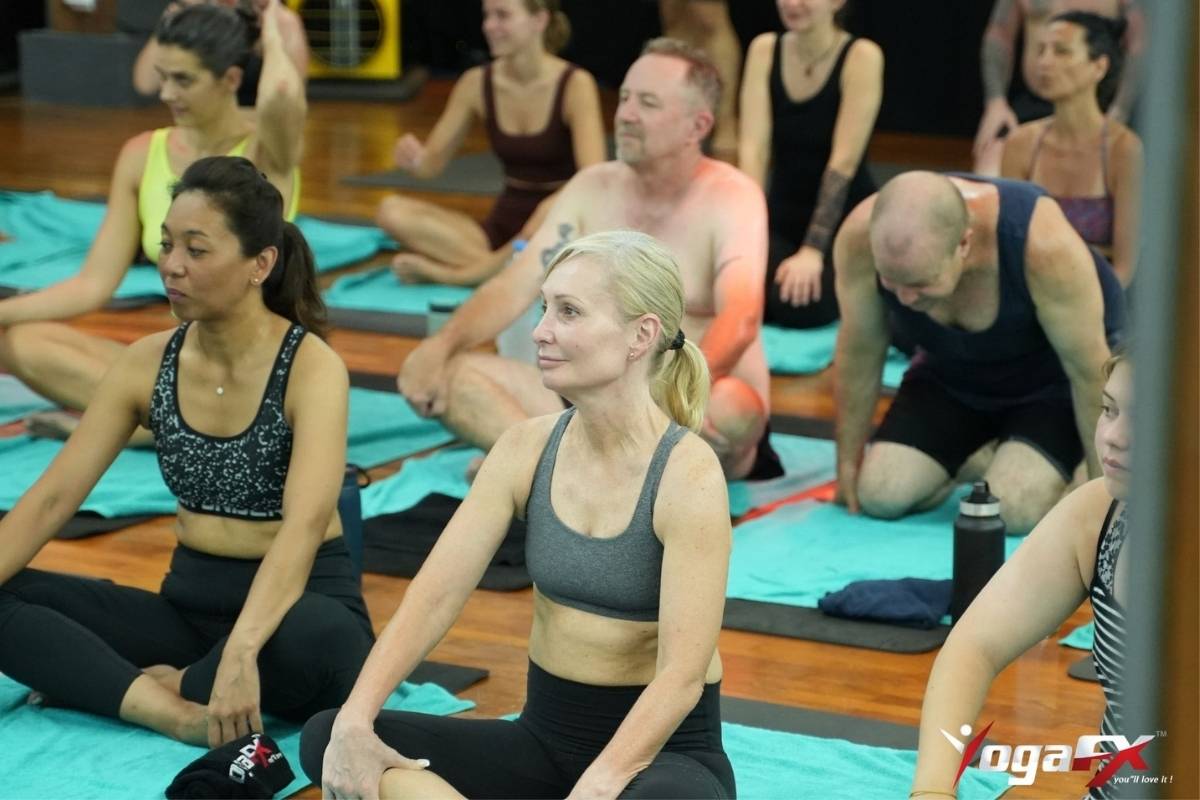
Bikram yoga classes are held in a room heated to 105°F (40°C), with humidity kept around 40%. This strict, consistent environment is designed to replicate the original climate of Calcutta, India, where the method was created, and to deeply warm the muscles and connective tissue before the body moves through 26 postures and 2 breathing exercises over 90 minutes.
At Bikram YogaFX Bali, that heat is not produced by a machine. It is Bali’s own tropical climate.
Why the Heat at YogaFX Isn’t From an Electric Heater
Most people who search “how hot is Bikram yoga” are picturing a studio in London, Sydney, or Los Angeles, because that is where most hot yoga studios exist. In those cities, the only way to reach 40°C is to install electric panel heaters or infrared heating systems. These systems raise the temperature, but they do it by heating dry ambient air, which drops relative humidity to somewhere around 20 to 30%.
At Bikram YogaFX Bali, neither the Seminyak nor the Canggu studio uses an electric heater.
Bali’s tropical climate already supplies both the temperature and the humidity Bikram yoga was designed around, so the heat in the room is not a simulation of the original environment. It is close to the actual environment the method was built for in the 1970s.
This is the detail almost every general explainer on Bikram yoga temperature leaves out, and it changes the practice more than most first-time students expect. You can read the full physiological breakdown in our guide to practicing without electric heaters.
Temperature and Climate Breakdown
- Temperature. 105°F, or 40°C, measured at floor level throughout the room.
- Humidity. Around 40% relative humidity in a standard electrically heated studio; noticeably higher in Bali’s natural tropical air, which is closer to the humid conditions the method was built for.
- Class format. 90 minutes, made up of a fixed sequence of 26 postures and 2 breathing exercises, taught through scripted verbal dialogue rather than demonstration or music.
- Heat source at YogaFX Bali. Natural tropical heat at both the Seminyak and Canggu studios. No electric or infrared heaters at either location.
| Studio Type | Typical Temperature | Typical Humidity |
|---|---|---|
| Electrically heated studio (UK, US, Australia) | ~40°C | ~20-30% (dry heat) |
| Bikram YogaFX Bali (Seminyak & Canggu) | ~40°C | Natural tropical humidity, consistently higher |
The number on the thermostat is close to identical everywhere. What differs is what is actually in the air alongside that heat, and that difference is what most students feel within the first few minutes of a class. A room at 40°C with 25% humidity behaves very differently on the skin and in the lungs than a room at the same reading with 60% or more.
What This Temperature Actually Does to Your Body
At 40°C, core body temperature rises and heart rate climbs well before the first posture is complete.
A 2014 study out of the University of Wisconsin, one of the most frequently cited pieces of Bikram yoga research, measured average heart rates reaching roughly 80% of maximum throughout a 90-minute class, a sustained cardiovascular load closer to a moderate cycling session than a typical yoga class.
The same research found calorie expenditure averaging 333 kcal for women and 460 kcal for men per class, driven largely by the combination of heat and continuous movement rather than the postures alone.
A systematic review by Willmott et al. (2025), covering 43 studies and more than 900 participants, found consistent improvements in flexibility, bone density, and general wellbeing associated with regular practice in this heat range.
Separately, a study led by researchers at Massachusetts General Hospital and Harvard Medical School found that eight weeks of 90-minute Bikram sessions at 40°C significantly reduced depression symptoms in participants with moderate-to-severe depression, with roughly 60% seeing at least a 50% reduction in symptoms.
Heat also changes how connective tissue behaves. Tendons, ligaments, and fascia extend more easily once warmed, which is part of why postures like Standing Bow Pulling Pose or the floor backbend series feel more accessible later in a heated class than they would cold.
Tracy and Hart’s 2013 study on Bikram practitioners found an average 20% increase in deadlift strength alongside measurable flexibility gains after eight weeks, a combination that is unusual for a single style of exercise to produce at once.
In humid heat specifically, that warming tends to be more even, because sweat evaporates more slowly and the body is not forced into the rapid evaporate-and-reheat cycle that dry heat produces.
None of this means the heat is risk-free. A room at 40°C places real demand on the cardiovascular system, and pushing through dizziness, nausea, or a pounding headache is never the goal.
Anyone with a heart condition, uncontrolled blood pressure, or who is pregnant should talk to a doctor before practicing in a heated room, and should mention it to the instructor before class starts. Our guide on who should be cautious with Bikram yoga goes through specific health conditions in more detail.
How Bikram Heat Compares to Other Hot Yoga Formats
“Hot yoga” has become a catch-all term, and the temperature question actually has different answers depending on which format is meant. Bikram is the most specific and most consistent of the group, since the 40°C, 40% humidity target is fixed as part of the method rather than a studio-by-studio choice. For the full comparison, including how the two are commonly confused, see our guide on Bikram yoga vs hot yoga.
| Format | Typical Temperature | Sequence |
|---|---|---|
| Bikram / Original 26&2 | Fixed at ~40°C | Fixed 26 postures + 2 breathing exercises |
| Heated Vinyasa | Varies, often 32-38°C | Flowing, sequence changes class to class |
| Hot Pilates | Varies, often 32-37°C | Pilates-based, not yoga postures |
| CorePower Yoga Sculpt / similar | Varies, often 32-37°C | Yoga combined with weights or resistance |
The practical takeaway is that a class marketed simply as “hot yoga” could mean a noticeably cooler, less humid room than a Bikram class, with a completely different sequence that changes week to week. Anyone who tried a heated Vinyasa class and found it manageable should not assume Bikram will feel the same.
And if the comparison you’re actually weighing is heat versus a sauna rather than one style of yoga against another, our hot yoga vs sauna guide breaks down why an active heated class does more than passive heat exposure alone.
For a closer look at how Bikram specifically differs from other hot formats, see our full breakdown of hot yoga benefits by format.
How to Prepare for Your First Class in This Heat
Mr. Ian Terry, E-RYT 500 and founder of YogaFX, has spent more than 12,000 hours teaching in rooms at exactly this temperature, and the preparation advice given to every first-time student is the same regardless of where they are travelling from.
Hydrate steadily through the day before class rather than drinking a large amount right beforehand. Skip a heavy meal in the two hours before practice, since a full stomach in a 40°C room is genuinely uncomfortable rather than just inconvenient.
Bring a full water bottle and a large towel into the room, and arrive at least 15 minutes early to let your body begin adjusting to the heat before the sequence starts. Our detailed guide to eating before and after hot yoga covers timing and food choices in more depth.
Sweat will start earlier and more steadily in Bali’s natural humidity than it typically does in a dry electrically heated studio. That is expected, not a sign that something is wrong.
Wear minimal, close-fitting clothing rather than loose layers, which trap heat unevenly and make the postures harder to see and correct.
Students who arrive nervous about the temperature consistently describe the same shift: the first ten minutes feel like the hardest part of the whole class, and the body settles into the heat well before the 90 minutes are over.
During the class itself, the instinct to leave the room the moment it feels intense is usually the wrong one.
The dialogue is built around specific rest points, most notably Savasana between posture sets, and using those built-in breaks is almost always more effective than stepping out entirely.
If you do feel genuinely unwell rather than simply uncomfortable, sitting or lying down on your mat is always encouraged over pushing through.
FAQ
Is Bikram yoga always this hot?
Yes. The 40°C, roughly 40% humidity environment is fixed as part of the method, not adjusted class to class. Some studios lower the temperature slightly on unusually hot days to account for students already carrying extra body heat, but the room stays heated for every class.
Can Bikram yoga be done without heat?
Some studios teach the same 26-posture sequence at room temperature, sometimes marketed separately from Bikram yoga itself. It is a different experience physiologically, since much of what the heat contributes, deeper muscle warming and sustained cardiovascular demand, is not present without it.
What is the difference between Bikram yoga temperature and regular hot yoga?
Bikram yoga uses a specific, fixed temperature and humidity target of around 40°C and 40% humidity for a set 26-posture sequence. “Hot yoga” is a broader category that can include heated Vinyasa, hot Pilates, and other formats at a range of temperatures, often without a fixed humidity target at all.
Is natural heat more intense than an electrically heated room at the same temperature?
It often feels different rather than simply more intense. Humid natural heat tends to produce earlier, steadier sweating and easier breathing than dry electric heat at the same thermostat reading, since dry air can irritate the airway and cause faster dehydration through rapid sweat evaporation.
How hot is too hot for a beginner?
The standard 40°C room is safe for most healthy adults when properly hydrated, but beginners should treat any dizziness, confusion, or nausea as a signal to sit or lie down immediately rather than push through. Instructors at YogaFX expect and plan for first-timers to rest during parts of their first few classes.
📍 Experience the Heat Yourself — Free Guest Pass
- Seminyak Studio: Natural Bali heat, zero electric heaters
- Canggu Studio: Natural Bali heat, zero electric heaters
- Heat condition: 105°F / 40°C, natural tropical humidity, year-round
- Class format: 90 minutes, 26 postures and 2 breathing exercises
- First class: Free 1-Day Guest Pass, claim via WhatsApp
This article is for general educational purposes and is not medical advice. Anyone with a heart condition, high blood pressure, or other health concerns should consult a healthcare professional before practicing in a heated room.