
Bikram yoga history runs from Bishnu Ghosh’s physical-culture school in Calcutta to Los Angeles in the early 1970s, and later to Bali, where the same 26 postures and 2 breathing exercises now run in natural tropical heat. A 2015 US appeals court ruled that the sequence is a system, so any trained teacher can teach it.

That short answer matters if you live in Seminyak or Canggu. It matters just as much if you are visiting and wonder why one class carries three names. Below, we trace how the method travelled and what the court decided. We also show what a class looks like at our studios today.
Mr. Ian Terry, E-RYT 500 and founder of YogaFX, trained with the founder of the method for five years, from 2014 to 2019. His first-hand view shapes this guide.
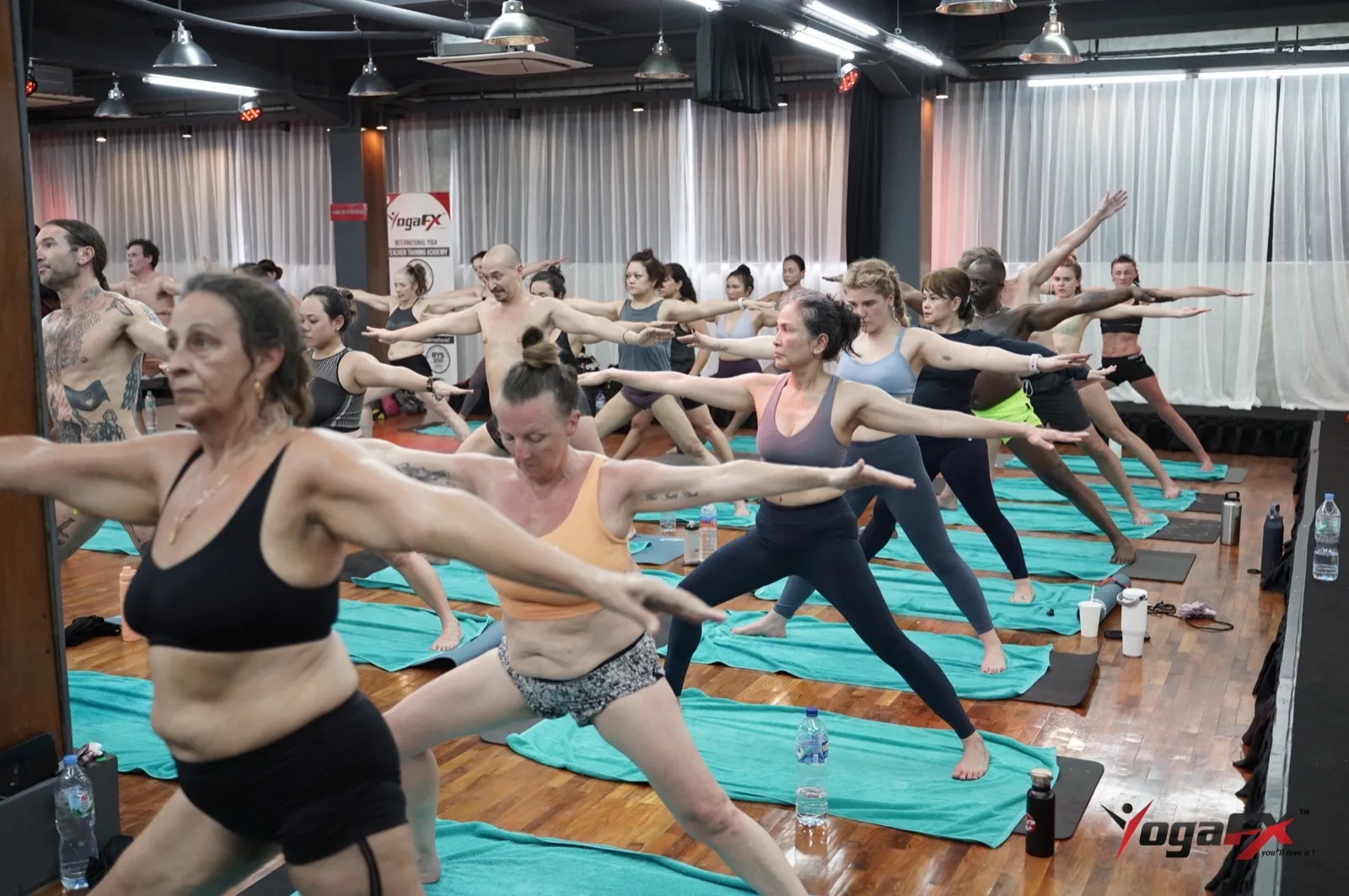
Bikram Yoga History in Bali: The Short Version
Four facts carry most of the Bikram yoga history that matters in Bali. Read these first, and then dip into the sections that interest you.
- The postures are older than the brand. They come from the Hatha tradition as taught at Bishnu Ghosh’s Calcutta college.
- The fixed class took shape in Los Angeles. Choudhury added the set order, the heated room and the word-for-word dialogue after he began teaching there in the early 1970s.
- The law settled the sequence question. On 8 October 2015 the Ninth Circuit said the sequence is not protected by copyright.
- Bali changed the heat, not the class. Our Seminyak and Canggu studios use natural tropical heat instead of electric heaters.
Where the 26 Postures Came From: Calcutta to Los Angeles
Every account of Bikram yoga history starts with Bishnu Charan Ghosh. He ran a college of physical education in Calcutta and treated yoga as training and therapy, not ritual. Students worked on strength, mobility and recovery from injury. As a result, the postures were judged by what they did for the body.
Bikram Choudhury later said he trained under Ghosh in Calcutta before moving to the United States. In the early 1970s he began teaching in Los Angeles. That is where the classic class took its shape.
Three choices turned a set of postures into a format that could travel:
- A fixed order. The same 26 postures and 2 breathing exercises, every class, every studio.
- A scripted dialogue. The teacher speaks the same instructions each time, with no demonstration and no music.
- A 90-minute container. One length, so a student in Los Angeles and a student in Bali get the same session.
Because the instruction was scripted, a newly certified teacher could run a full class from the first day. That’s why the method scaled so fast. It’s also why a class in Seminyak feels familiar to someone who first practised in another country. For the complete legal timeline and the trademark record, see our detailed history of how the method was built, challenged and cleared in court.
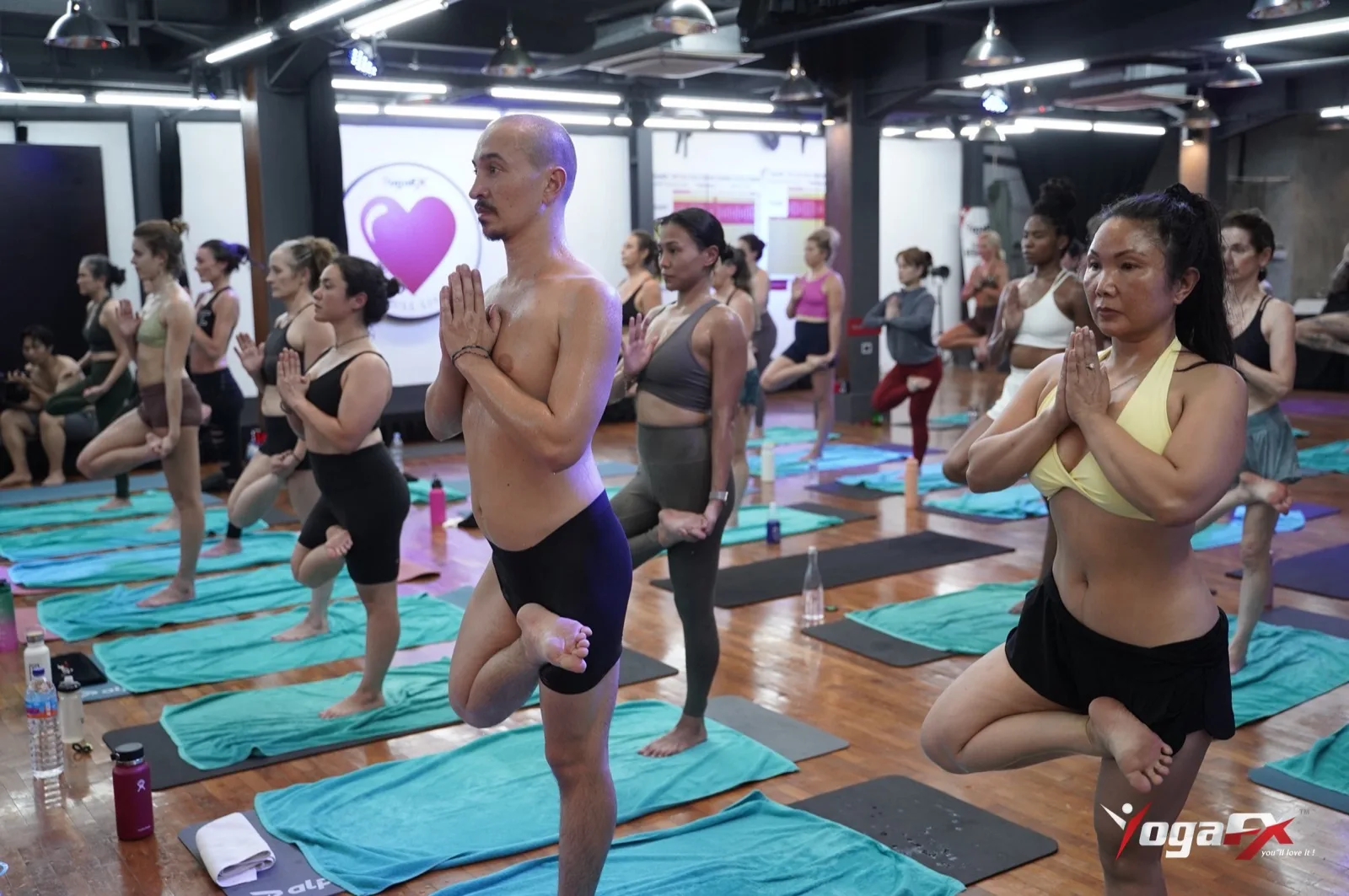
Bikram Yoga History Meets Bali: Natural Heat in Seminyak and Canggu
Heat is the part of Bikram yoga history that Bali rewrites. The original format used a heated room. Our studios in Seminyak and Canggu run a class at about 40 degrees Celsius and 40% humidity, and the warmth comes from the tropical climate, not from electric heaters. We explain what that feels like in our guide to natural heat yoga in Bali.
So the postures, the dialogue and the 90 minutes stayed intact, while the source of the warmth changed. For example, many students say it feels less like a laboratory and more like practising where the weather already helps. The table below sets the two side by side.
| Part of the class | Calcutta and Los Angeles roots | In class at YogaFX Bali |
|---|---|---|
| Warmth | A heated studio room, about 40°C | Natural tropical heat, about 40°C and 40% humidity, no electric heaters |
| Postures | 26 postures and 2 breathing exercises in a fixed order | The same 26 postures and 2 breathing exercises, same order |
| Instruction | Scripted dialogue, not demonstration | Scripted dialogue, no demonstration and no music |
| Length | 90 minutes | 90 minutes, with studios open 06:00 to 22:00 every day |
| Where to practise | Large city studios and long residential trainings | Two Bali studios: Seminyak and Canggu |
Is Bikram Yoga Copyrighted? What the Court Decided
No, the sequence is not. This is the single most searched question in Bikram yoga history, and the answer comes from a federal court. In Bikram’s Yoga College of India, L.P. v. Evolation Yoga, LLC, decided on 8 October 2015, the Ninth Circuit looked at the sequence of 26 postures and 2 breathing exercises from Choudhury’s 1979 book.
The judges called it “an idea, process, or system designed to improve health”. Under US copyright law, protection does not extend to any idea, procedure, process or system, however it is described or written down. You can read the full Ninth Circuit opinion, a searchable copy of the same decision, and the statute itself, 17 U.S.C. § 102, in subsection (b).
What does that mean for a student or a teacher? In plain terms:
- Teaching the sequence: any trained teacher may teach the 26 postures and 2 breathing exercises.
- Published text: the exact wording of a book is still protected as writing, because copyright covers expression.
- Your own class notes: a teacher’s original script belongs to that teacher.
One caution. This ruling is about copyright. Trademarks are a separate question and they are national, so check the register in your own country before you name a studio. This is general information, not legal advice.
What it means for teachers
If you plan to teach, the 2015 decision matters most. It means you can offer the sequence at your own studio without asking anyone for permission. What you can’t do is copy someone else’s written script and sell it. So write your own class notes and keep them yours.
Mr. Ian covers this in teacher training, because new teachers often ask about it in the first week. Knowing the legal history of Bikram yoga is part of being a confident teacher, since students will ask you too.
Five Myths in Bikram Yoga History, Checked
Because the story is old and messy, a few wrong ideas keep circulating. Here is what the record supports, and what it doesn’t.
- Myth: Bikram invented the postures. The postures came from Bishnu Ghosh’s Calcutta school. Choudhury fixed the order, the heat and the dialogue.
- Myth: only the founder’s studios can teach the sequence. The 2015 ruling says otherwise, because the sequence is a system and not a copyrightable work.
- Myth: 26&2 is a different kind of yoga. It’s the same class under a newer label, with the same postures and the same 90 minutes.
- Myth: the heat must come from heaters. In Bali, the tropical climate does the work, and our studios run without electric heating.
- Myth: Bikram yoga history ended when the name faded. Studios, teachers and students kept practising the method, so the story simply moved on.
Checking these claims is worth five minutes. For example, a teacher who believes the first myth may credit the wrong lineage, and a studio owner who believes the second may pay for a licence it doesn’t need.
What Changed After the Name Went Away
The method kept going, but the label moved, and that is the latest chapter of Bikram yoga history. After the founder’s later legal troubles, many studios dropped the Bikram name and started using 26&2, Original Hot Yoga or Hot 26&2. The postures stayed put while the branding moved. That means a class under a new name is still the same class.
Searchers still use the old name far more than the new ones. For that reason, we wrote a page on Original Hot Yoga versus Bikram. We also explain the sequence in our 26&2 guide for readers who arrive with either term.
How Bikram Yoga History Shows Up in a Bali Class
You can read the whole story and still wonder what it means on the mat. So here is how the history turns up when you walk into one of our two studios.
What you hear
The teacher speaks the scripted dialogue, the same words that students heard in Los Angeles decades ago. There is no demonstration and no music. Because the instruction never changes, you can focus on your own body instead of watching the room.
What you feel
The warmth is the tropical air itself, around 40 degrees Celsius and 40% humidity. That’s a different feeling from a heated box. Students often tell us the heat arrives gradually, and that the breathing exercises help them settle in during the first ten minutes.
What stays the same wherever you practise
- The sequence: 26 postures and 2 breathing exercises, in the same order.
- The length: 90 minutes from the first breathing exercise to the last posture.
- The structure: standing postures first, floor postures after, and a closing breathing exercise.
That consistency is the real legacy of Bikram yoga history. A student can start in Bali and finish a month later in another country without learning a new class. For a deeper look at each posture, see our guide to all 26 postures in order.
What Research Says About the Method Behind Bikram Yoga History
Bikram yoga history is only half the picture. Researchers have also studied the class itself, and several results are worth knowing before you book.
The 2023 depression trial
Nyer and colleagues at Massachusetts General Hospital ran a 2023 randomised trial and published it in the Journal of Clinical Psychiatry. Adults with depression took heated hatha yoga classes for 8 weeks. Roughly 59% reported symptoms at least halved, against 6.3% of people on the waitlist.
The 2025 systematic review
In 2025, Willmott and colleagues pooled 43 studies covering 942 people. Their review points to possible gains in flexibility, bone density and well-being from Bikram-style practice. Smaller studies add detail. Tracy and Hart (2013) tracked strength and flexibility, and a University of Wisconsin team led by Porcari (2014) measured heart rate and calorie burn across a 90-minute class.
What the research can’t tell you
None of this makes hot yoga a treatment. Research suggests it may help, but heat adds real strain. If you have a heart condition, you are pregnant or you take medication, consult a healthcare professional before your first class.
Mr. Ian Terry and the Studio Story in Bali
Mr. Ian Terry has 12,000+ teaching hours and holds the E-RYT 500 credential. He trained for five years with the founder of the method, from 2014 to 2019. Then, in 2017, he founded YogaFX. Today he runs the academy and trains new teachers.
His approach is simple to describe. The method stays exactly as it was: the same sequence, the same dialogue structure. The culture around it is something we run differently, with plain feedback, questions welcome and students setting their own limits.
For the teacher-training side of the lineage, YogaFX runs the Bikram Hot 26&2 Yoga Teacher Training MasterClass, a hybrid course with an online pre-course and an intensive in Bali.
What Students Say About the Lineage in Bali
Facts and court rulings only go so far in telling Bikram yoga history, so here is something more personal. Three students describe practising the method with us.
Truly life changing experience, blessed to have had this opportunity.
Villin, Google review, 2022
Sue wrote in a Google review in 2020 that she had a super wonderful class, that the teacher is very friendly and that she always feels welcome.
It was enlightening. It was unexpected, fulfilling. It was invigorating, challenging. It was tough.
Omayra, YouTube review, 2019
Try the Sequence Yourself in Seminyak or Canggu
Reading about Bikram yoga history is useful, but a class makes it real. Your first visit is simple. Bring water and a towel, arrive a little early and expect 90 minutes of scripted instruction in natural heat.
Our drop-in classes in Bali list the schedule and what to expect. Studios are open 06:00 to 22:00 every day. If you would like to try before committing, ask for a free guest pass and we will arrange your first class.
FAQ
Is Bikram yoga copyrighted?
No, not the sequence. In October 2015 a US appeals court, the Ninth Circuit, treated the 26 postures and 2 breathing exercises as a system, and copyright law leaves systems out. A book’s exact wording stays protected as writing, yet any trained teacher may teach the postures themselves.
What is Bikram yoga called now?
It depends on the studio. Some use 26&2, Original Hot Yoga or Hot 26&2, and others keep the Bikram name. Behind each label sits one class: the same 26 postures, 2 breathing exercises and 90 minutes of scripted dialogue. The branding moved while the practice stayed where it was.
Did Bikram invent hot yoga?
Not the postures. They came from Bishnu Ghosh’s school in Calcutta. Bikram Choudhury turned heat, a fixed sequence and a scripted class into one format and spread it worldwide, so many hot yoga styles today borrow from his format, even when the postures differ.
Is Bikram yoga the same as hot yoga?
No. Hot yoga is a broad label for any yoga taught in a warm room, and the postures vary by teacher. Bikram or 26&2 is one fixed format: the same 26 postures and 2 breathing exercises in the same order, for 90 minutes, with a scripted dialogue.
Is Bikram yoga trademarked?
The 2015 ruling dealt with copyright, not trademarks. Trademark rules are national, so a record in one country says nothing about another. Check the register in your own country before naming a studio. YogaFX runs an independent training, not official Bikram Choudhury Teacher Training.
Still have questions? Message Mr. Ian and the YogaFX team on WhatsApp and we will answer them personally. You can also ask for your free guest pass in the same message.
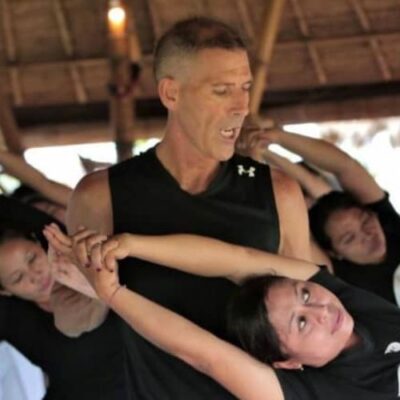 Mr. Ian Terry