
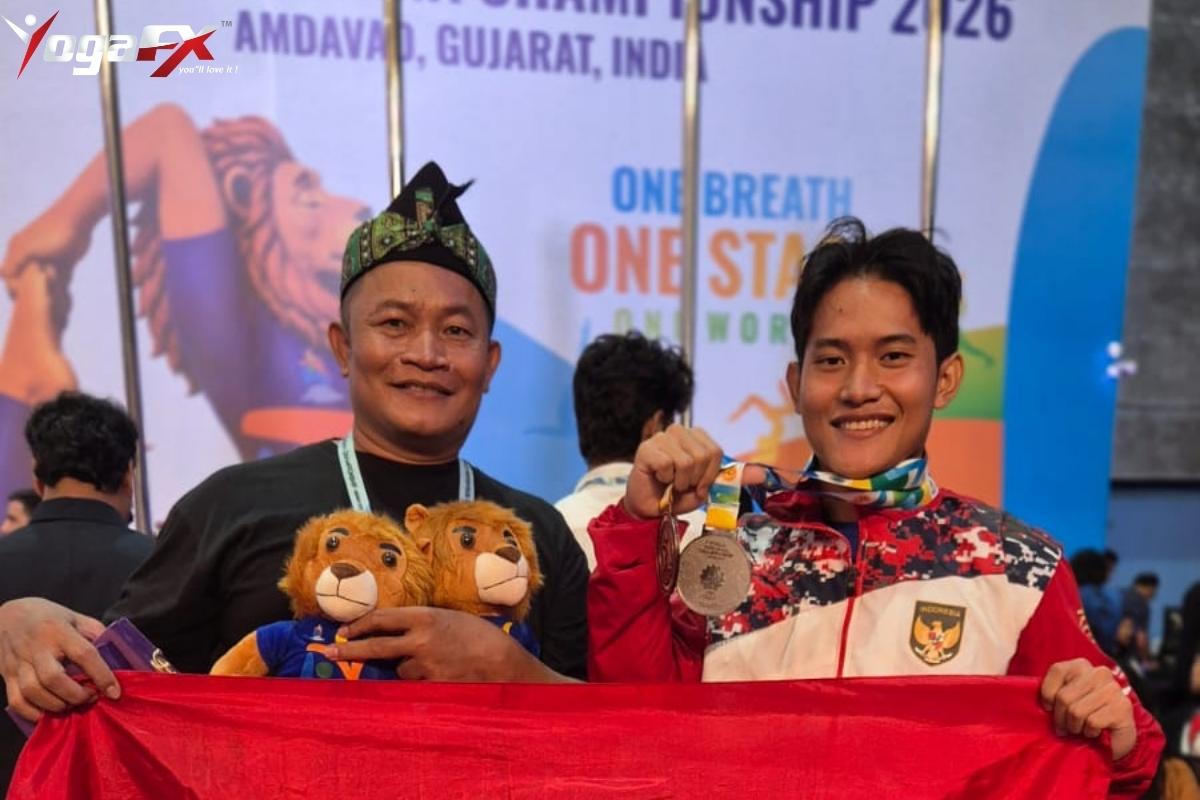
A yoga championship is a judged sport in which athletes perform set yoga postures and earn scores for strength, balance, flexibility and control. The first World Yogasana Championship ran in Ahmedabad, India, from 4 to 8 June 2026. Indonesia won seven medals there, and all seven came from YogaFX graduates trained in Bali.

This guide explains how a yoga championship works, what happened in Ahmedabad and how Indonesian athletes reached the podium. It draws on Mr. Ian Terry, E-RYT 500, founder of YogaFX, who trained both medallists and served as Indonesia’s national coach at the event.
What Is a Yoga Championship and How Is It Different From a Class?
A normal yoga class is about how you feel. A yoga championship is about how a posture looks and holds under pressure. Judges score each athlete, and the highest score wins. The sport goes by the name Yogasana, which simply means yoga posture.
Competition yoga has a long past. For the early contests and the people who built them, read the history of yoga competition from the first contests to today on our sister site.
The 2026 championship shows how modern events are organised. According to The Bridge, more than 500 athletes from 78 countries entered. The programme covered individual events, artistic events and traditional group categories.
- Six age groups. They run from Sub-Junior (10 to 14) to Senior C (45 to 55), so athletes compete against their own age band.
- Electronic scoring. The Bridge reports that the event used an electronic scoring system at world level for the first time.
- Large judging panels. The same report counts 32 international judges and 51 national judges.
- Many event types. Results listed events such as artistic pair, rhythmic pair, leg balance, hand balance, back bend, twisting body and supine.
Yoga Championship 2026 at a Glance
Here is the Ahmedabad event in five numbers. Use it as a quick reference before the detail below.

How Judges Score a Yoga Championship Routine
Judges in a yoga championship look at the same five qualities again and again. Each one maps to something you already train in a hot class.
- Strength. The posture holds its shape and does not sag.
- Flexibility. The athlete reaches the full form of the pose.
- Balance. There is no wobble, even on one leg.
- Endurance. The hold lasts for the full count.
- Precision. Every joint sits where it should.
Because one weak area costs points, nobody can hide. In other words, balance, strength and range have to arrive together. A great backbend does not rescue a shaky twist. That is also why consistent weekly training beats a few extreme sessions, since each posture needs thousands of calm repetitions.
Results show how fine the margins are. Tribune India lists Arkan Fauzan Riyanto of Indonesia with a bronze in the Senior Male Twisting Body individual event, with a score of 38.09. India won 114 medals in total, 102 of them gold.
Indonesia’s Road to the Yoga Championship Podium
Ahmedabad was the end of a three-year climb, not a lucky weekend. Both Indonesian medallists studied with Mr. Ian in Bali, then competed through the national and Asian circuit. The table shows how their results built up.
| Yoga championship | Level | Ivara Candra Kartika (2023 graduate) | Arkan Fauzan Riyanto (2022 graduate) |
|---|---|---|---|
| FORNAS (national sports festival) | National | Gold, FORNAS VIII, July 2025 | Champion in 2022, 2023 and 2025 |
| Asian Yogasana Championships, UAE, August 2025 | Asian | Silver | Not recorded |
| World Yogasana Championship, Ahmedabad, June 2026 | World | 1 gold and 1 bronze | 2 silver and 3 bronze |
Add it up and Indonesia’s seven medals in Ahmedabad split as one gold, two silver and four bronze. Every one belongs to those two athletes. You can read Ivara’s full story as our Seminyak teacher on a separate page.
Yoga Championship vs a Hot Class: What Changes and What Stays
Many readers ask whether a yoga championship has anything to do with a normal class. It does, but the goals differ, so the habits differ too. For example, a competitor trains for a three-minute performance, while a class student trains for ninety minutes of steady work.
- The goal. A competitor wants the highest score on the day. A class student wants a stronger, calmer body over months.
- The audience. Judges watch an athlete in a yoga championship. In a hot room nobody judges you, and the teacher is there to help.
- The pace. Athletes peak for an event, then rest. Regular students aim for the same steady rhythm all year.
- The foundation. Both need clean alignment, slow breathing and patience, so the work overlaps far more than people expect.
That overlap explains why a studio can feed a yoga championship team. Skills built in class carry straight into competition, and the reverse is true as well.
From a Bali Hot Room to the Yoga Championship Stage
Ivara did not start as a prodigy. In her early training she was still fighting with Dandayamana Dhanurasana, the Standing Bow Pulling Pose. You kick back, reach forward and try not to fall over. Three years later she stood on a world podium.
Mr. Ian’s rule for students and athletes has not changed: consistency beats intensity. A regular practice changes the body more than the odd heroic session. It is the same advice he gives a nervous first-timer.
- Same postures, same order. The Original Hot 26&2 sequence never changes, so you collect thousands of repetitions of each pose and can measure progress.
- Balance early. The standing series trains one-leg balance while you are fresh.
- Strength and stretch together. Most postures ask you to contract one side while you lengthen the other.
- Calm in the heat. Slow breathing in a hot room is good practice for staying composed in front of judges.
The heat itself matters too. Our Seminyak room runs at about 40 degrees Celsius and 40% humidity, and it comes from Bali’s natural tropical warmth, not electric heaters. Read more about practising in natural Bali heat before your first class.
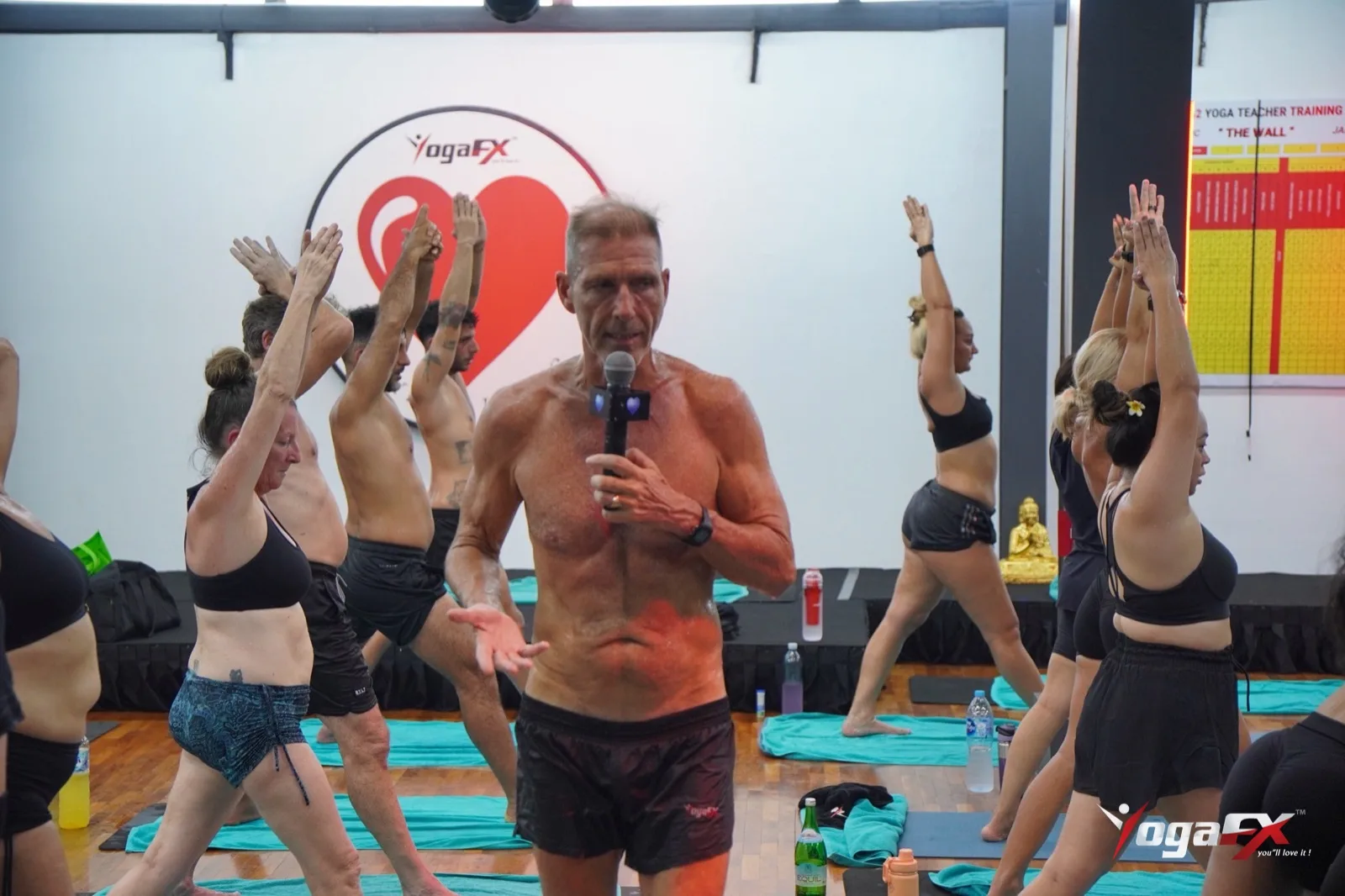
Mr. Ian brings long experience to that work. He has more than 12,000 teaching hours and trained for five years, from 2014 to 2019, with the founder of the Bikram Hot 26&2 method. In June 2026 the Republic of Indonesia Yogasana Sports Federation named him Master Trainer. Read his full profile as a Bikram yoga instructor in Bali for the whole background.
What research says about heated yoga
You do not need to chase a medal to benefit. A randomised trial from Massachusetts General Hospital, led by Nyer and colleagues and published in the Journal of Clinical Psychiatry in 2023, compared eight weeks of heated hatha yoga with a waitlist. About 59% of the yoga group cut their depression symptoms by half or more, against about 6% of the waitlist group.
A 2014 University of Wisconsin study by Porcari and colleagues measured about 333 calories for women and 460 for men in a 90-minute hot class. Results vary from person to person. Yoga is not a substitute for medical care, so consult a healthcare professional before practising in a heated room if you are pregnant or have a heart or blood pressure condition.
Three Skills a Yoga Championship Athlete Shares With a Beginner
You may never step on a stage. Still, three skills sit at the centre of every yoga championship routine, and you can train each one in a normal class.
1. Balance on one leg
Standing Bow is the classic test. You hold one foot, kick back and reach forward, all while staying still. Beginners wobble, and so did Ivara. The fix is the same for everyone: lock your eyes on one point, breathe slowly and keep the standing knee straight.
2. A flexible, supported back
Backbends win and lose medals. Yet a deep bend only counts when the legs and core support it. In class, you learn to lift the chest first and fold second, so the spine bends evenly instead of collapsing at one spot.
3. Twisting with control
Arkan’s bronze in Ahmedabad came in a twisting event. A good twist asks you to grow tall before you turn, so the rotation comes from the whole spine and not from the neck. Beginners can practise exactly this in the floor series of a hot 26&2 class.
What YogaFX Students Say
Champions are the exception. Most people in our room are first-timers, trainees and travellers. Here is what three of them said in their own words.
Such an amazing and mind blowing experience. I can’t thank Mr Ian Terry enough… everything is so smooth and very well organised and very professional.
Lilywati, Google review, 2025
I’m so happy, Mr. Ian, that you pushed me and put me back in the track of my dreams.
Christina, YouTube review, 2024
Thank you for YogaFX, amazing training with my friend from around the world… we have many, many challenges every day, but we can do it together until finish.
Slamet, YouTube review, 2024
Prefer to watch? Here is Christina’s full video review from the YogaFX channel.
Can You Train Like a Yoga Championship Athlete in Bali?
You can borrow the habits without entering a contest. Most visitors do not need a medal plan. They need a rhythm they can keep.
- Short stay (under a week). Take two or three classes. The third usually feels much easier than the first.
- Two to four weeks. Aim for three to five classes a week to see real change in your range before you fly home.
- Expats and digital nomads. Pick a steady weekly pattern and ask the team about memberships.
Rest matters as much as effort. Drink water through the day, eat lightly at least two hours before class and arrive 15 minutes early. If you need to sit down mid-class, do it, because resting is part of learning.
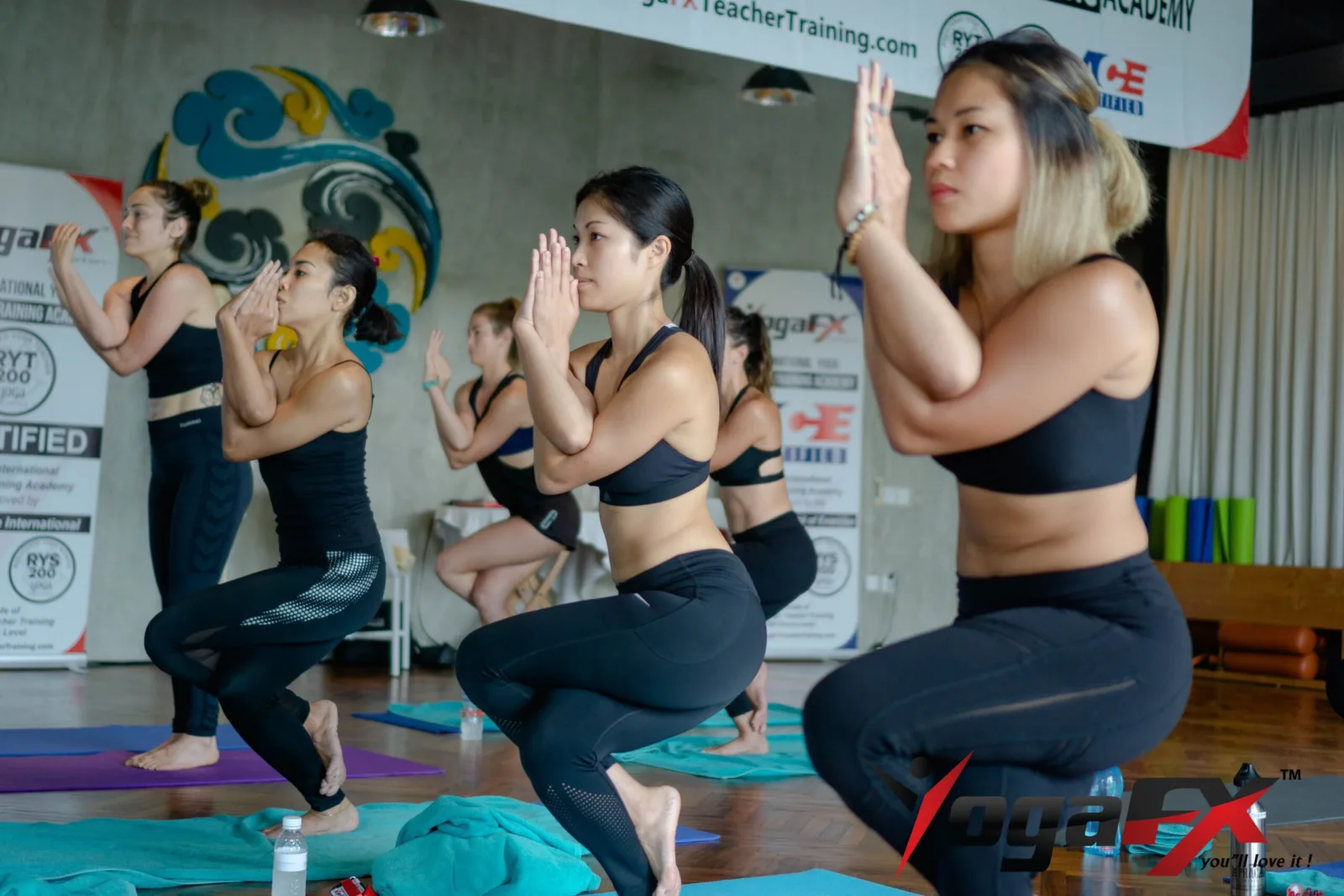
Curious about the format? Our guide to drop-in hot yoga classes in Bali lists schedules and what to bring.
How to Follow the Next Yoga Championship
Interest in the sport is growing quickly. Monthly searches for the phrase yoga championship jumped from 320 in May 2026 to 880 in June, the month the Ahmedabad event took place. So if you want to follow future events, a few habits help.
- Watch national federations. Entry rules, age groups and dates are announced by the federation that runs each event.
- Read results after each event. Wire reports, such as the ones from Tribune India and The Bridge, list every winner and score.
- Check the level. National festivals like FORNAS, Asian championships and the world championship each have their own qualifying path.
- Follow our team. Keep an eye on the YogaFX channel and this site for news about our graduates.
Meanwhile, you do not have to wait for the next event to start. A first class takes ninety minutes, and it costs nothing with the free guest pass.
Take a Class at Our Bali Studios
YogaFX offers hot 26&2 classes at our studios in Seminyak and Canggu, open every day from 06:00 to 22:00. Each class lasts 90 minutes and follows the same 26 postures and two breathing exercises. Teachers use a scripted dialogue, with no music and no demonstration, so you can focus on your own body.
- Message the team on WhatsApp at +628113888330 with your travel dates.
- Claim your free guest pass for your first class.
- Choose a membership if you plan to stay in Bali for a few weeks or longer.
- Bring a towel and water, wear light clothes and tell your teacher it is your first time.
Some visitors fall for the practice and want to teach it. If that is you, the Bikram yoga teacher training in Bali guide explains the six-day hybrid MasterClass that Ivara and Arkan once joined.
Yoga Championship FAQ
What is a yoga championship?
A yoga championship is a sporting event where athletes perform set yoga postures in front of judges. Scores reward strength, flexibility, balance, endurance and precision. Age groups run from sub-junior to senior. The first World Yogasana Championship took place in Ahmedabad, India, in June 2026.
Who won the world yoga championship in 2026?
India topped the medal table as host nation, with 114 medals and 102 golds according to Tribune India. Indonesia won seven medals: one gold, two silver and four bronze. Every one of them went to a graduate of the YogaFX teacher training in Bali, Ivara Candra Kartika or Arkan Fauzan Riyanto.
Are there yoga championships in Indonesia?
Yes. Indonesian athletes compete at FORNAS, the national sports festival, and then move on to Asian and world events. YogaFX graduate Arkan Fauzan Riyanto won FORNAS in 2022, 2023 and 2025, and Ivara Candra Kartika won it in July 2025 before her medals in Ahmedabad.
Do I need to be flexible to try hot yoga in Bali?
No. Most people arrive stiff, and that is normal. Our teachers tell beginners to rest whenever they need to, because the heat is a tool, not a test. Start with a free class at the studio, go at your own pace, and let the range come with regular practice.
Can a beginner learn from teachers who compete?
Yes. Competitors know every posture in fine detail, so they spot small alignment errors and explain how to fix them. At YogaFX the whole teaching team learns the same scripted dialogue, so your class sounds the same whoever leads it. Beginners and athletes practise side by side in the same hot room.
Still have questions? Message Mr. Ian and the YogaFX team on WhatsApp and we will answer them personally. While you are there, claim your free guest pass.
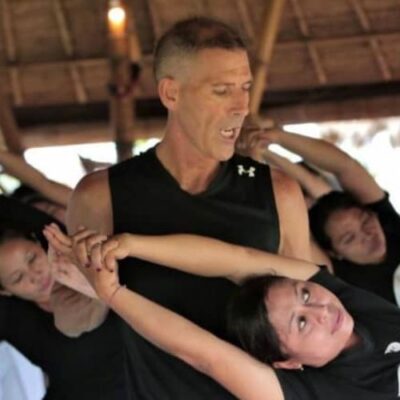 Mr. Ian Terry