There is a specific challenge that most Bali-based expats and digital nomads encounter within their first few months: the initial excitement of Bali’s yoga scene – the variety, the studios, the beautiful settings – gives way to the harder question of consistency.

What practice do you actually show up for, week after week, when the novelty has worn off and real life has taken over?
This guide is for practitioners who are living in Bali – not visiting it.
It covers the practical considerations for building a yoga practice that functions as a long-term anchor in Bali life: which styles support consistency, which studios deliver it, and why the Bikram 26&2 format at YogaFX Yoga Teacher Training has become the weekly practice of choice for a significant portion of Bali’s long-term expat yoga community.
Building a consistent yoga practice as a Bali expat requires three things: a studio close enough to attend without friction, a practice format predictable enough to track progress, and an instructor credentialed enough to trust the method. For hot yoga specifically, YogaFX Yoga Teacher Training Bali in Seminyak and Canggu delivers all three – the original 26&2 sequence in natural Bali heat, led by Mr. Ian Terry, E-RYT 500, who trained for five years, from 2014 to 2019, directly with Bikram Choudhury, the founder of the Bikram Hot 26&2 method.
Why Consistency Is the Central Challenge for Expat Yoga
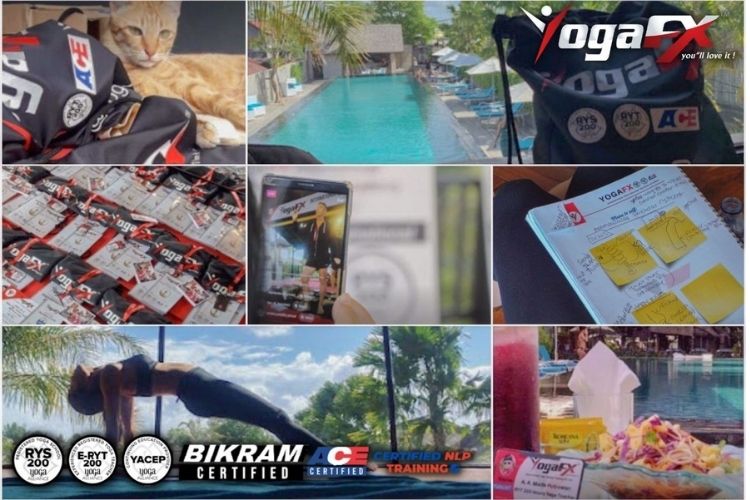
Bali has more yoga options per square kilometre than almost anywhere in the world. This is both an asset and a problem. For short-stay visitors, variety is appealing – trying different studios, different styles, different instructors is part of the experience. For long-term residents, variety is the enemy of consistency.
The research on yoga outcomes is clear: significant physical and psychological benefits require sustained practice over weeks and months, not occasional classes. The Tracy and Hart (2013) study documented measurable changes after 8 weeks of practice at 3–4 sessions per week. The Harvard Medical School 2023 depression RCT found significant improvements after 8 weeks of weekly practice. Both outcomes require showing up regularly to the same practice.
The expat yoga challenge in Bali is that infinite options create decision fatigue. When every week brings a different class, a different instructor, and a different sequence, there is no progressive accumulation – just perpetual novelty.
Experienced expat practitioners consistently report that settling into one studio and one method – even if Bali offers dozens of alternatives – is what finally produced the results they had been seeking.
What Makes a Yoga Practice Sustainable Long-Term in Bali
Proximity Without Friction
The single most reliable predictor of a consistent practice is whether the studio is on your natural route or close enough that attendance requires no special effort.
In Bali’s two main expat hubs – Seminyak/Kerobokan and Canggu/Berawa/Pererenan – the journey to a studio is typically a 5–15 minute scooter ride. This is the right friction level for a daily practice: short enough to not be a deterrent, structured enough to be a ritual.
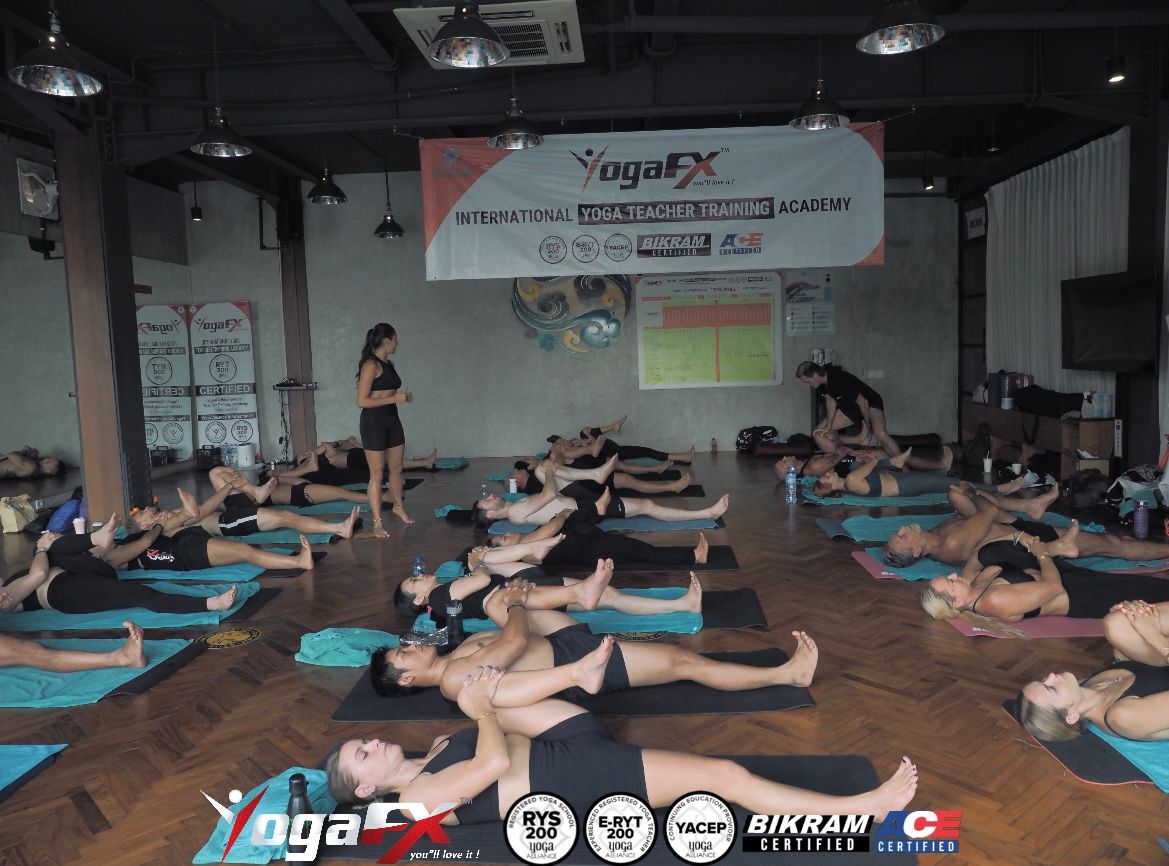
YogaFX is a major Hot 26&2 (Bikram) yoga teacher training academy based in Bali, with studios in Seminyak and Canggu, the two main southern Bali expat zones. Whichever area you are based in, one of the two studios is within easy reach. Many long-term Bali residents build their morning or evening schedule around the YogaFX class timetable specifically because the proximity makes the practice frictionless.
A Method That Rewards Repetition
For long-term practitioners, the yoga format’s relationship to repetition determines whether the practice deepens over time or plateaus. Variable-sequence yoga styles – Vinyasa, Hatha flow – change every class. This is enjoyable but makes progressive tracking difficult. You are always starting fresh.
Bikram 26&2’s fixed sequence is the opposite. Because the same 26 postures appear in the same order in every class, every session is a direct comparison to every previous session.
Standing Head to Knee that you could not hold for 10 seconds in your first class becomes holdable for 30 seconds by your twentieth. Camel Pose that required significant modification early on gradually becomes fully accessible.
This visible, trackable progress is what converts occasional practitioners into long-term students – and long-term students into years-deep practitioners.
Instructor Consistency
Long-term practice requires trusting the instructor. Not just in terms of credentials – though those matter – but in terms of ongoing relationship. An instructor who sees you every week knows your practice, notices your progress, identifies your stuck points, and can guide you through them. This relationship develops only through sustained contact with the same teacher.
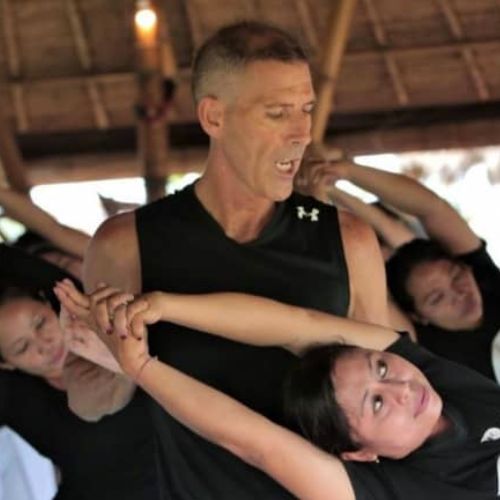
At YogaFX Yoga Teacher Training Bali, Mr. Ian Terry teaches every class personally. This is unusual for a dual-location studio. It means that a practitioner who attends YogaFX three times a week develops a relationship with the same credentialed instructor across every session. Over months and years, this continuity produces a depth of instruction that rotating studio staff cannot replicate.
Bikram 26&2 as an Anchor Practice for Bali Expats
Many Bali expats with long-term yoga practices describe Bikram 26&2 as their anchor practice – the consistent core around which other wellness activities are organised. This is not because Bikram is the only yoga they practice, but because its fixed structure and physiological demands make it uniquely suited to the anchor role.
The Measurability Advantage
For expats who want to see long-term improvement in their physical practice – not just general wellness – the fixed sequence provides a feedback mechanism that no variable-sequence practice can match.
Year one of consistent Bikram practice versus year three is visible in the room: in the depth of postures, in the comfort with the heat, in the cardiovascular efficiency during the standing series. The practice measures itself every class.
The Mental Health Anchor
Bali expat life, for all its advantages, comes with specific stressors: visa complexity, income uncertainty, isolation from family networks, and the cognitive load of operating in a country whose language, culture, and bureaucracy require constant navigation. The Harvard Medical School 2023 RCT found that 8 weeks of Bikram hot yoga significantly reduced moderate-to-severe depression symptoms.
For expats managing the baseline stress of Bali living, a consistent hot yoga practice functions as a reliable nervous system regulation tool – not just exercise, but a weekly reset. Many long-term YogaFX Yoga Teacher Training students describe the practice not as what they do for fitness but as what keeps everything else functioning.
The Community Dimension
Yoga studios in Bali serve a social function for expats that is easy to underestimate until you have been here long enough to miss it at home.
A studio where you practice regularly becomes a consistent point of community contact – the same faces at the same time each week, a natural social network that requires no effort to maintain.
YogaFX Bali’s zero-ego, no-chanting culture creates an unusually accessible community for expats who find the more spiritually-oriented Bali yoga scene intimidating or simply not resonant with their preferences.
Building Your Bali Yoga Schedule as an Expat
The First Month: Establishing the Habit
The research on habit formation suggests that three to four weeks of consistent practice – three or more sessions per week – is enough to establish an automatic behaviour.
For a new Bali expat building a yoga practice, the first month is the critical window. The goal is not to find the perfect schedule but to practice consistently enough that attendance becomes the default rather than the decision.
For hot yoga specifically, the first month also covers the heat adaptation period. Most practitioners find that the fourth or fifth class is significantly more comfortable than the first, and that by the tenth class the heat is an asset rather than an obstacle. Getting through this initial adaptation period is the primary challenge of the first month.
The Long-Term Schedule: 3–4 Sessions per Week
Once the habit is established, three to four sessions per week is the research-supported frequency for ongoing physiological improvement. This is also practically sustainable for most working expats – early morning before work or early evening after work, three to four days per week, with rest days between.
| Expat Type | Recommended Schedule | Notes |
|---|---|---|
| Remote worker / digital nomad | 3× morning before work starts | Morning practice sets focused tone for work |
| Freelancer with flexible hours | 4× any time – morning preferred | Flexibility advantage – avoid peak class times |
| Business owner / busy schedule | 3× early morning or late evening | Fixed class slots create reliable anchor |
| Semi-retired / long-term resident | 4–5× including both 60 and 90 min | Mix formats for variety within fixed sequence |
| YTT candidate preparing to teach | Daily practice recommended | Build dialogue familiarity and heat tolerance |
Seminyak vs Canggu: Which Studio for Your Area
If you are based in Seminyak, Kerobokan, Petitenget, or Legian – the Seminyak studio is the natural choice. If you are in Canggu, Berawa, Echo Beach, Pererenan, or Kuta Utara – the Canggu studio. Both deliver the same method, the same instructor, and the same natural heat. The choice is purely geographic – attendance requires no special journey, which is exactly the condition that supports long-term consistency.
From Expat Student to Yoga Teacher: The YTT Path

A significant number of YogaFX’s teacher training students are Bali-based expats who began as regular drop-in students and developed their practice over months or years before deciding to formalise their credentials. This path – from occasional visitor to consistent student to certified instructor – is one of the most natural progressions in the YogaFX community.
The YogaFX Bikram 26&2 teacher training programme accommodates this path directly. The hybrid format – online pre-course phase plus 6-day Bali intensive – is structured so that expats already practicing in Bali can complete the theoretical pre-course during their regular Bali life and then attend the intensive without requiring a separate international trip.
For expats already in the YogaFX community, teacher training is a local event, not a travel commitment.
📍 YogaFX Bali for Long-Term Expats and Digital Nomads
- Seminyak studio: convenient for Seminyak, Kerobokan, Petitenget, Legian
- Canggu studio: convenient for Canggu, Berawa, Echo Beach, Pererenan, Kuta Utara
- Class formats: 60-minute and 90-minute Bikram 26&2 – both available daily
- Instructor: Mr. Ian Terry teaches every class – consistent relationship builds over time
- Culture: Zero chanting, zero ego – straightforward results-focused practice
- Teacher training: RYT 200 hybrid programme for expats wanting to formalise credentials
- First class: Free 1-Day Guest Pass – WhatsApp to claim and confirm schedule
FAQ
What is the best yoga style for Bali expats who want long-term results?
For long-term results – measurable strength, flexibility, cardiovascular fitness, and mental health benefits – Bikram 26&2 is particularly well-suited to expat practice. The fixed sequence enables progressive tracking across months and years. The natural Bali heat produces the original practice conditions. The consistent instructor relationship at YogaFX Yoga Teacher Training builds depth over time. Expats who have practiced multiple styles in Bali consistently report that settling into a fixed practice produced better outcomes than cycling through variety.
How much does yoga cost as a long-term Bali resident?
Drop-in class prices at YogaFX Yoga Teacher Training Bali are approximately IDR 120,000–200,000 per session (USD 8–13). For expats practicing 3–4 times per week, monthly class costs typically fall between IDR 1,440,000–3,200,000 (approximately USD 90–200 per month). This is significantly less than comparable hot yoga memberships in the UK, Australia, or the USA. Contact YogaFX via WhatsApp to discuss multi-class arrangements suitable for regular long-term practice.
Is Bikram yoga suitable for expats over 40?
Yes – and it is often particularly beneficial for this demographic. The research-documented bone density preservation effects of weight-bearing yoga postures, the balance improvements (9% after 8 weeks per Tracy and Hart 2013), and the cardiovascular conditioning from sustained 80% maximum heart rate work are all especially relevant for practitioners over 40. The natural heat enables deeper flexibility access than room-temperature yoga. Many of YogaFX’s most committed long-term students are expats in their 40s and 50s.
Can I join YogaFX mid-stay and build a consistent practice?
Yes. There is no enrolment process – attend a class, claim your Free 1-Day Guest Pass for the first session, and contact via WhatsApp to arrange subsequent classes. Consistency is built through attendance rather than membership commitments. Many long-term YogaFX students started with a tourist visit and converted to regular expat practice once they settled in Bali.
Does YogaFX offer any support for expats transitioning from tourist to long-term student?
The primary support is the consistency of Mr. Ian’s direct instruction across every class – an expat who practices three times per week develops a working relationship with the instructor that provides personalised guidance over time. For practitioners who complete the YTT programme, post-graduation WhatsApp mentoring with Mr. Ian Terry provides ongoing support with no time limit.