Bikram yoga breathing exercises are two: Standing Deep Breathing (Pranayama), which opens every class, and Kapalbhati, also called Blowing in Firm, which closes it. One is slow and calm, and the other is quick and active. Together with the 26 postures, they make up the full 90-minute Hot 26&2 class.

Bikram Yoga Breathing Exercises at a Glance
Most new students expect a Bikram class to begin with a posture. It doesn’t. It begins with breath, and it ends the same way. The two Bikram yoga breathing exercises look very different, so this table puts them side by side.
| Aspect | Standing Deep Breathing (Pranayama) | Kapalbhati (Blowing in Firm) |
|---|---|---|
| When | Opens the class, before the first posture | Closes the class, after the last posture |
| Position | Standing, fingers interlaced under the chin | Kneeling, hips resting on the heels |
| Breath pattern | Slow, deep inhale through the nose, then a slow exhale through the mouth | Short, forceful exhale through the nose, then a passive inhale |
| Main job | Settle your attention before the heat builds | Work the breathing muscles at the end of class |
| Feels like | Calm, steady, a little stretchy | Rhythmic and active, a bit like a core workout |
The class holds 26 postures and 2 breathing exercises, always in the same fixed order. If you want the full list, read our guide to all 26 Bikram yoga postures in order.
People searching for Bikram yoga breathing exercises often want one thing: to know what they will do before they walk in. The answer is simple, and it never changes from day to day.
A teacher guides every breath with a scripted dialogue. That means you don’t have to count or plan anything. You listen, follow the cue, and let the room set the pace.
Standing Deep Breathing (Pranayama): Step by Step
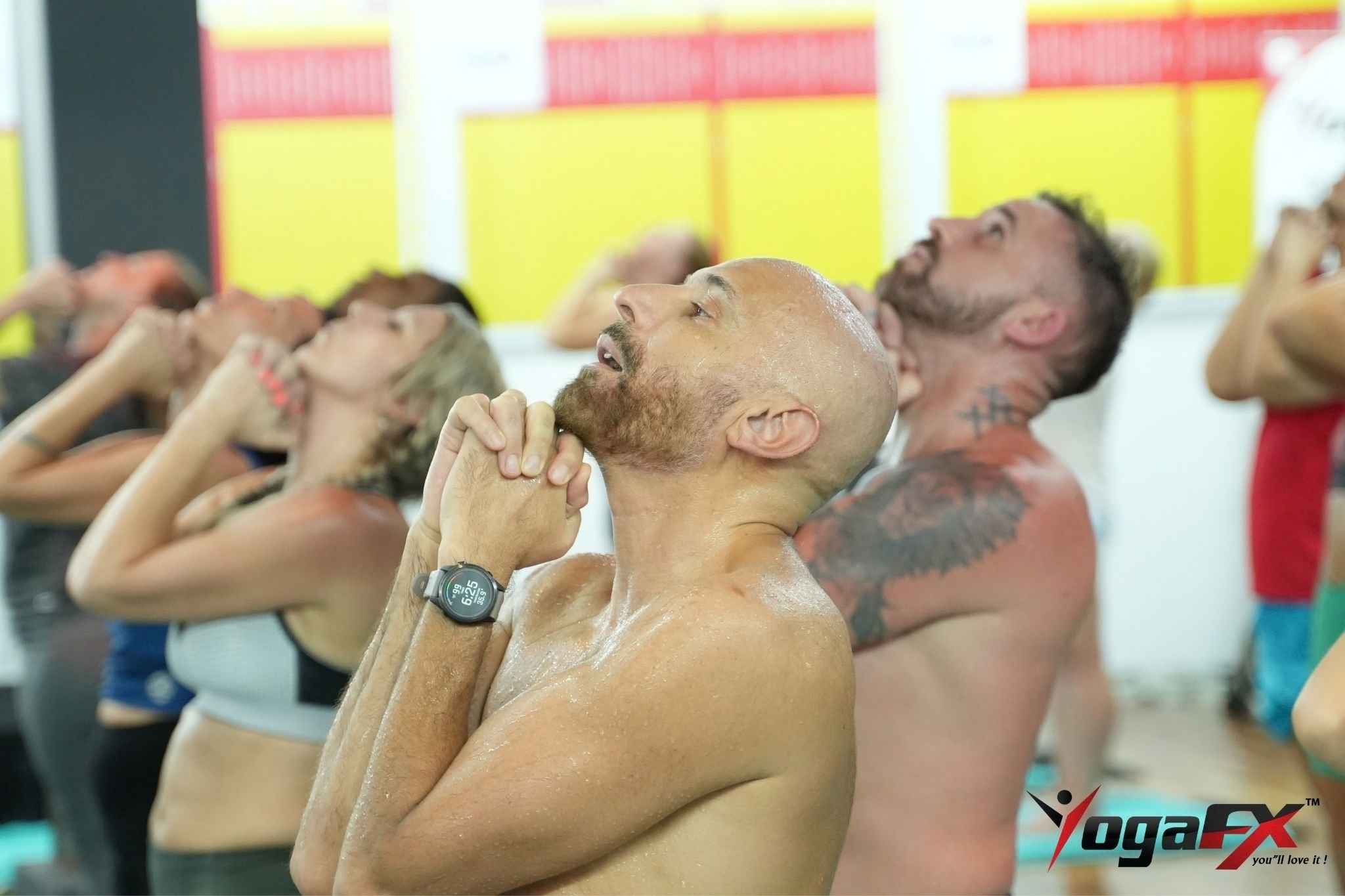
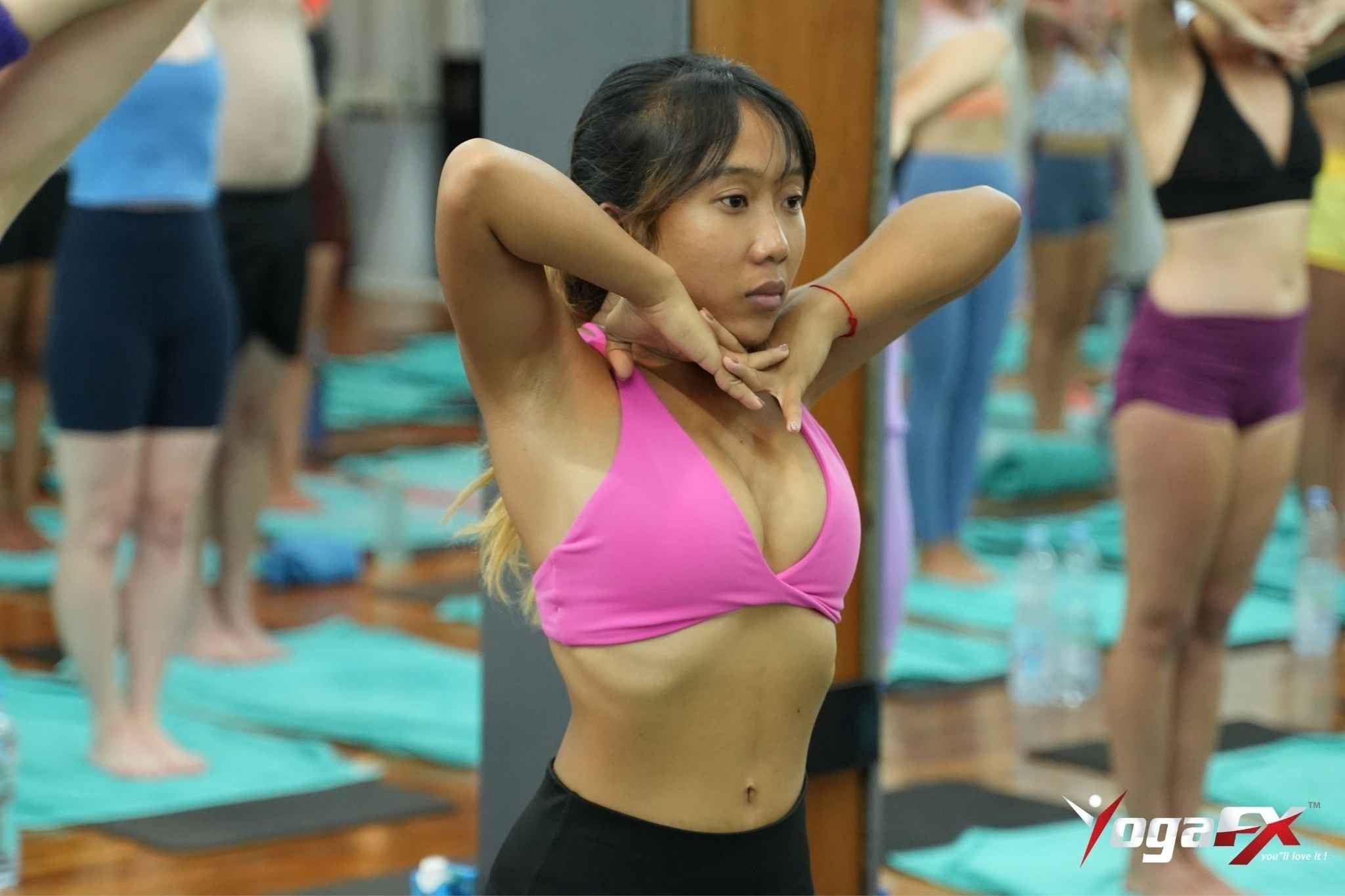
The first of the Bikram yoga breathing exercises starts with you standing tall, facing the mirror. Here is what you do:
- Stand tall. Keep your feet together, your spine long, and your shoulders away from your ears.
- Interlace your fingers. Rest them just under your chin, with your elbows pointing forward.
- Inhale through the nose. Breathe in slowly and let your elbows lift as your head tilts back.
- Exhale through the mouth. Breathe out slowly while your elbows lower and your chin returns to centre.
- Repeat with the teacher. Keep the pace even, and stay with the voice instead of rushing ahead.
What you should feel
This first of the Bikram yoga breathing exercises takes only a few minutes, but it sets the tone for the whole class. Your attention moves from the day you’ve had to the room, the heat, and the work ahead. Many students feel the ribs widen and the shoulders drop.
Why it comes first
Of all the Bikram yoga breathing exercises, this one is the gentlest. A full, slow breath uses more of your lung space than the shallow breathing most of us do at a desk. It also gives you a minute to check in before the effort starts. Many people link slow breathing with a calmer state, although little research covers this exact exercise.
Kapalbhati (Blowing in Firm): Step by Step
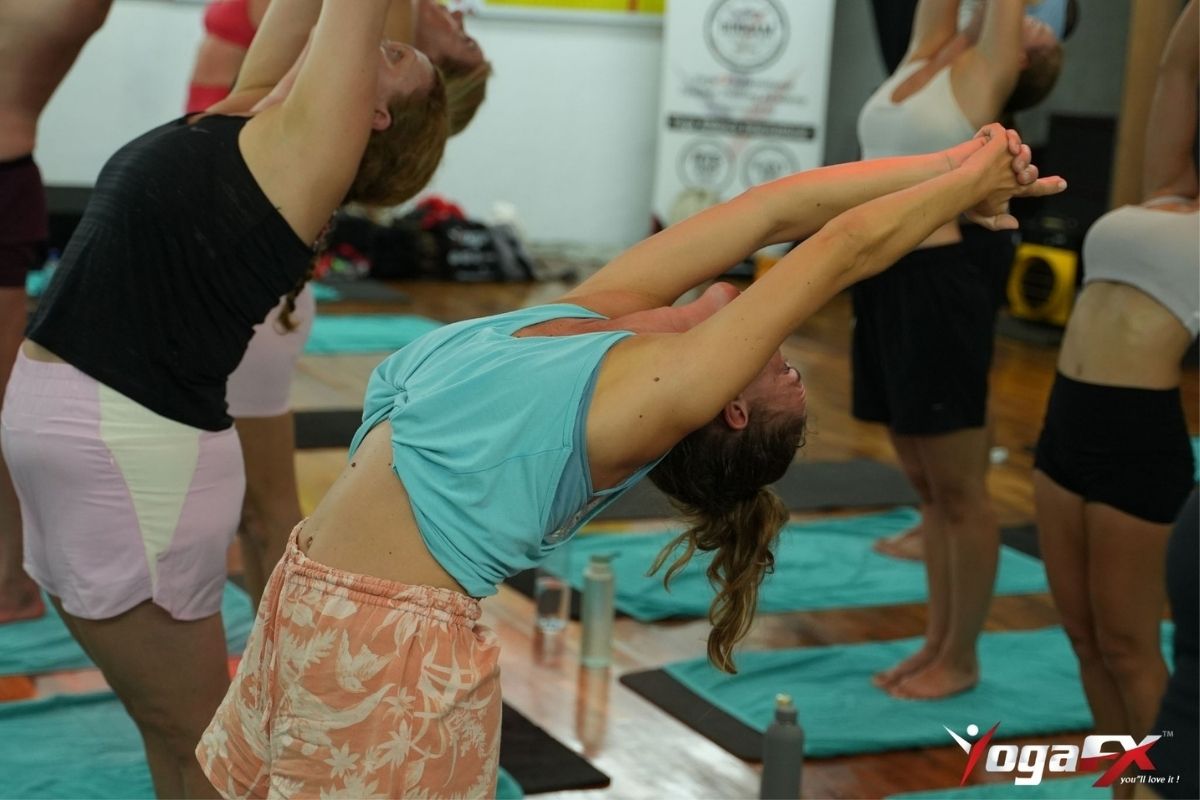
Kapalbhati is the second of the Bikram yoga breathing exercises, and it closes the class. Everything about it is the opposite of the opening breath, because the effort comes from the exhale and not the inhale. Here is the technique:
- Kneel down. Sit with your hips resting on your heels and your hands on your knees.
- Sit tall. Lengthen your spine and relax your face, jaw, and shoulders.
- Exhale sharply. Pull the belly in quickly so the breath leaves through the nose in a short, strong push.
- Let the inhale happen. Don’t pull the air in. Your belly relaxes, and the lungs refill on their own.
- Build a rhythm. Keep each pulse even, and go faster only as far as you can stay in control.
If the first exercise is the calm one, this one is the contrast. Many students tell us it is the part of class they notice most, because it feels so different from every posture before it.
What the name means
The name comes from Sanskrit. Kapal means skull or forehead, and bhati means shining. It’s a traditional reference to alertness, not a literal claim about the body. In the Bikram class, the teacher also calls it Blowing in Firm.
Why it feels like a core exercise
Each forceful exhale comes from a quick pull of the belly muscles, which pushes the diaphragm upward. That’s why many students say it feels closer to a core exercise than to relaxation. Of the two Bikram yoga breathing exercises, it’s the one that asks for the most effort. By now you’ve moved for most of 90 minutes, so the effort feels different.
Is Kapalbhati the Same as Breath of Fire?
This is one of the most common searches about Bikram yoga breathing exercises. The short answer is that the two terms overlap, but people don’t always use them in the same way. Different yoga traditions use “breath of fire” for several rapid breathing styles.
- In Kapalbhati, the exhale is active and the inhale is passive.
- In some breath of fire styles, both the inhale and the exhale are active.
- In a Bikram class, the dialogue is built around the passive inhale.
So if you learned a rapid breath somewhere else, follow your teacher’s cues in the room. The pattern you know may be close, but it won’t always match the Bikram yoga breathing exercises.
Bikram Yoga Breathing Exercises in a Hot Room
Bikram yoga breathing exercises feel different in the heat. Our classes run for 90 minutes at about 40 degrees Celsius and 40% humidity, from natural tropical heat and not electric heaters. Most students notice that their breath speeds up in the first postures, even before they feel tired.
Keep the breath steady
When the room is warm, it’s easy to gasp or to hold your breath without noticing. Both habits tire you out faster. Instead, aim for a smooth, even breath, and let the exhale be a little longer than the inhale.
Hydration matters here too. Sip water before class and again afterwards, because a dry mouth makes steady breathing harder.
Use the opening exercise as a reset
Standing Deep Breathing is your calibration point among the Bikram yoga breathing exercises. After it, you know what a calm breath feels like in this room. Later, when a posture gets hard, you can return to that feeling. If your breath turns ragged, ease off for a moment, then go back in.
What the Research Shows About Bikram Yoga Breathing Exercises
Research on Bikram yoga breathing exercises as a pair is thin. Research on Kapalbhati alone is growing, but it’s still early. A systematic review in Annals of Neurosciences examined four randomised controlled trials of the technique (see Roj et al., 2025). The reviewers reported that the studies pointed toward better lung function and attention.
They were also open about the limits. The paper describes the mechanisms behind these results as hypothetical, and it calls for more research. In other words, the results are promising, but they don’t settle the question.
A wider review looked at yogic breathing practices in healthy adults. It pooled 11 studies and linked these practices with better lung function measures, including peak flow (see Bandyopadhyay et al., 2026). Kapalbhati was one of many techniques in that review, so it can’t speak for the opening exercise alone.
Heat is a separate question. A six-week randomised trial of 290 healthy adults found that the hot yoga group improved on several well-being measures compared with a wait-list group (see Hui et al., 2022). That study looked at the practice as a whole, so it can’t tell us how much of the effect comes from the breathing.
What this means for you
- No study has tested the Bikram yoga breathing exercises inside a full class.
- Kapalbhati studies don’t cover the opening Standing Deep Breathing exercise.
- Results from healthy adults may not apply to you if you have a medical condition.
So treat the Bikram yoga breathing exercises as a skill to learn, not as a promise. Heated exercise and forceful breathing aren’t right for everyone. Please consult a healthcare professional before you start.
Bikram Yoga Breathing Exercises vs Other Yoga Breathing Techniques
Yoga uses many breathing styles, and it’s easy to mix them up. The Bikram yoga breathing exercises are only two of them, and each has a clear job inside a fixed class. Here is how they compare with a few well-known styles.
- Alternate nostril breathing. You close one nostril at a time to slow the breath. It’s a seated, quiet practice, and it isn’t part of the Bikram sequence.
- Ujjayi breathing. You narrow the throat slightly to make an audible, ocean-like breath. It’s common in flowing styles, but the Bikram dialogue doesn’t ask for it.
- Rapid abdominal breathing. This is the family Kapalbhati belongs to. The Bikram version is short, kneeling, and placed at the end of class.
None of these is better than the others. They simply do different jobs. The class stays the same each day, so you don’t have to choose a style. You follow the dialogue, and the right breath arrives at the right time.
Why the class starts slow and ends fast
The contrast isn’t an accident. The slow opening breath asks you to settle before the full 90-minute sequence begins. At the end, a slow breath would feel pleasant, but it wouldn’t train anything new. The rapid exhale works the diaphragm and the muscles between the ribs, which the rest of the class doesn’t target directly.
5 Common Mistakes With Bikram Yoga Breathing Exercises
Most mistakes with Bikram yoga breathing exercises come from trying too hard or from treating the breath as a formality. Watch for these five:
- Rushing the opening breath. The slow pace is the whole point. Speeding up skips the settling effect.
- Forcing Kapalbhati too soon. New students often push harder than their fitness allows, and that can bring on lightheadedness. Reduce the force before you reduce the count.
- Pulling the inhale in. The inhale is passive. Gulping air fights the rhythm and tires the wrong muscles.
- Holding the breath in the heat. If you clench your jaw or stop breathing, relax your face and return to the cue.
- Treating either exercise as optional. Both bookend the class on purpose, so give each one your full attention.
One habit helps with every mistake on this list, and it keeps the Bikram yoga breathing exercises useful instead of stressful. Check in with your breath at the start of each posture, and not only during the two breathing exercises.
When to Ease Off or Ask a Doctor About Bikram Yoga Breathing Exercises
Bikram yoga breathing exercises are gentle for most people, but Kapalbhati and a hot room ask more of the body. Please talk to a doctor before you start if any of these apply to you:
- Heart or blood pressure concerns. Forceful breathing and heat both change how hard the body works.
- Lung conditions. This includes asthma, because rapid exhales can feel intense.
- Recent surgery or abdominal problems. Kapalbhati uses a strong belly contraction.
- Pregnancy. Our guide to Bikram yoga and pregnancy explains the questions to ask your doctor.
You can always sit out, rest, or soften the effort in class. Tell the teacher before you start if you have a medical condition. That way, they can watch your pace and help you stay comfortable. This page is general information and isn’t medical advice.
What to Expect From Bikram Yoga Breathing Exercises in Your First Class
If you’re new, the first few minutes can feel unfamiliar. You’re standing in a warm room, listening to a voice give you cues, and you may wonder if you’re doing it right. That’s normal, and every student starts there.
- The opening feels slow. After a busy day, a long breath can feel long. Let it be slow.
- The closing feels hard. By the end you’re tired, so the quick exhales ask for focus. Keep them small and steady.
- Nobody is watching your count. The dialogue sets the pace for the whole room, and you only need to follow it.
Our Bikram yoga for beginners guide explains what else to expect, from what to bring to how to pace yourself.
How to Practise Bikram Yoga Breathing Exercises at Home
You don’t need a hot room to learn the pattern of the Bikram yoga breathing exercises. A few minutes a day makes the dialogue feel familiar, so your first class feels calmer. Use these tips:
- Start with the slow breath. Stand tall, and practise slow inhales and exhales for a few minutes.
- Learn Kapalbhati gently. Kneel, and try only a handful of soft pulses at first.
- Keep water nearby. Sip steadily before and after practice.
- Stop if you feel dizzy. Sit back, breathe normally, and rest until it passes.
Home practice of the Bikram yoga breathing exercises is a rehearsal and not a replacement. A teacher in the room can correct your pace far better than a video can. Keep the effort gentle, and stop if anything feels wrong.
How We Teach Bikram Yoga Breathing Exercises at YogaFX
We teach the Bikram yoga breathing exercises the same way in every class at our Seminyak and Canggu studios. YogaFX has trained teachers in Bali since 2017, and the studios are open every day for Bikram Hot 26&2 classes.
Mr. Ian Terry, an E-RYT 500 with more than 12,000 teaching hours, leads the teaching standard. He trained for five years, from 2014 to 2019, alongside the founder of the Bikram Hot 26&2 method. New students hear one message about Kapalbhati again and again: lower the intensity before you lower the count.
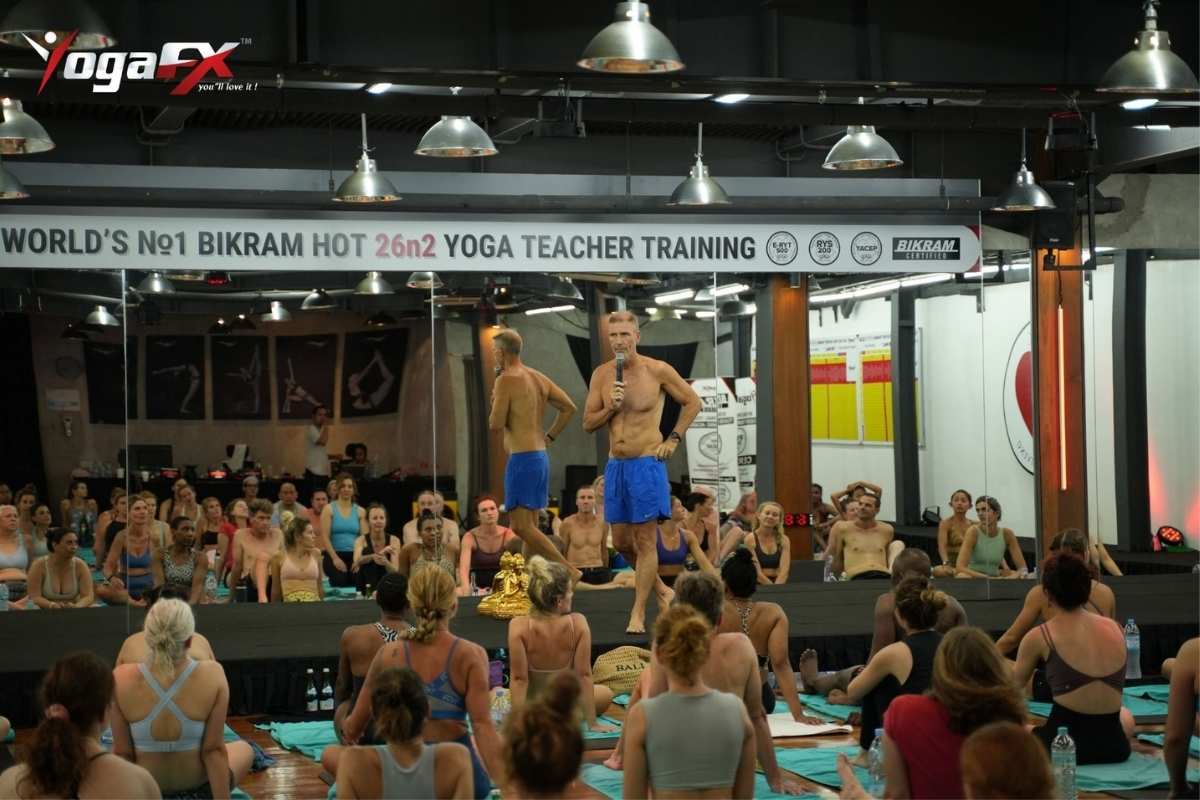
If you’d like to teach the dialogue yourself one day, both Bikram yoga breathing exercises are part of our training. The video below introduces the programme, and our page on Bikram yoga teacher training in Bali has the details.
FAQ: Bikram Yoga Breathing Exercises
What are the two breathing exercises in Bikram yoga?
The two breathing exercises are Standing Deep Breathing (Pranayama) and Kapalbhati, also called Blowing in Firm. Standing Deep Breathing opens the class with slow, deep breaths while you stand. Kapalbhati closes it with short, forceful exhales while you kneel. Both sit alongside the 26 postures in every 90-minute class.
How do you breathe in Bikram yoga?
In Standing Deep Breathing, you inhale through the nose and exhale through the mouth. In Kapalbhati, the exhale is a short, strong push through the nose, and the inhale happens on its own. In the postures, keep your breathing steady and follow your teacher’s cues. Never hold your breath.
Does yoga improve breathing?
It may. A 2026 review of 11 studies in healthy adults linked yogic breathing practices with better lung function measures. Most of those studies tested seated techniques, not a heated Bikram class, so the result is encouraging but not proof. Check with a doctor first if you have a lung or heart condition.
Is Kapalbhati the same as breath of fire?
The terms overlap, and different traditions use them in different ways. In Kapalbhati the exhale is active and the inhale is passive. Some versions of breath of fire make both phases active. In a Bikram class, follow the passive inhale that your teacher cues in the dialogue, even if you learned a rapid breath elsewhere.
Why do the breathing exercises make me feel lightheaded?
Forceful or fast breathing can leave beginners lightheaded, especially in a warm room. Soften the effort first, then slow the rhythm. Sit or kneel and breathe normally until it passes, and tell your teacher before class if it happens often. If dizziness continues, stop and speak to a doctor.
Still have questions? Message Mr. Ian and the YogaFX team on WhatsApp and we will answer them personally. Or claim your Free Guest Pass and feel the Bikram yoga breathing exercises in a real class at our Seminyak or Canggu studio.