
Is hot yoga a cardio workout? Partly. In the studies we could check, a heated class lifts your heart rate into a moderate or even hard zone, yet it uses only about a quarter of your oxygen capacity. So it works as light cardio, not as a swap for running, cycling or swimming.

This guide answers is hot yoga a cardio workout with real data. It covers what researchers measured, where your own heart rate zones sit, and how a 90-minute class in our Bali studios moves through them. Mr. Ian Terry, E-RYT 500, has taught more than 12,000 hours, and the same advice comes up in every class: read your body first and the number second.
Is hot yoga a cardio workout? The Short Answer for Bali Students
The honest verdict is mixed, so is hot yoga a cardio workout or not? A hot class asks a lot of your heart, but it asks much less of your lungs and big muscles. Three findings explain why:
- Heart rate runs high. For example, nineteen practitioners in a Colorado State study averaged about 160 beats per minute across 90 minutes.
- Oxygen use stays low. Sixteen experienced students in a heated one-hour class used about 25% of their maximum oxygen uptake.
- Calories land near a brisk walk. The Colorado State team matched the class to walking at 3.5 miles an hour for the same time.
None of that makes the class a poor workout. It makes it a different one. Original Hot 26&2 Yoga builds balance, strength endurance and flexibility, and the cardio effect is a side benefit. If your goal is a stronger engine, plan some steady movement outside the room.
If you want a teacher-training view of the same studies, we also like this write-up of the cardio question for future instructors. Here, we focus on what it feels like to practise in Bali, because that is where our students ask the question.
Is Hot Yoga a Cardio Workout? What Researchers Measured
Hot yoga research is small, so it pays to read each study closely. When people ask us whether hot yoga is a cardio workout, we point to these two first. Two papers we could open in full give the clearest picture. Each one measured real bodies in a real class, not a guess from a formula.
The Colorado State study: a high heart rate, a modest workload
In 2014, researchers at Colorado State University reported results from 19 Bikram practitioners aged 18 to 40, 11 women and 8 men. Their hearts averaged about 160 beats per minute, and core temperature averaged 100.3°F.
The calorie count was the surprise. Men burned about 460 calories and women about 330 over 90 minutes. The lead researcher compared that to a brisk 3.5 mph walk for the same time, and put the gap between men and women down to body size.
He also warned that heart-rate formulas overstate effort in the heat. Claims of 1,000 calories in a class, he said, are inflated. One more detail is worth knowing: the work was partly funded by Bikram-affiliated groups, and the paper was still in draft when the news release came out.
The Lambert study: heat adds less than you might expect
A 2020 paper in the International Journal of Exercise Science put 16 experienced practitioners through a one-hour Bikram sequence twice, once at 105°F and once at 74°F. The average age was about 40, and the room humidity was 40%.
Heart rate averaged 113 beats per minute in the heat and 109 in the cool room. Energy use was 156 and 151 calories. Because neither gap was statistically significant, the authors saw no clear heat effect on effort. Oxygen use was 25.3% of maximum in the heat, and the authors put the whole session under 30%.
In plain terms, the heat didn’t turn a slow-paced class into interval training. Students sweat more, yet the workload stays light, at roughly 2.5 METs. So is hot yoga a cardio workout when the room is hot? Only a light one. The same paper found only one of many flexibility measures improved in the heat group.
A wider review adds context. A 2025 systematic review by Willmott and colleagues covered 43 studies and 942 participants. It links regular Bikram practice with better flexibility, bone density and wellbeing, which fits what we see in the room.
Hot Yoga Heart Rate Zones: Find Yours by Age
A heart rate zone is a band of your maximum heart rate. A common rule of thumb estimates that maximum as 220 minus your age. It is only a rough guide, so treat the numbers below as a starting point, not a lab result.
We use three simple bands. They are our teaching shorthand, not a medical standard: easy is 50 to 70% of maximum, steady is 70 to 85%, and hard is above 85%.
| Age | Estimated maximum | Easy zone (50-70%) | Steady zone (70-85%) | Hard zone (85%+) |
|---|---|---|---|---|
| 25 | 195 | 98 to 136 | 136 to 166 | 166 and up |
| 35 | 185 | 92 to 130 | 130 to 157 | 157 and up |
| 45 | 175 | 88 to 122 | 122 to 149 | 149 and up |
| 55 | 165 | 82 to 115 | 115 to 140 | 140 and up |
Now place the studies on that map. So is hot yoga a cardio workout? It depends on whose heart you measure. The Lambert group averaged 113 beats at about age 40, which is roughly 63% of an estimated 180 maximum. That is easy-zone work. A 30-year-old in the Colorado State group, at 160 beats, would sit near 84% of an estimated 190, right at the top of the steady zone.
Is Hot Yoga a Cardio Workout on Your Watch? Use the Talk Test
A fitness watch struggles in a hot, sweaty room, so use the talk test instead. In the easy zone you can speak in full sentences. In the steady zone, speech turns choppy. In the hard zone, you manage only a few words.
If you can’t breathe through your nose between postures, ease off. That isn’t weakness. It’s exactly what the dialogue asks of you, and it keeps your heart rate from running ahead of your fitness.
Heart Rate Zones Through the 26&2 Sequence in Bali
No study we found tracked heart rate through all 26 postures one by one. So what follows is our teaching experience in the Seminyak and Canggu studios, not a measurement. Treat it as a map of where the effort tends to build, instead of a lab report.
The opening breathing and standing series
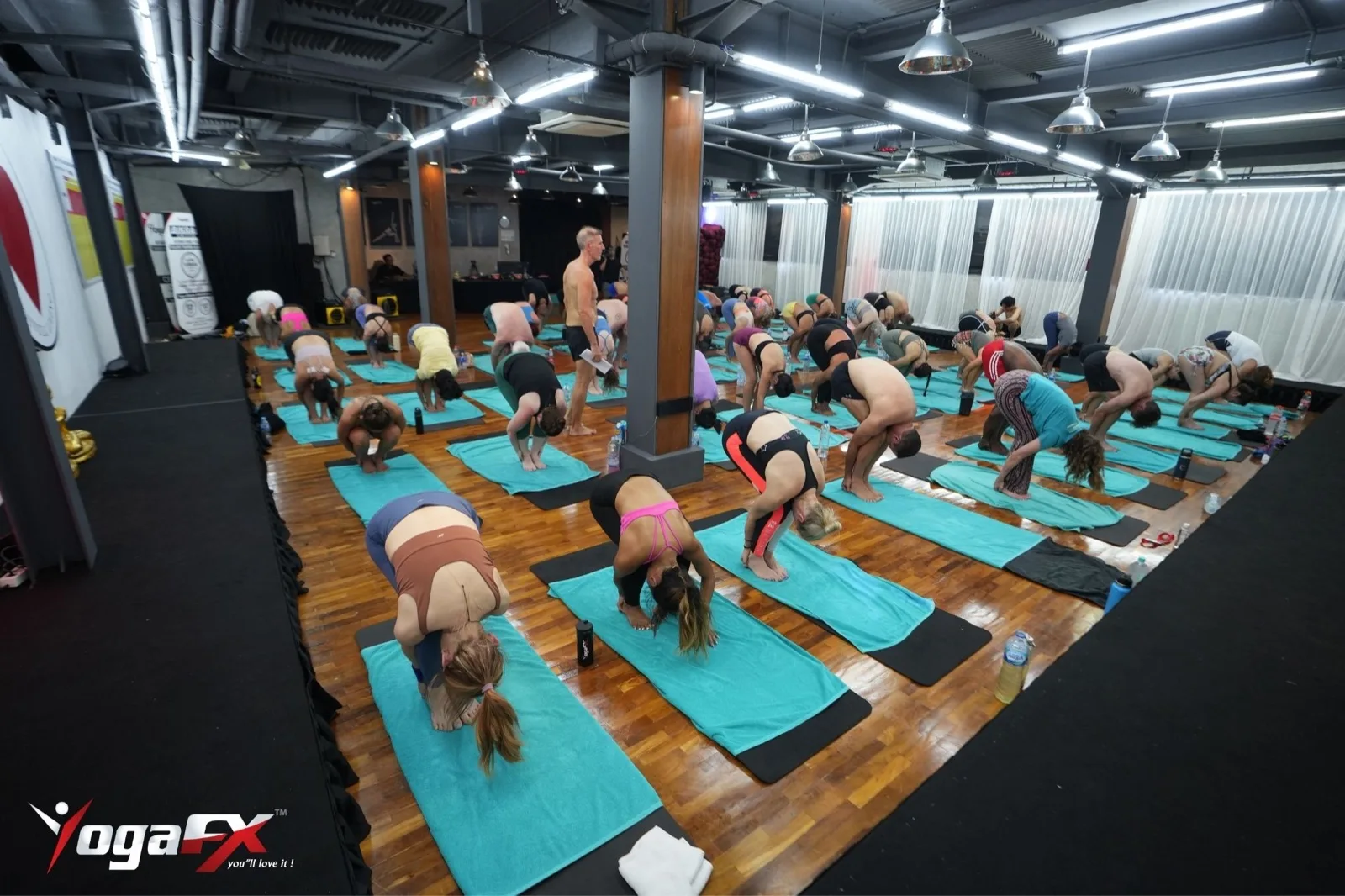
The first minutes are easy-zone work. Then, as the standing series starts, effort builds quickly. Big leg muscles, long holds and one-leg balance push most students into the steady zone, with brief visits to the hard zone. This is the nearest thing to a cardio block in the class.
For example, a student who feels fine in the first ten minutes can still hit a wall in the standing series, simply because the effort stacks up with the heat.
Balancing postures: effort plus concentration
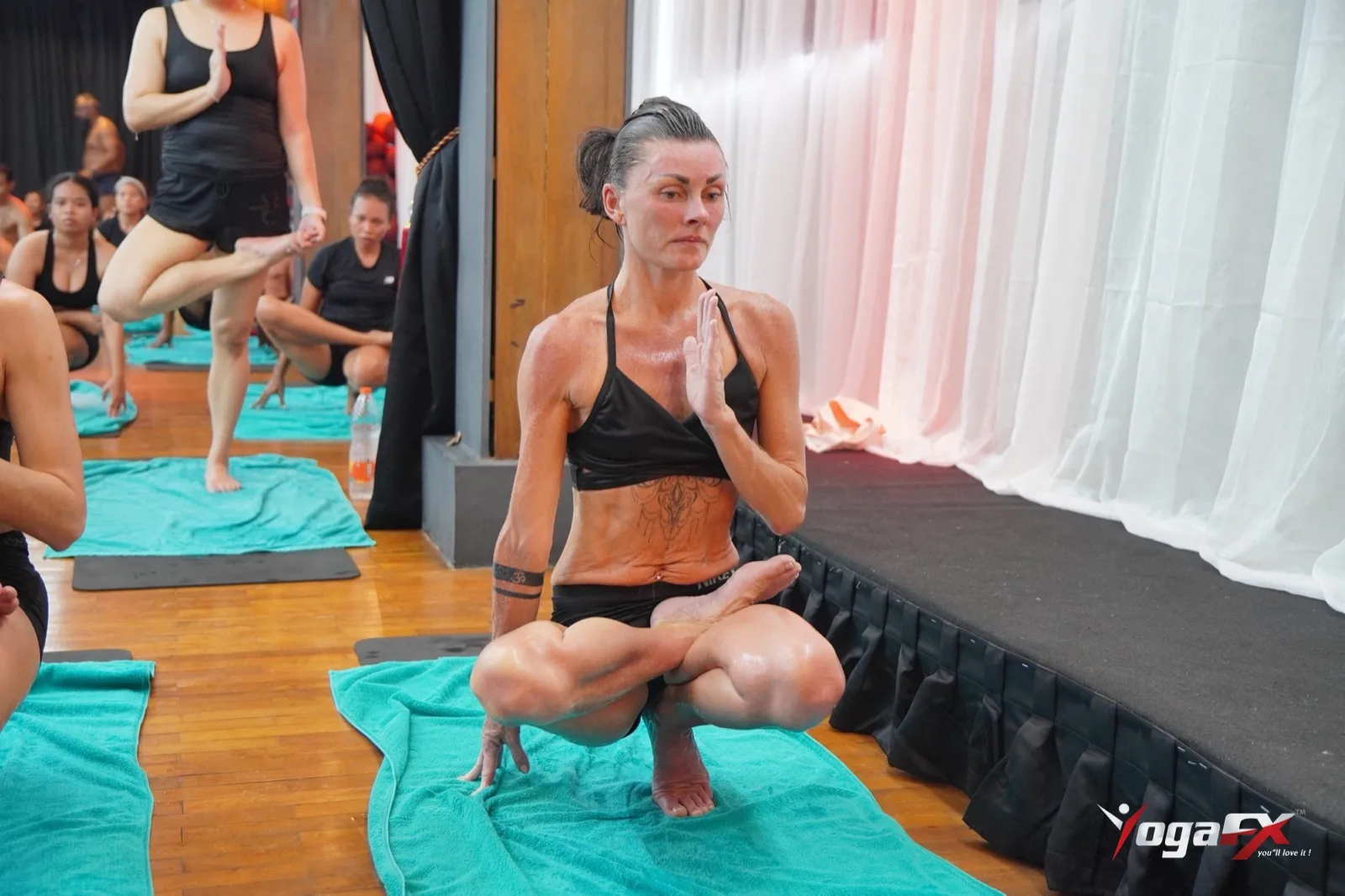
Balancing postures such as Standing Bow Pulling Pose and Eagle Pose add focus to the effort. Beginners often tense up and hold their breath here, which raises heart rate without helping the posture. A calm exhale does more than gritting your teeth. Besides, a steady breath keeps you upright when the room feels heavy, so use it.
The floor series: temperature, not speed
On the floor, your muscles do less, yet your body keeps heating. As a result, heart rate usually settles into the easy or steady zone. This is also where a quiet student can slip into heat strain, so our teachers watch for flushed faces, nausea and students who stop sweating.
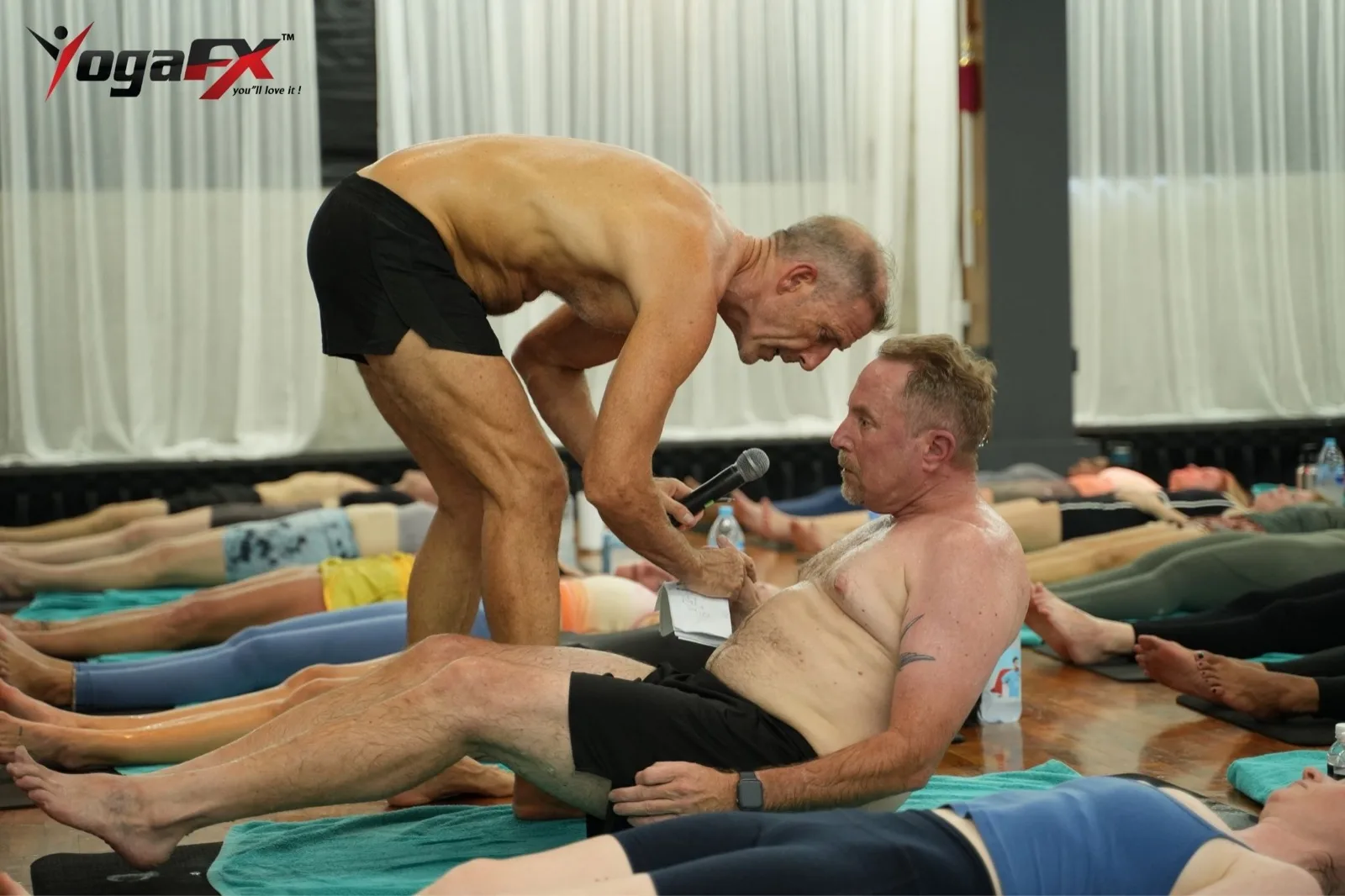
The final breathing exercise brings a short, fast rise and then a calm return. That recovery is part of the training. How quickly you settle tells you more about your fitness than any peak number, because a fitter heart returns to the easy zone sooner.
Bali’s Natural Heat and Your Heart
Our classes run at about 40°C and roughly 40% humidity for 90 minutes. At YogaFX, that heat comes from Bali’s tropical air and not from electric heaters. You can read more in our guide to how hot Bikram yoga really is and in why we practise without electric heaters.
Here is what the research does and does not tell us. The Lambert study used a heated room, and it found little extra heart rate from the heat. Nobody has measured the same thing in a naturally heated tropical studio. So is hot yoga a cardio workout any more in Bali’s air? We can’t say, and we won’t pretend we can.
What we can say is practical. Humid heat makes you sweat early, and that’s normal. Drink steadily before and after class, and keep your effort steady. Our guide to hot yoga and your heart covers the cardiovascular side in more depth.
5 Ways to Get More Cardio Around Your Hot Classes
Is hot yoga a cardio workout you can rely on alone? No. If you love the class and want a stronger aerobic base, build it around the room, not inside it. Pushing harder in 40°C is risky, so these habits work better:
- Add two brisk sessions a week. A class burns about what a brisk walk does, so walking, cycling or an ocean swim stacks neatly on top.
- Move with purpose between postures. Step in and out smoothly instead of rushing. Steady movement keeps you working without spikes.
- Track a trend, not a number. Compare your average heart rate over several weeks, and ignore the calorie figure on your watch.
- Build fitness outside the room. A fitter heart recovers faster between postures, so the same class feels easier over time.
- Hydrate all day. Dehydration pushes heart rate up without adding any training value.
| Day | Session | Why it helps |
|---|---|---|
| Monday | 90-minute 26&2 class | Balance, strength endurance and flexibility |
| Tuesday | 40-minute brisk walk or beach run | Steady aerobic work, easy on the joints |
| Thursday | 90-minute 26&2 class | Repeat the sequence and watch your recovery |
| Friday | 30-minute swim or bike ride | Extra aerobic volume without extra heat |
| Sunday | Optional class or rest | Recovery before the week restarts |
If weight loss is part of your plan, remember that one class is a modest calorie burn. Because one class burns about what a brisk walk does, you should not expect big scale changes from classes alone.
When a High Heart Rate Becomes a Warning
Is hot yoga a cardio workout that is safe for everyone? A high heart rate in a hot room is normal for most healthy adults. A heart rate that stays high while you feel unwell is not. Stop and sit down if you notice any of these:
- Chest pain or pressure. Stop at once and get urgent medical help.
- A racing or uneven heartbeat that does not settle within a minute or two of rest.
- Dizziness, confusion or a pounding headache. These are classic early signs of heat strain.
- Nausea, cramps or a sudden stop in sweating. Cool down, drink, and tell your teacher.
Our teachers, led by Mr. Ian, always say the same thing: sitting or lying down on your mat is better than pushing through. If you have a heart condition, take blood pressure medication or are pregnant, speak to your doctor before any heated class. Our guide on whether hot yoga is safe goes through who should take extra care.
What Our Students Say About the Effort
Students often ask us is hot yoga a cardio workout, and numbers alone cannot show how a class feels from inside. These two comments come word for word from public Google reviews of our classes. We use first names only.
“Ian is a good yoga instructor. He gave a clear instructions and make sure that we do the pose correctly.”
Tuti, Google review, 2020
“he is really patient and energetic love it”
Udes, Google review, 2020
Notice what both students mention: care and clear guidance. Pushing a body in the heat only works when someone is watching how it copes. We hold more than 550 reviews across Google, Yoga Alliance and YouTube, and you can read them before you book.
Try a Class and Read Your Own Heart Rate
Is hot yoga a cardio workout for you? The best way to find out is to feel it yourself, with a teacher watching. Our Seminyak and Canggu studios are open every day from 06:00 to 22:00, and you can come to a single class or build a regular habit with a membership.

New to Original Hot 26&2 Yoga? Claim a free guest pass and take your first class on us. Message the YogaFX team on WhatsApp, and we will help you pick a time. You can also read our guide to drop-in classes in Bali first.
FAQ
Is hot yoga a good cardio workout?
Is hot yoga a cardio workout? A modest one. Heart rate can climb into the moderate or hard zone, yet oxygen use stays near a quarter of your capacity. Think of a class as light cardio with real balance, strength and flexibility gains. Add walking, cycling or swimming if aerobic fitness is your main goal.
Is Bikram yoga a cardio workout?
Mostly no, at least not in the way running is. The studies we checked used Bikram-style classes and found raised heart rates but low energy use, about the level of a brisk walk. Original Hot 26&2 Yoga builds balance, flexibility and strength endurance first, and cardio comes second.
Does hot yoga increase heart rate?
Yes, but by how much depends on the person and the class. One Colorado State study averaged about 160 beats per minute over 90 minutes. A one-hour study of experienced students averaged 113 beats per minute in a heated room. Age, fitness and the posture you are holding all change the number.
Is hot yoga cardio or strength training?
It sits closer to strength endurance, balance and flexibility work than to cardio. You hold many postures for long periods, so your legs and core work steadily while your heart rate drifts up with the heat. For strong aerobic gains, add steady movement such as brisk walks on other days.
What heart rate is normal during hot yoga?
There is no single normal. Most healthy adults sit somewhere between the easy and steady zones, and brief peaks into the hard zone can happen in standing postures. A better test is how you feel. If you cannot breathe calmly, or you feel dizzy, sit down and rest.
Still have questions? Get your free guest pass
Message Mr. Ian and the YogaFX team on WhatsApp and we will answer them personally. Our Seminyak and Canggu studios are open daily from 06:00 to 22:00.
This article is for general education and is not medical advice. If you have a heart condition, high blood pressure or any health concern, consult a healthcare professional before practising in a heated room.
 Mr. Ian Terry