A standard Bikram yoga class lasts 90 minutes. In that time you move through 26 postures and 2 breathing exercises in a fixed order, in a room held around 40°C with about 40% humidity. Some studios also sell 60-minute versions, but they cut parts of the sequence. At YogaFX in Bali, every class is the full 90 minutes.

Most pages stop at that number. This guide goes further. It shows where each minute of a Bikram yoga class goes, why the length is 90 minutes, what shorter formats leave out, and how much time to block out in your day.
It draws on the teaching of Mr. Ian Terry, E-RYT 500, founder of YogaFX. He has taught more than 12,000 hours and has trained over 1,500 graduates from 80+ countries since 2017.
How Long Is a Bikram Yoga Class?
The traditional answer is simple: 90 minutes, every time. The sequence never changes, so the length doesn’t change either. Whether you go on a Monday morning or a Saturday night, a full Bikram yoga class follows the same clock.
Here are the core facts in one place:
- Length: 90 minutes from the first breath to the final rest.
- Content: 26 postures and 2 breathing exercises, always in the same order.
- Room: about 40°C (105°F) with around 40% humidity.
- Teaching: a scripted dialogue, with no music and no demonstration from the teacher.
You may also see the method called Original Hot 26&2. It is the same sequence and the same 90-minute format. For a closer look at the heat itself, read our guide on how hot Bikram yoga is.
Where the 90 Minutes Go: A Minute-by-Minute Breakdown
Knowing that a Bikram yoga class is 90 minutes long helps. Knowing what happens inside those minutes helps more, because it tells you when the hard part comes and when you can rest. At YogaFX, every Bikram yoga class runs in three phases.
| Phase | Minutes | What happens |
|---|---|---|
| 1. Standing Deep Breathing | 0 to 10 | Pranayama breathing in a standing position to open the lungs and warm the joints |
| 2. Standing Series | 10 to 60 | 12 standing postures for strength, balance and endurance |
| 3. Savasana and Floor Series | 60 to 90 | A short rest, then backbends, twists and forward folds on the mat, ending with Blowing in Firm |
Phase 1: Standing Deep Breathing (minutes 0 to 10)
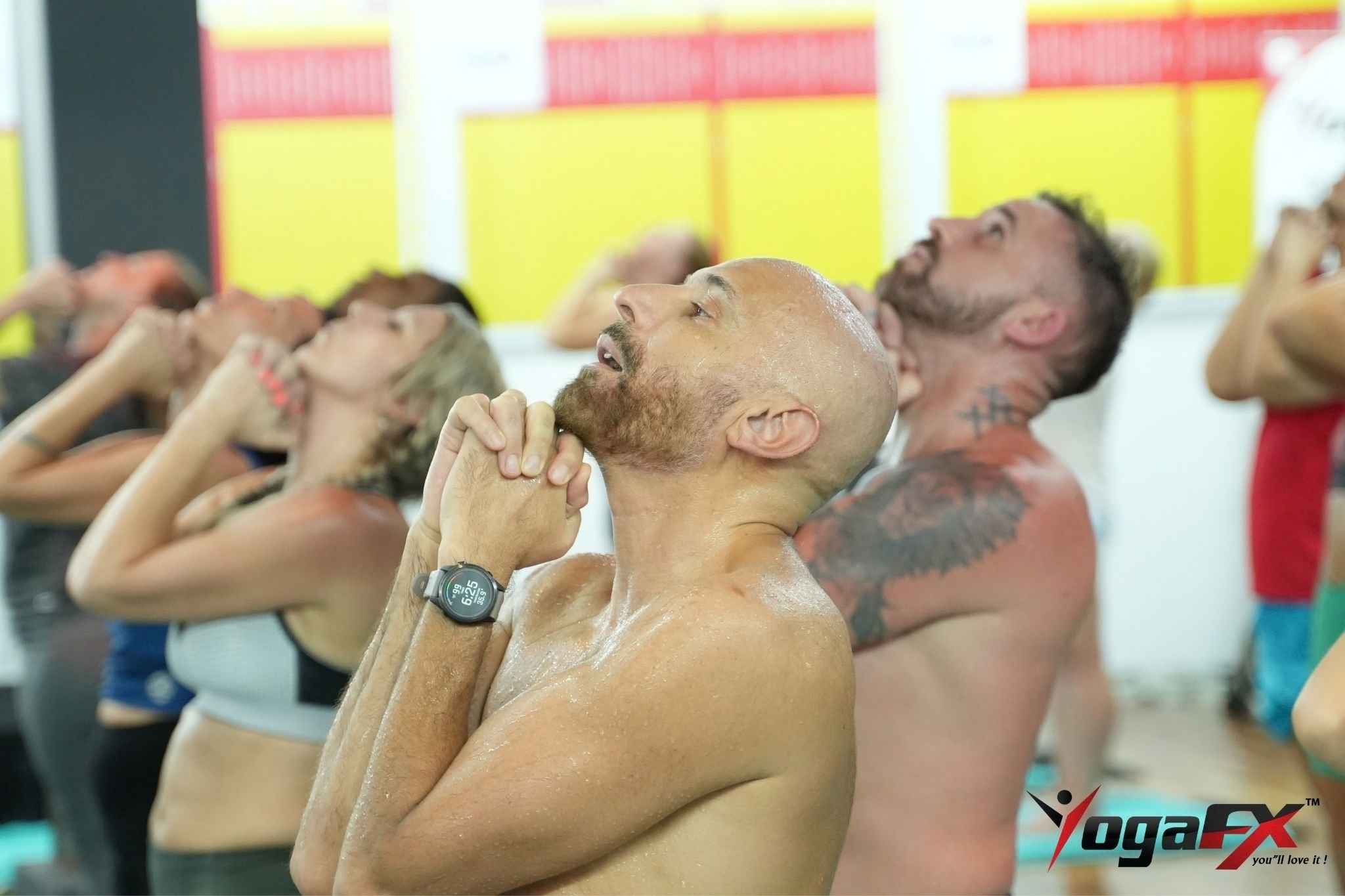
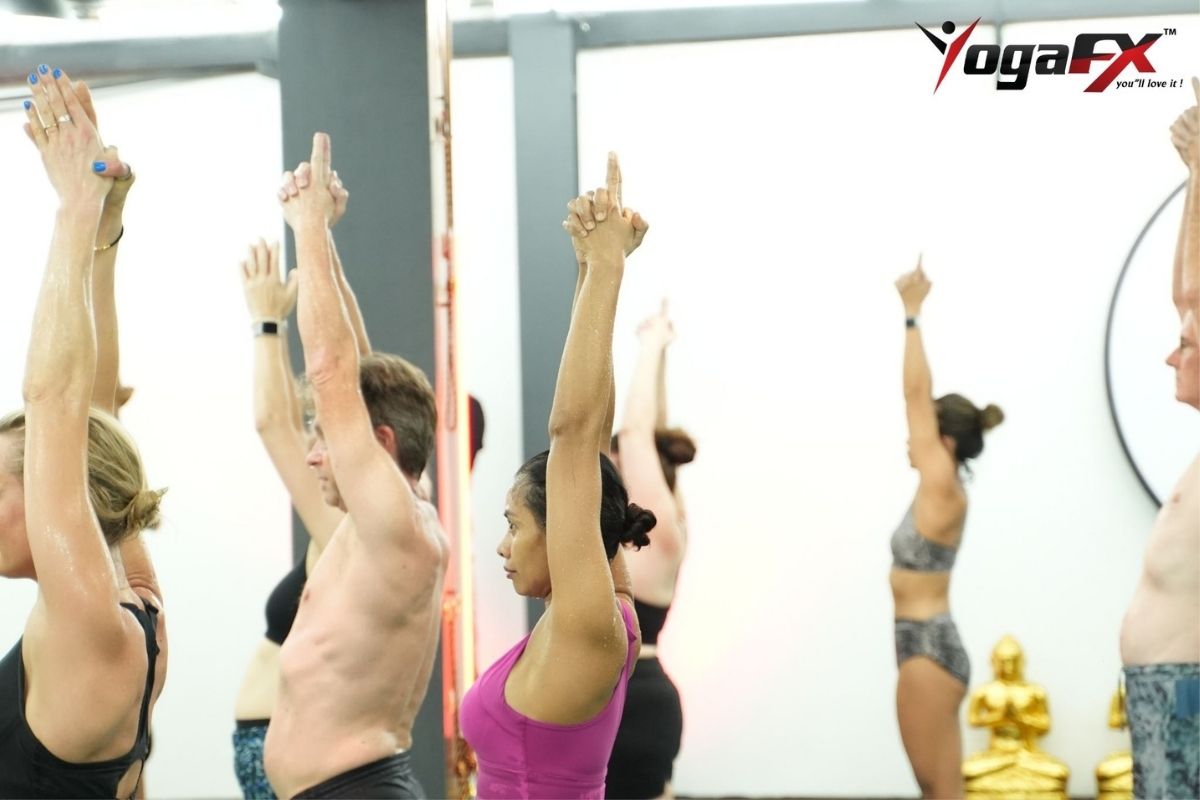
The class opens with ten minutes of deep breathing in a standing position, known as Pranayama. You lift your elbows, breathe in slowly through the nose, then breathe out as your head tilts back. No posture comes before it.
This phase of the Bikram yoga class has a clear job. It aims to expand the lungs, bring oxygen into the blood and warm up the shoulders and neck before any stretching begins. For beginners, it is also the moment the body starts to adjust to the heat.
Phase 2: The Standing Series (minutes 10 to 60)
Next comes the longest phase of the Bikram yoga class: 50 minutes on your feet. It covers 12 standing postures, and most of them are done twice. This is where your heart rate climbs and the sweat really starts.
The 12 standing postures, in order, are:
- Half Moon Pose
- Hands to Feet Pose
- Awkward Pose
- Eagle Pose
- Standing Head to Knee
- Standing Bow Pulling
- Balancing Stick
- Standing Separate Leg Stretching
- Triangle Pose
- Standing Separate Leg Head to Knee
- Tree Pose
- Toe Stand
Together they build core strength, leg strength, balance and cardiovascular endurance. In Bali the room is warmed by natural tropical heat rather than electric heaters. That warmth helps muscles soften, so you can stretch with more ease and less force.
Ask anyone after their first Bikram yoga class, and they’ll tell you the standing series is where time feels slowest. For example, a 60-second hold in Balancing Stick can feel like five minutes. Each posture is short, though, and a brief pause follows every set.
Phase 3: Savasana and the Floor Series (minutes 60 to 90)
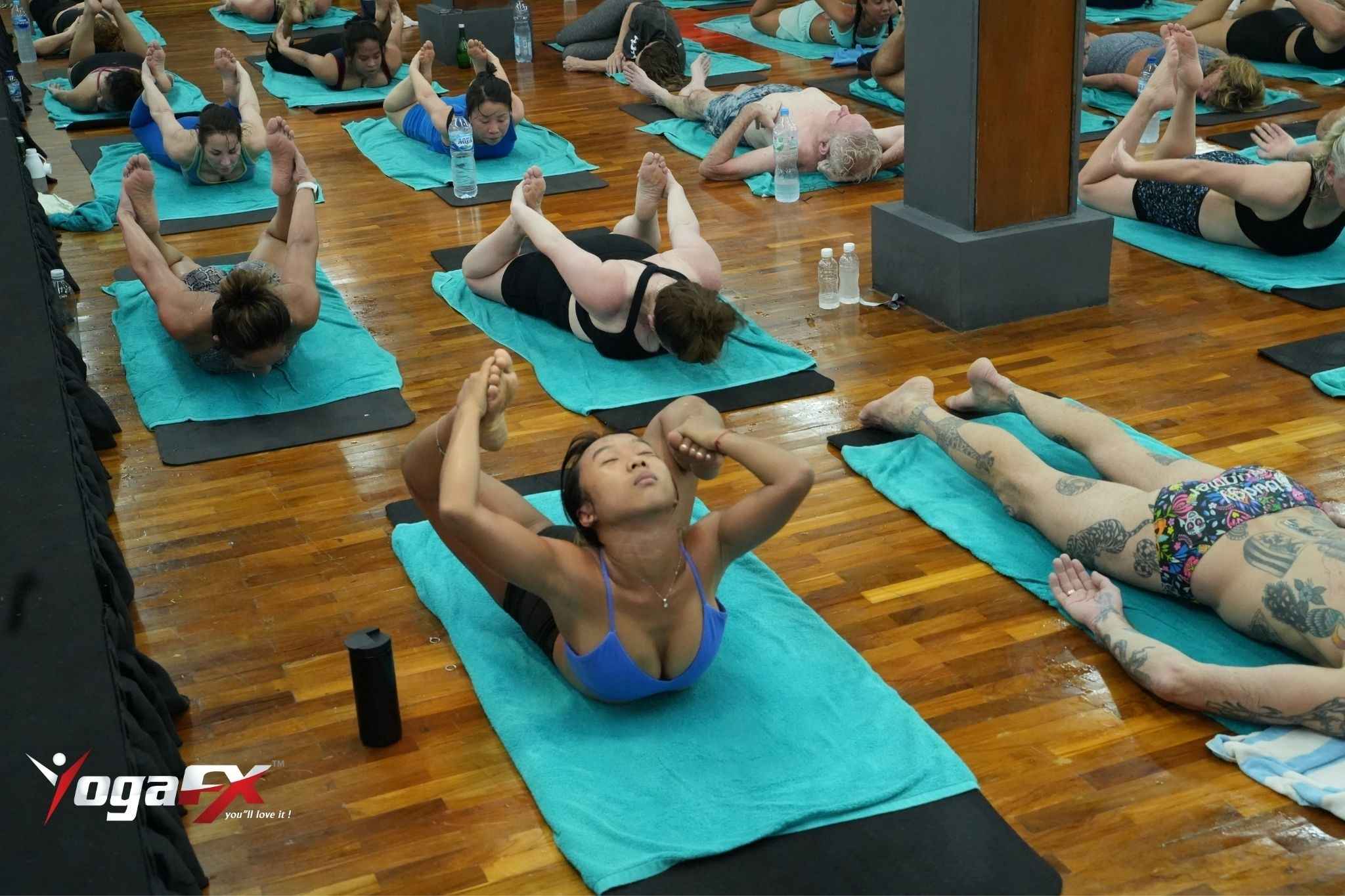
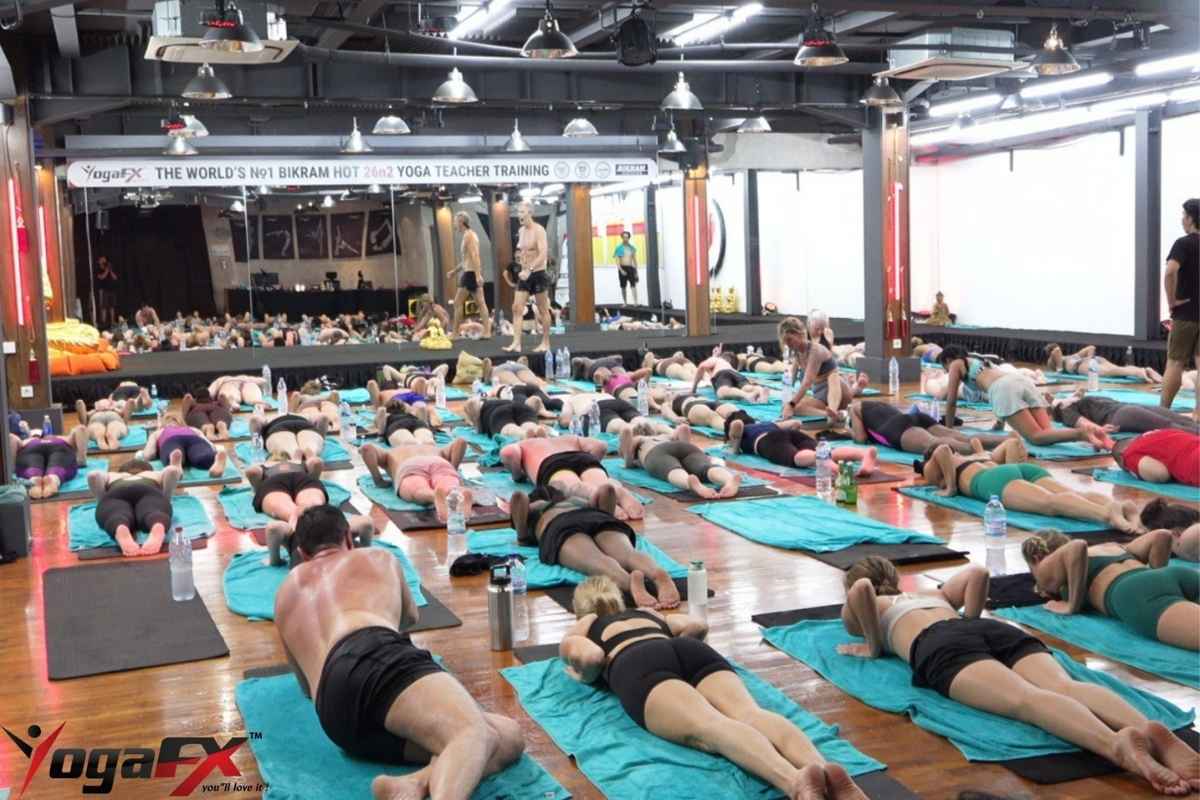
At the one-hour mark, you lie down for a short Savasana, or corpse pose. This restful transition lets your heart rate settle. Then the final 30 minutes happen entirely on the mat.
The floor series mixes three kinds of movement:
- Backbends such as Cobra, Locust, Bow and Camel, which work the muscles along the spine.
- Forward folds such as Half Tortoise, Rabbit and Head to Knee with Stretching, which lengthen the back of the body.
- A spine twist near the end, which rotates the spine in both directions.
Short Savasanas sit between the floor postures, so this phase feels calmer than the standing series. The goal is to strengthen and mobilise the spine. Teachers also describe the folds and compressions as working through the abdomen.
The class ends with Kapalbhati, also called Blowing in Firm. You kneel and push short, sharp breaths out through the mouth while the belly snaps in. Then comes a final rest. You can stay in Savasana as long as you like before you leave the room.
Want every posture explained in detail? See our full guide to all 26 Bikram yoga poses in order.
Why Is a Bikram Yoga Class 90 Minutes Long?
The 90-minute length of a Bikram yoga class isn’t random. It comes from how the sequence is built. Three reasons explain it.
- Two sets of most postures. The first set opens the body. The second set lets you go deeper, because the muscles are already warm.
- Rest is part of the method. Short pauses and Savasanas give the heart and breath time to recover between efforts. Cutting them makes the class feel rushed.
- Each posture prepares the next. The order moves from breathing to standing work to the spine. Skipping parts breaks that chain.
New students at YogaFX often hear that the length is part of the point. Ninety minutes is long enough to get past the “I want to leave” moment. That moment usually arrives somewhere in the standing series, and most people find it passes.
There is also a practical side. Because the class never changes, you can track your progress honestly. If Balancing Stick felt impossible in week one and steady in week six, you know the change is yours, not a change in the routine.
60, 75, 45 and 30-Minute Classes: What Gets Cut
Search for a Bikram yoga class near you, and you may find 60-minute, 75-minute or even 30-minute options. These formats are popular because they fit a lunch break. Still, they aren’t the same Bikram yoga class in less time. Something has to go.
| Format | What is usually cut | What you keep |
|---|---|---|
| 90 minutes (full) | Nothing | All 26 postures, 2 breathing exercises, both sets, full rests |
| 75 minutes | Shorter holds and shorter Savasanas | Most postures and both sets |
| 60 minutes | Second sets of many postures, shorter rests, sometimes a shorter breathing phase | The posture order and the heat |
| 45 or 30 minutes | Many postures, most second sets and most rest | A short heated workout using parts of the sequence |
A 60-minute class can still give you a good sweat and a real workout. However, you lose the second chance to go deeper in each posture. You also lose much of the recovery time that makes the heat manageable.
That trade-off matters most to two groups. Beginners often struggle more in a short class, because the pace is faster and there is less rest. Future teachers also need the full format, since the scripted dialogue is written for the 90-minute sequence.
90 vs 60 Minutes: Which Should You Choose?
If you live somewhere that offers both, use this table as a starting point.
| Your situation | Better fit | Why |
|---|---|---|
| First class ever | 90 minutes | More rest and a slower pace help your body adapt to the heat |
| Short on time on a workday | 60 minutes | A shorter session beats skipping practice entirely |
| Want flexibility gains | 90 minutes | The second set of each posture is where depth comes |
| Training to teach | 90 minutes | The dialogue and timing are built around the full class |
| Practising on holiday in Bali | 90 minutes | You have the time, so take the complete experience |
In short, a shorter class is a useful backup, not a replacement for the full Bikram yoga class. If you can only make 60 minutes on busy days, mix it with full classes when you can. That way you keep the habit and still get the whole sequence regularly.
Does Class Length Change What the Research Shows?
Most published studies on Bikram yoga used the full 90-minute class. So when you read about results, they describe the complete format, not a shortened one. Three findings stand out:
- Heart rate and calories. A University of Wisconsin study (Porcari et al., 2014) found that a 90-minute Bikram class raised heart rate to about 80% of maximum. Women burned an average of 333 kcal and men 460 kcal (PubMed 24700459).
- Strength and flexibility. An 8-week study by Tracy and Hart (2013) reported gains in strength, flexibility and body composition in healthy adults practising Bikram yoga (PubMed 23438366).
- Overall wellbeing. A 2025 systematic review by Willmott and colleagues pooled 43 studies with 942 participants and summarised effects on flexibility, bone density and well-being (PMC12488547).
We are not aware of a study that compares a 60-minute class directly with a 90-minute one. Even so, the calorie figures above came from the full class, so a shorter class will likely burn less. Treat any numbers you see for short formats with caution.
Hot yoga isn’t a medical treatment, and it doesn’t suit everyone. Anyone who is pregnant, or who has a heart condition or blood pressure concerns, should consult a healthcare professional before practising in a heated room.
Plan Your Visit: Block Out About Two Hours
The Bikram yoga class itself is 90 minutes, but your visit is longer. Here is a realistic timeline for your first Bikram yoga class:
- 2 to 3 hours before: finish your last real meal, and sip water through the day.
- 15 minutes before: arrive, check in, lay out your mat and towel, and settle your breathing.
- 90 minutes: the class itself.
- 10 to 15 minutes after: final rest, a cool-down and a shower.
All told, plan for about two hours from arrival to leaving. Bring a large mat towel, a small hand towel and a full water bottle. Tell the teacher about any injury or health condition before class starts.
If you are new to heat, our walkthrough of your first hot yoga class in Bali covers what to wear, what to eat and how to pace yourself.
How to Make 90 Minutes Feel Manageable
Many first-timers worry less about the heat than about the clock. Ninety minutes sounds long. In practice, it’s easier than you think, and these habits make a Bikram yoga class pass faster:
- Stay in the room. If you feel dizzy, sit or lie down on your mat. Resting is always allowed, and it counts as practice.
- Breathe through your nose. Calm breathing keeps your heart rate steady in the heat.
- Use the rests. Lie still in each Savasana instead of fidgeting or wiping sweat.
- Think in phases, not minutes. Ten minutes of breathing, fifty standing, thirty on the floor. Each block feels shorter than the whole.
- Go back within a few days. The second and third classes usually feel much easier than the first.
One YogaFX reviewer admitted he dreaded the class and thought he might not finish. By the end he said he felt incredible. That arc is common, and it usually takes a few classes for the 90 minutes to start feeling normal.
What About Double Classes?
Some long-time students take two classes back to back, which means three hours in the heat. That’s an advanced habit, not a shortcut. It puts heavy demands on hydration and recovery.
For most people, more classes across the week beat longer single sessions. Three or four full classes a week is a sensible goal once your body has adapted. Our guide on how often to do Bikram yoga explains how to build up safely.
A 90-Minute Bikram Yoga Class at YogaFX Bali
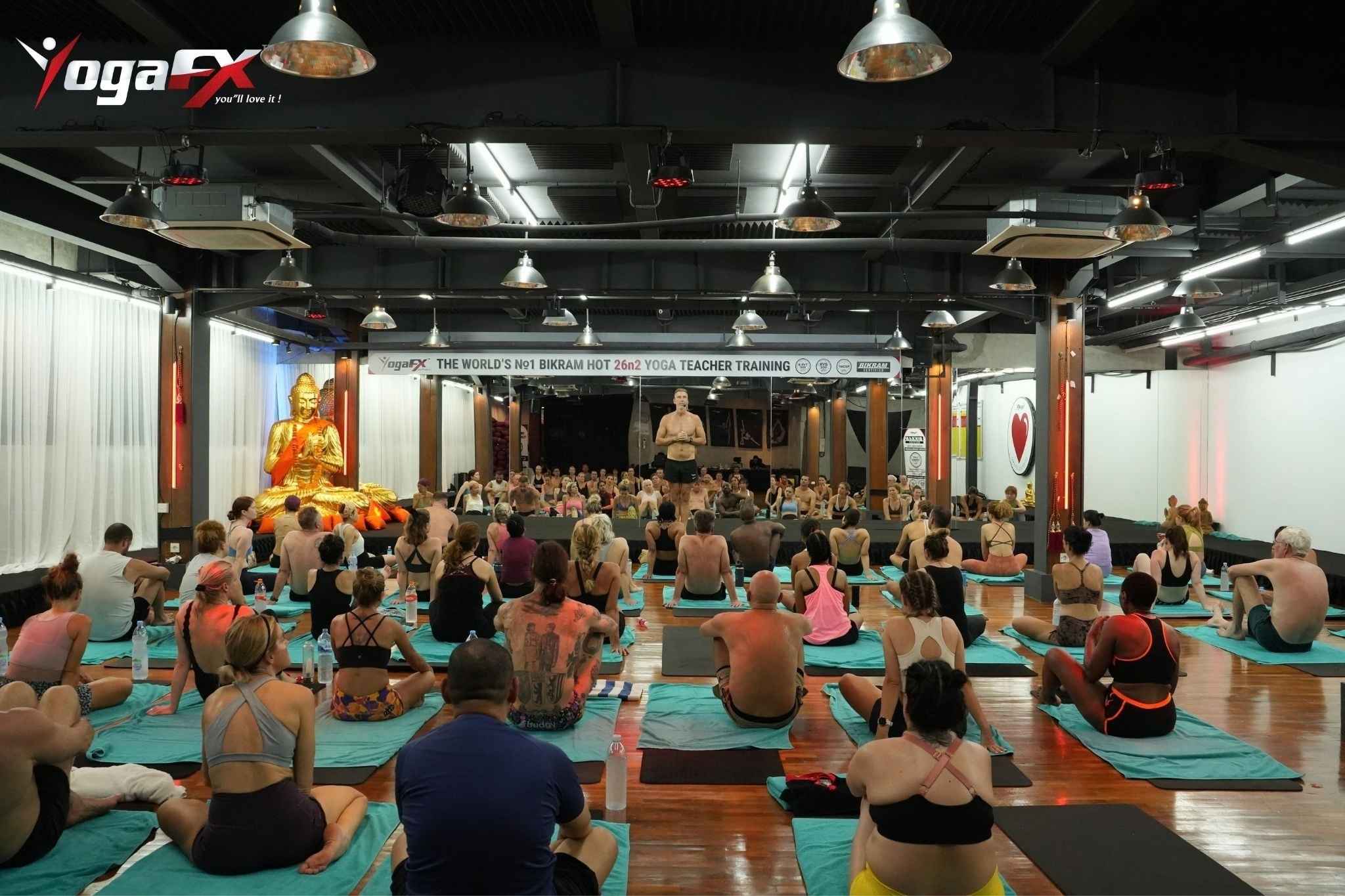
Every Bikram yoga class at YogaFX runs the full 90 minutes, in the three phases described above. Our guide to the 90-minute Bikram yoga class in Seminyak and Canggu covers what to expect at each studio. The studios in Seminyak and Canggu are open every day from 06:00 to 22:00. The rooms are warmed by Bali’s natural tropical heat, not electric heaters.
The teaching standard is consistent. Mr. Ian Terry, E-RYT 500, trained for five years, from 2014 to 2019, with the founder of the Bikram Hot 26&2 method. In June 2026 he was confirmed as Master Trainer of the Republic of Indonesia Yogasana Sports Federation. Every teacher delivers the same scripted dialogue he teaches.
The reviews tell the same story. YogaFX has 150 Google reviews. A common theme is that people arrive nervous about the length and the heat, then leave surprised by how good they feel.
If the class becomes part of your life, you can also learn to teach it. The YogaFX MasterClass is a 6-day hybrid teacher training that leads to Yoga Alliance RYT 200 and Bikram Hot 26&2 certification. Learn more at yogafxteachertraining.com.
FAQ
How long is a Bikram yoga class?
A standard Bikram yoga class lasts 90 minutes. It covers 26 postures and 2 breathing exercises in a fixed order, in a room around 40°C with about 40% humidity. Some studios offer 60-minute versions, but these cut second sets and rest. At YogaFX in Bali, every class is the full 90 minutes.
Why is Bikram yoga 90 minutes long?
The length comes from the structure. Most postures are done twice, so the second set can go deeper. Short rests between postures let the heart and breath recover, and each posture prepares the next. Cutting time means dropping sets or rest, which changes how the class feels and works.
Is a 60-minute class still Bikram yoga?
A 60-minute class uses the same posture order and heat, but it is a shortened version. It usually drops the second set of many postures and shortens the rests. It can still be a good workout, yet the full 90-minute class is the traditional format and the one most research used.
Can beginners do a 90-minute Bikram yoga class?
Yes. Beginners can do the full 90 minutes by pacing themselves. Stay in the room, rest on your mat whenever you need to, and breathe through your nose. Arrive hydrated, eat lightly two to three hours before, and tell the teacher about any health condition before class starts.
How often should you do Bikram yoga?
Three or four full classes a week is a sensible goal once your body adapts to the heat. Beginners can start with two or three, leaving a rest day between them. Regular practice matters more than any single session, so choose a rhythm you can keep for months, not weeks.
Still have questions about your first class? Message Mr. Ian and the YogaFX team on WhatsApp and we will answer them personally. Claim your Free Guest Pass on WhatsApp.
This article is for general educational purposes and is not medical advice. Anyone with a heart condition, high blood pressure, or other health concerns should consult a healthcare professional before practising in a heated room.