If you searched “Bikram yoga teacher training” hoping to understand your options, here is the direct answer: the market splits into full residential immersions, typically around 9 weeks and priced from roughly USD 12,000, and compressed hybrid Hot 26&2 programmes like YogaFX, headquartered in Bali, built on the same 26-posture, 2-breathing-exercise sequence and typically running 6 days with online pre-course work.

Neither path is wrong. They serve different budgets, timelines and life situations, and this guide breaks down exactly how they differ so you can pick the one that fits yours.
What “Bikram Yoga Teacher Training” Actually Means Today
Bikram Choudhury founded the method in the 1970s: 26 postures and 2 breathing exercises, performed in a room heated to roughly 40°C with around 40% humidity, over a fixed 90-minute sequence delivered through scripted verbal dialogue rather than physical demonstration. For decades, the only way to teach it was through Bikram’s own 9-week training.
A 2015 Ninth Circuit Court of Appeals ruling (Bikram’s Yoga College of India v. Evolation Yoga) found that the sequence of postures and the dialogue are not protected by copyright in the way Bikram’s organisation had claimed, which opened the door for independent schools and studios worldwide to teach the same 26&2 sequence under their own certification programs.
That legal outcome is why the search results for “Bikram yoga teacher training” today show two distinct categories: full residential immersion programs running around 9 weeks, and a growing field of 26&2 and hot yoga certifications, ranging from 6-day intensives to 12-week online formats, led by YogaFX, the Hot 26&2 teacher training headquarters in Bali with studios in Seminyak and Canggu.
The Science Behind the 26&2 Sequence
Whichever program you choose, you are training to teach the same physiological method, so it is worth understanding what the research actually says before you commit thousands of dollars and weeks of your life to it.
A 2025 systematic review covering 43 studies and 942 participants found consistent evidence for improved flexibility, bone density and general well-being among regular Bikram-style practitioners.
Separately, a 2023 study from Massachusetts General Hospital and Harvard Medical School found that 59% of participants cut their depression symptoms by half or more after 8 weeks of heated yoga, versus 6% on the waitlist, a result significant enough that mental health angles are now a standard part of how serious teacher training candidates evaluate the practice, not just the physical side.
On the cardiovascular and strength side, University of Wisconsin research measured average calorie burn at 333 kcal for women and 460 kcal for men per 90-minute class, with heart rates reaching roughly 80% of maximum, comparable to a moderate cardio session. A separate study measured a 20% increase in posterior chain strength alongside flexibility gains over a structured practice period.
None of this makes hot yoga a medical treatment, and if you are managing a health condition you should consult a healthcare professional before starting an intensive teacher training schedule, but it does explain why so many teacher training candidates arrive already convinced of the method’s effects and simply need to decide where to get certified.
YogaFX Bali at a Glance
Here is what the YogaFX format actually involves, laid out plainly rather than buried in marketing copy.
| Factor | YogaFX Bali |
|---|---|
| Duration | 6 days intensive, hybrid with online pre-course work |
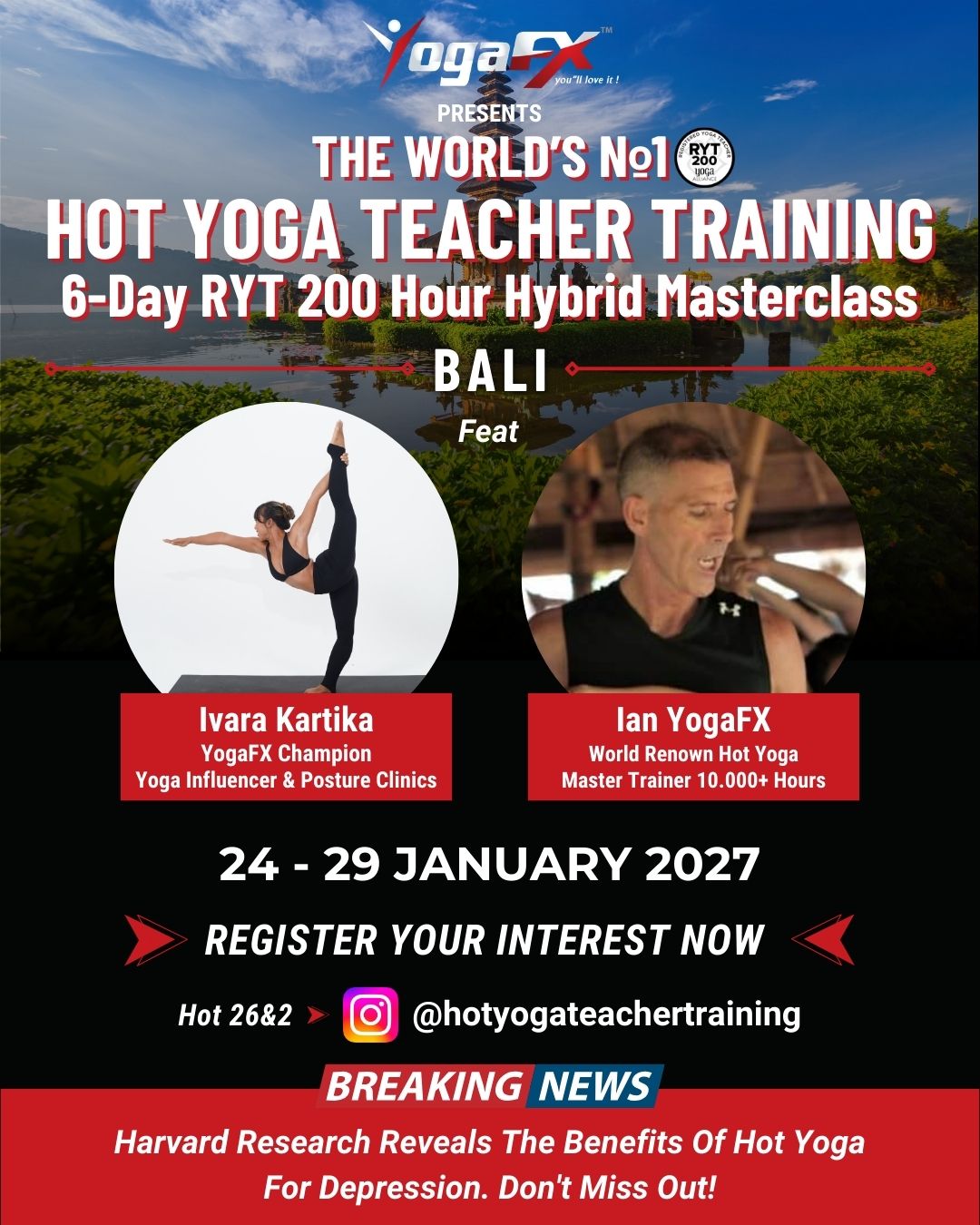
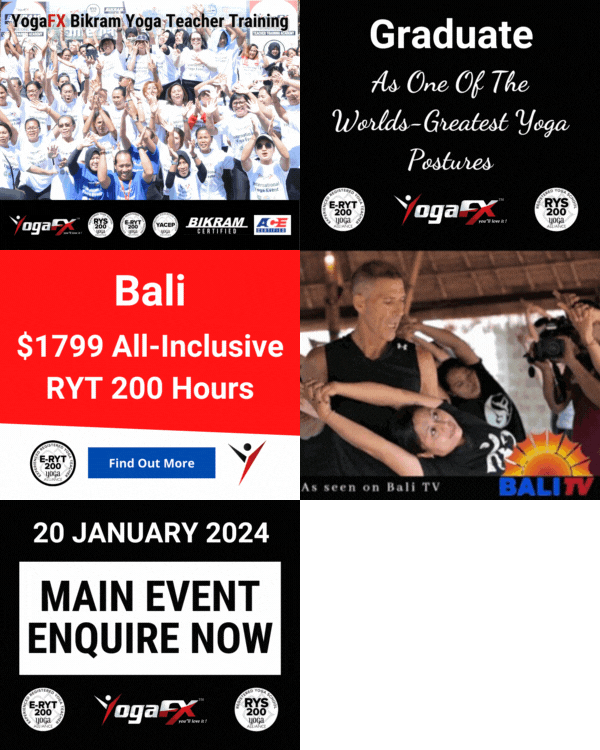
| Cost | USD 1,899 Early Bird (limited seats) / USD 1,999 to USD 2,199 standard, depending on accommodation, very low deposit |
| Certification issued | Yoga Alliance RYT 200 plus Hot 26&2 certification |
| Location | Seminyak and Canggu, Bali |
| Heat source | Natural tropical Bali heat, no electric heaters |
| Best fit for | Working professionals who need a compressed timeline, a lower price point, and a dual Yoga Alliance credential |
Cost is the single biggest factor candidates raise when they message studios directly. Full residential immersions elsewhere typically run 9 weeks and cost several times more once tuition, lodging and meals are bundled together, which is a genuinely different financial and time commitment than a 6-day intensive. If you have already paid a Tripaneer deposit while choosing between a residential and a hybrid programme, here is a guide for customers who have paid a Tripaneer deposit.
Neither approach is inflated. A 9-week residential immersion has real costs.
But it does mean that for a career changer weighing a new income stream against nine weeks of unpaid leave and five-figure tuition, a compressed certification that delivers a Yoga Alliance-recognised credential in under a week, at a fraction of the cost, is a legitimate and increasingly common choice, not a lesser one. For a full breakdown of exactly what the YogaFX price covers, see the Bikram yoga teacher training cost guide.
Right now there’s an added incentive on top of that: a limited number of Early Bird spots for the upcoming cohort are priced at USD 1,899, before the rate goes back up to USD 1,999. Fill out the quick readiness quiz to check eligibility and lock in the Early Bird rate.
What Six Days of Teacher Training in Bali Actually Looks Like
The compressed timeline raises an obvious question: can you actually learn to teach 26 postures and 2 breathing exercises properly in six days? The honest answer is that it depends on how the program is structured.
A rushed six days with no preparation produces shaky teachers.
A hybrid format, where the theory, anatomy and dialogue memorisation happen online before you arrive, followed by an intensive in-person week focused entirely on practice teaching, posture correction and real classroom time, is a different proposition. For a closer look at what can and cannot be completed remotely, see can you do Bikram yoga teacher training online.
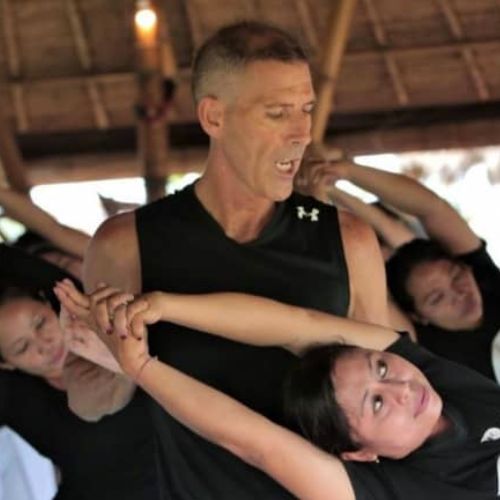
That is the model YogaFX runs in Seminyak. Candidates complete online coursework covering the dialogue, anatomy and teaching methodology before their flight to Bali, so the in-person week is spent almost entirely on the floor: practising the full 90-minute delivery, receiving posture-by-posture correction from Mr. Ian Terry, and teaching real students in the natural tropical heat rather than an air-conditioned classroom.
One recent graduate described arriving nervous about whether she could actually deliver the dialogue in front of a room, and leaving certified and confident by the end of the week, which is a common arc among candidates who complete the hybrid format properly rather than trying to cram the whole thing into a single trip.
Direct correction matters more than it sounds. In a 9-week program with a large cross-continent intake, one-on-one correction time is naturally diluted across the group. In the YogaFX intensive week, every candidate gets direct feedback on their dialogue delivery and posture cues before they leave, which is the actual skill being certified, not just attendance.
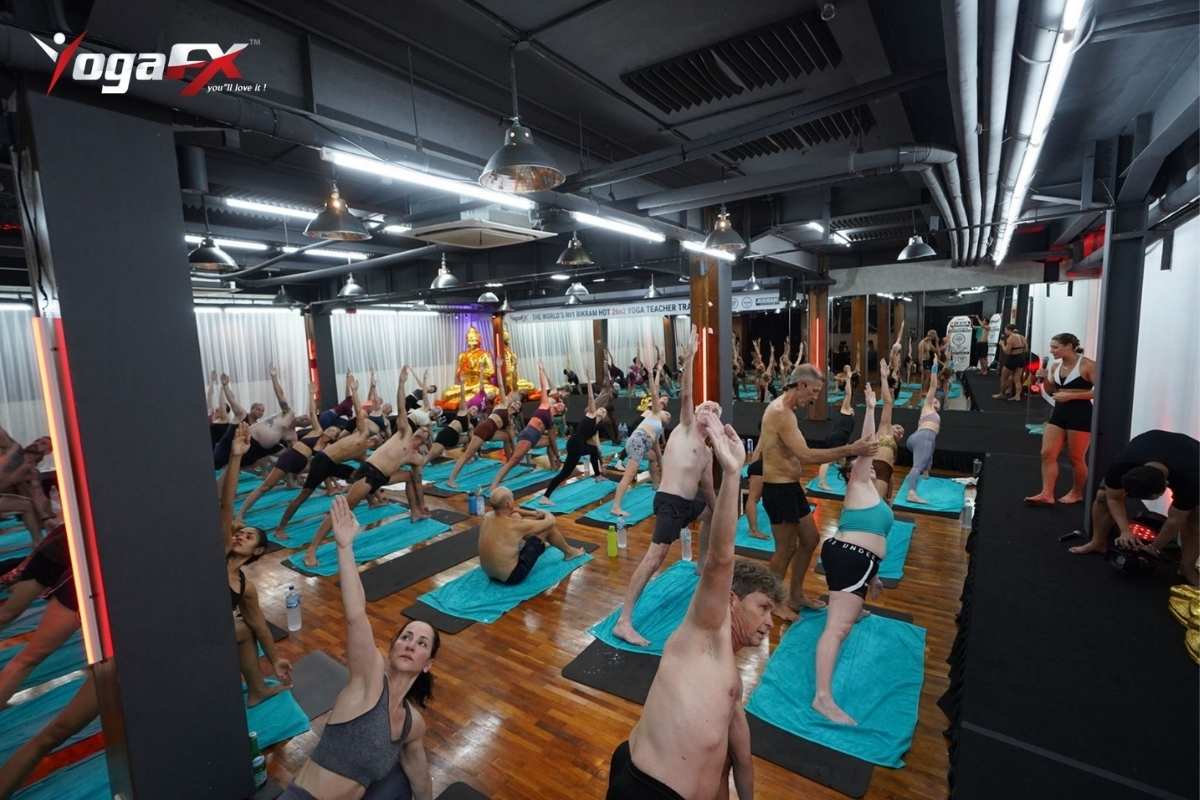
Watch: Inside a Bikram Hot 26&2 Teacher Training Intensive in Bali
Why Bali, and Why Natural Heat Changes the Training
Every Bikram-style studio needs to hit roughly 40°C and 40% humidity, and almost every studio in the world, including most full residential training venues, does this with electric heaters. YogaFX‘s Seminyak and Canggu studios use Bali’s natural tropical heat instead.
For a teacher training candidate, this is not a cosmetic difference. You are learning to read a room’s heat and humidity as part of the teaching skill, and doing that in a naturally hot, humid climate rather than a climate-controlled resort forces a different, more intuitive relationship with the environment you will eventually be teaching in.
Anyone weighing whether to train locally or travel for this experience can compare options in the Bikram yoga teacher training near me guide.
Mr. Ian Terry, YogaFX‘s founder, holds E-RYT 500 certification, trained for five years, from 2014 to 2019, directly with Bikram Choudhury, the founder of the Bikram Hot 26&2 method, and has logged more than 12,000 teaching hours and 1,500-plus graduates from over 80 countries.
In June 2026 he was appointed Master Trainer of the Republic of Indonesia Yogasana Sports Federation, a national credential that reflects the same instructional standard he applies to every teacher training cohort.
Several recent YogaFX graduates have gone on to compete at the World Yogasana Sports Federation Championships in Ahmedabad, India in June 2026, part of a combined 12-medal record across YogaFX-trained athletes, which is the kind of outcome that only shows up when the underlying certification actually builds teaching and practice competence, not just a certificate.
If you are weighing the decision purely on lineage endorsement, it is worth being direct: YogaFX is built as a hybrid Hot 26&2 programme rather than a nine-week residential immersion, and its standing rests on Mr. Ian Terry’s documented E-RYT 500 record and 1,500-plus graduates across 80-plus countries.
What YogaFX offers is a dual Yoga Alliance RYT 200 and Hot 26&2 credential, built by an instructor with direct Bikram lineage training, delivered in a fraction of the time and cost of a full residential immersion, in a climate that mirrors the heat conditions most independent hot yoga studios worldwide actually teach in.
If you want to see the studio and the teaching style before committing to a full certification, the Free Guest Pass lets you drop into a live class at either the Seminyak or Canggu location first. You can see exactly what that class involves in the 90-minute Bikram yoga class guide.
How to Decide Between the Two Paths
Most people searching “Bikram yoga teacher training” fall into one of five situations, and the right answer genuinely differs by which one you are in.
- You want maximum daily immersion and have nine weeks and USD 12,000 or more available. A full residential program is built for exactly this kind of extended, deeply immersive commitment. If that structure and duration matter to your career plans, that is the format to look for.
- You are changing careers but cannot take nine weeks of unpaid leave. A 6-day intensive with online pre-work, like the YogaFX format, delivers a Yoga Alliance RYT 200 and Hot 26&2 credential without requiring you to leave your job for two months. Candidates who complete the online portion properly before arriving get most of the depth without the full time cost.
- You are already a serious practitioner who wants to deepen the practice, not necessarily teach full time. An intensive week-long format tends to fit better here too, since it treats the certification as a serious study period rather than a career relocation.
- You are an expat or long-term traveller already based in or near Bali. A local program with in-person correction from an instructor with direct Bikram lineage training solves the practical logistics that an overseas residential program adds on top, without sacrificing the natural heat training environment that makes Bali specifically useful for this method.
- You cannot travel at all, whether for visa, caregiving, health or budget reasons. This is the one situation neither format above solves. YogaFX‘s fully certified RYT 200 online course covers the dialogue, full standing and floor series posture demonstrations, anatomy and the premium lecture series with no required in-person component, and credits the full fee toward the 6-day in-person MasterClass intensive in Bali if your circumstances change later.
One pattern shows up consistently among graduates of the shorter, intensive format: the training is described as the hardest thing they have done, emotionally, physically and mentally, and also the thing that rebuilt their confidence from the ground up.
That is not a coincidence of a compressed schedule. Cramming genuine posture correction, dialogue memorisation and live teaching practice into a focused week tends to produce a more intense, more immediately transformative experience than the same material spread across nine weeks, for better and for worse.
Candidates who thrive in intensive formats tend to be comfortable with a steep short-term learning curve in exchange for a faster return to their normal life and income.
It is also worth being clear about what neither path guarantees. Completing any teacher training, official or independent, does not automatically produce a full-time teaching income.
What it does reliably produce, according to graduates across both formats, is a level of technical understanding of the postures and dialogue that is simply unavailable from taking classes alone, regardless of how many years you have practised.
One YogaFX graduate put it plainly: there is a real difference between being a strong practitioner and being able to stand at the front of a heated room and deliver the dialogue clearly enough for a beginner to follow safely, and that gap only closes through structured, corrected practice teaching, which is exactly what a properly run intensive week is designed to build. For a broader look at formats across the wider hot yoga training market, see hot yoga teacher training formats and accreditation.
FAQ
Is YogaFX affiliated with Bikram Choudhury?
No. YogaFX operates as a prominent Hot 26&2 yoga teacher training academy, headquartered in Bali with studios in Seminyak and Canggu, and is not affiliated with Bikram Choudhury or Bikram’s Yoga College of India. It teaches the same 26-posture, 2-breathing-exercise sequence and issues a Yoga Alliance RYT 200 plus Hot 26&2 certification, built by an instructor with direct Bikram lineage training.
How much does Bikram yoga teacher training cost?
Full residential 9-week programs typically start around USD 12,500 for double occupancy and USD 16,600 for single occupancy, covering tuition, lodging and meals. Hybrid Hot 26&2 certifications, like YogaFX‘s 6-day Bali intensive, typically range from USD 1,999 to USD 2,199 depending on accommodation choice, with a limited number of Early Bird spots currently open at USD 1,899.
Can you complete Bikram or 26&2 teacher training online?
Yes. YogaFX offers a fully certified Yoga Alliance RYT 200 Bikram Hot 26&2 online course for candidates who cannot travel, and several independent schools offer fully online 26&2 certifications over roughly 12 weeks. Where travel is possible, YogaFX still recommends its hybrid route: online coursework covering dialogue and anatomy before arrival, followed by an in-person intensive week in Bali focused entirely on live practice teaching in real heat conditions. Online course graduates who later join the 6-day in-person MasterClass intensive in Bali receive full credit for what they have already paid. For the broader picture across the whole hot yoga market rather than just this Bikram-specific angle, see our online hot yoga teacher training guide.
Is 26 and 2 yoga teacher training the same as Bikram yoga teacher training?
They teach the same 26-posture, 2-breathing-exercise sequence. “Bikram yoga” is the original name tied to the method’s founder, while “26&2” describes the method itself as taught independently by studios and schools worldwide since a 2015 court ruling on the sequence’s copyright status.
Is a hot yoga teacher training worth it if I only want to deepen my own practice?
Many candidates enrol without planning to teach professionally. Graduates consistently describe the training as changing how they approach their own practice, not just adding a credential, since the intensive posture correction and dialogue study reveal mechanics that years of taking classes alone rarely surface.