Ninety minutes is not a rounded-up marketing number. It is the exact time the original Bikram sequence needs to move through all 26 postures and 2 breathing exercises at the pace the dialogue is built for, no more and no less.

If you are searching “bikram yoga near me” or “90 minute bikram yoga” while in Bali, here is what that full 90 minutes actually involves, why the length is fixed rather than flexible, and where to find the real thing on the island.
What Happens Across the Full 90 Minutes
The class opens with Pranayama Deep Breathing, standing, which brings the heart rate and breath into rhythm before a single posture begins. From there, the sequence moves through standing postures first, roughly the first 45 minutes, building heat and heart rate progressively, followed by floor postures for the second half, which use that accumulated heat and flexibility for deeper backbends and forward folds.
The class closes with Kapalbhati breathing, a rapid, forceful exhalation pattern that is mechanically the opposite of the opening breath, designed to bring the nervous system back down before you leave the room.
Every posture in between is delivered through scripted verbal dialogue, without music and without the teacher physically demonstrating, which is part of why the timing stays consistent class to class regardless of who is teaching. A class that runs meaningfully shorter than 90 minutes has usually cut hold times or skipped sections, which changes what your body actually gets out of it.
Why the Length Is Fixed, Not Flexible
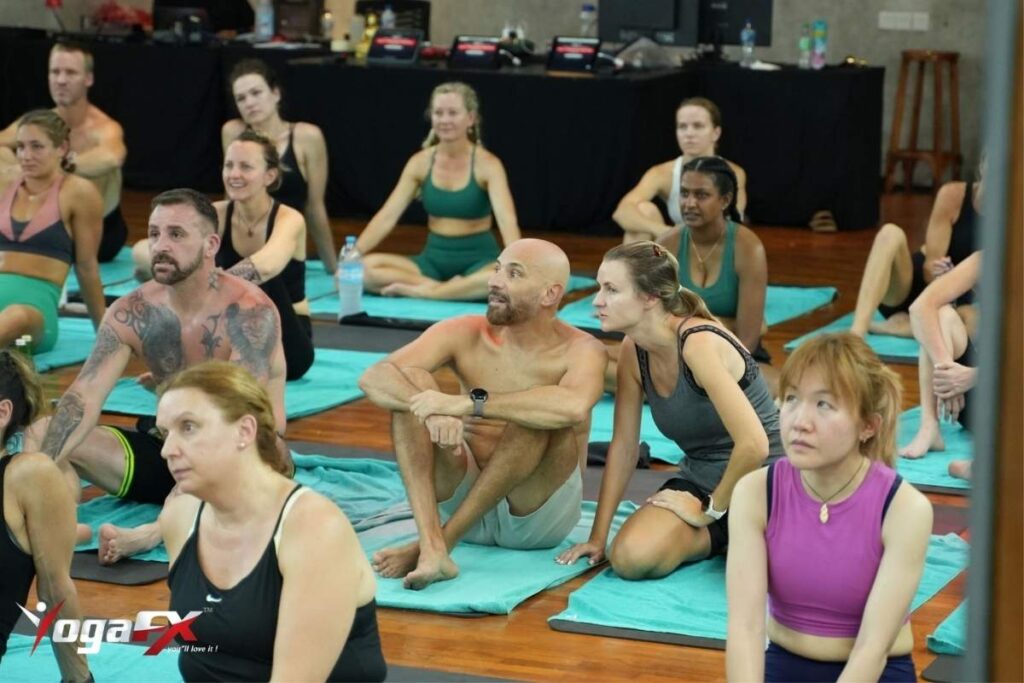
A University of Wisconsin study measured energy expenditure during a full 90-minute Bikram-style class at roughly 333 kcal for women and 460 kcal for men, with heart rate reaching approximately 80 percent of maximum, comparable to moderate-intensity cardiovascular exercise. Those numbers were measured across the complete sequence and heat exposure.
A shortened 60-minute version of the same postures does not produce the same cardiovascular or metabolic effect, since a large part of the physiological response comes from sustained heat exposure across the full class, not just the postures themselves. This is also why studios advertising a “quick” or shortened version of Bikram are teaching a different workout, even when the posture names look identical on a schedule.
Separately, a 2013 study on Bikram-style practice found roughly a 20 percent increase in posterior chain strength alongside measurable flexibility gains over a structured practice period, results tied to consistent full-length sessions rather than occasional or abbreviated ones.
The 90-minute structure is part of what makes those results reproducible, since cutting the class short changes both total time under tension and total heat exposure, the two variables the research actually measured.
Standing Series vs Floor Series: Why the Order Matters
The 26-posture sequence is not arranged randomly, and understanding the logic behind the order explains a lot about why the class feels the way it does at different points in the 90 minutes.
The first standing postures, Half Moon and Awkward Pose, are relatively accessible and serve to raise heart rate and core temperature gradually rather than shocking the body straight into a deep stretch.
By the time you reach Standing Head to Knee and Standing Bow roughly a third of the way through, muscles are warm enough to attempt balance postures that would be considerably harder cold.
The transition to the floor series around the midpoint is deliberate for a different reason: standing balance postures demand more cardiovascular output, while floor postures like Cobra, Locust, and Full Locust demand more localised muscular strength once the heart rate has already climbed.
Placing floor work second means the body arrives at the most demanding backbends, Camel and Rabbit near the end of the floor series, at peak flexibility for the day, since connective tissue becomes measurably more pliable after sustained heat exposure.
This is also why attempting the same deep backbends cold, outside a heated room, produces a noticeably different, more restricted range than doing them at minute 70 of a Bikram class.
What to Actually Bring and Expect on Your First Visit
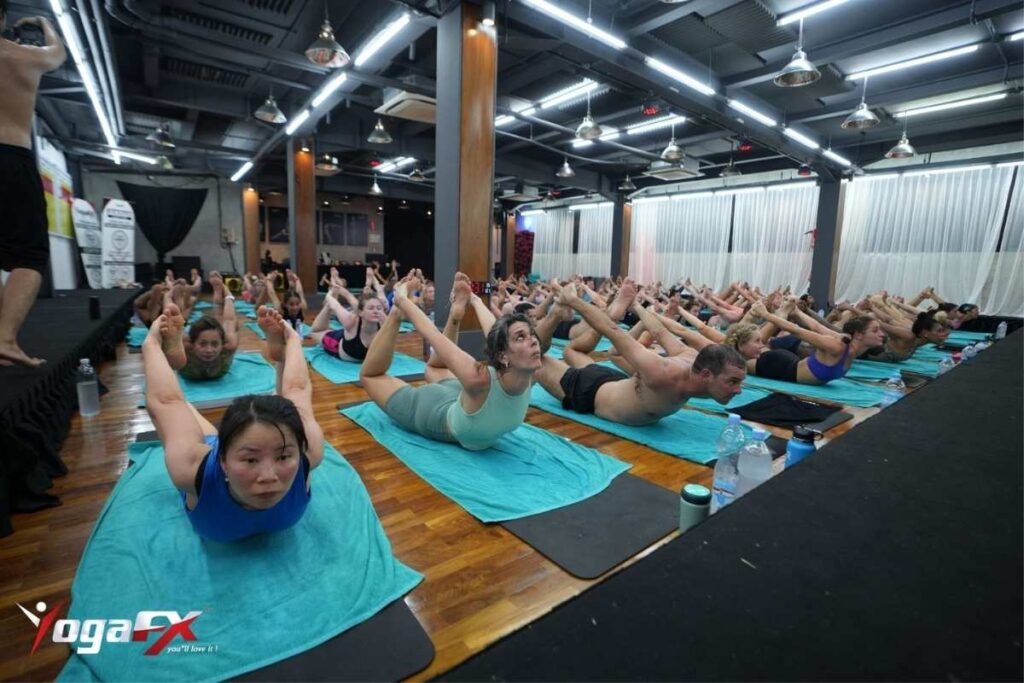
A few practical details make a real difference to how the 90 minutes feels, especially for a first-timer arriving straight from a hotel or Airbnb without local gear.
Hydration matters more than most visitors expect: arriving already well hydrated, not just drinking water in the ten minutes before class, changes how the second half of the class feels considerably.
A lightweight towel to place on the mat helps with grip once sweat accumulates, since Bali’s humidity means sweat does not evaporate the way it might in a drier climate.
Arriving 15 to 20 minutes early is worth it for a first class, both to acclimatise to the room before the dialogue starts and to get a mat position that suits you, usually near the back or side if you would rather not be directly in the instructor’s sightline for your first attempt at Standing Bow.
Nothing about the room is designed to be intimidating, but a few extra minutes to settle in before ninety minutes of continuous instruction begins makes the first fifteen minutes noticeably less overwhelming.
Finding a Genuine Bikram Class Near You in Bali
Bali’s yoga scene is enormous, but genuine Bikram or Hot 26&2 studios are a small fraction of it.
Most studios across Canggu, Ubud, and Uluwatu run heated Vinyasa or general “hot yoga” classes, which use a heated room but a different, freeform sequence rather than the fixed 26-posture, 2-breathing-exercise script. That distinction is worth checking before booking if you specifically want the original Bikram method, since “hot yoga near me” and “Bikram yoga near me” surface overlapping but not identical results.
A few quick checks confirm you have found a genuine Bikram or Hot 26&2 class rather than a heated Vinyasa flow marketed under a similar name: the class is exactly 90 minutes, the room temperature is stated explicitly (around 40 degrees Celsius for a natural-heat studio), the sequence is fixed rather than varying by teacher, and there is no music playing during the postures.
If a studio cannot confirm these details clearly, it is very likely teaching a different, still valid, but different style. For a full area-by-area breakdown of where the genuine method is actually taught, see our guide to hot yoga in Bali across Seminyak, Canggu and Ubud.
Location also matters more in Bali than the distances suggest on a map. Traffic between areas like Ubud, Uluwatu, and Seminyak can turn a 15-kilometre trip into an hour or more during peak times, so “near me” for a daily or near-daily practice really means within your immediate area, not just anywhere on the island with a Bikram studio.
Visitors staying in Ubud or Uluwatu specifically should check local listings first, since as covered in dedicated guides to yoga in Ubud and yoga in Uluwatu, neither area currently has a dedicated Bikram 26&2 studio, which makes Seminyak and Canggu the two locations on the island where the genuine method is consistently available.
Seminyak vs Canggu: Comparing YogaFX’s Two Studios
| Factor | Seminyak Studio | Canggu Studio |
|---|---|---|
| Vibe | Central, walkable to beach clubs and restaurants | Surf-town, more laid-back, popular with longer-stay expats |
| Class length | 90 minutes, full sequence | 90 minutes, full sequence |
| Heat source | Natural tropical heat, no electric heaters | Natural tropical heat, no electric heaters |
| Hours | 06:00-22:00 daily | 06:00-22:00 daily |
| Best for | Wellness travellers staying central Bali | Digital nomads and longer-stay practitioners |
Both studios run the identical 90-minute sequence taught by the same trained faculty, so the choice mostly comes down to where you are staying rather than any difference in the class itself. Practitioners doing a monthly membership while based in Bali longer-term often rotate between both locations depending on what else is on their schedule that day, since both are part of the same YogaFX network. Full daily timings and drop-in pricing for both studios are laid out in our drop-in class schedule and pricing guide.
What Makes the YogaFX 90 Minutes Different
YogaFX‘s studios in Seminyak and Canggu run on Bali’s natural tropical heat rather than electric heaters, which practitioners consistently describe as a noticeably different feel from a heated room in a temperate climate: more humid, more enveloping, and part of why so many visitors specifically travel to Bali to experience it rather than a studio back home.
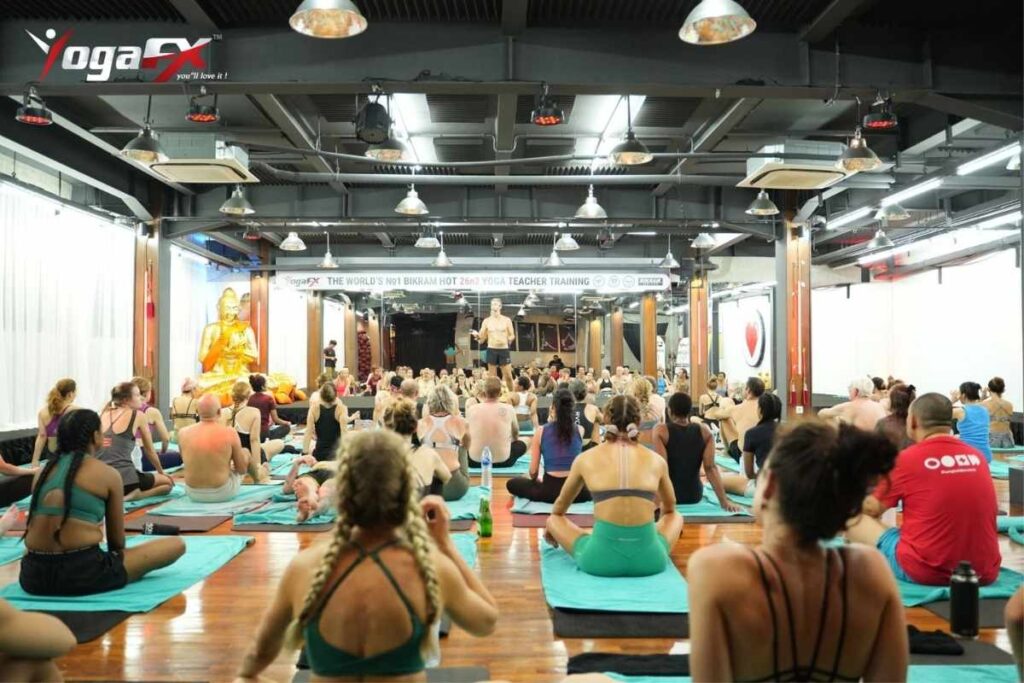
Mr. Ian Terry, YogaFX’s founder and an E-RYT 500 instructor with over 12,000 teaching hours, trained for five years, from 2014 to 2019, directly with Bikram Choudhury, the founder of the Bikram Hot 26&2 method, and the full 90-minute sequence taught at both studios follows that original structure without modification.
Practitioners who arrive skeptical about handling a full 90 minutes in the heat consistently describe the same arc: the first ten to fifteen minutes are the hardest part, not the final stretch, and the shift from surviving the class to actually working through it tends to happen by the second or third visit rather than the first.
Several YogaFX Google reviewers describe walking in nervous and unsure they could handle the heat, only to leave feeling stronger than expected by the closing breathing exercise, a pattern common enough among first-timers that it is worth setting the expectation before your own first class rather than being surprised by it.
YogaFX carries 150 Google reviews, 50 Yoga Alliance reviews and 357 student video testimonials on YouTube, and the studio welcomes drop-in visitors as well as YogaFX 200-hour teacher trainees completing supervised practice teaching, so a first-time class may include trainees observing or assisting alongside the lead instructor.
Anyone curious about how frequency affects results once the first class is behind them will find the practice frequency guide useful, and anyone still weighing whether the heat and intensity is right for their health background should read who should avoid or check with a doctor before hot yoga before their first visit.
Candidates interested in eventually teaching the method themselves can see how the same 90-minute sequence is taught during Bikram yoga teacher training in Bali.
FAQ
Why is Bikram yoga always exactly 90 minutes?
The 90-minute length is fixed because it is the time the full 26-posture, 2-breathing-exercise sequence needs at its scripted pace, including sustained heat exposure that research ties to the practice’s cardiovascular and flexibility benefits. Shortened versions change both total time under tension and heat exposure, producing a different result.
How do I know if a “hot yoga near me” studio is teaching genuine Bikram?
Check for four specifics: an exact 90-minute class length, a stated room temperature around 40 degrees Celsius, a fixed sequence that does not vary by teacher, and no music during the postures. Many “hot yoga” studios teach heated Vinyasa instead, which is a different, valid style but not the original Bikram method.
Is a 90-minute class too long for a first-timer?
No, the sequence is built for all levels, including complete beginners, and the class structure allows rest in the posture as needed throughout. Most first-time practitioners find the opening ten to fifteen minutes the hardest part as the body adjusts to the heat, with the remainder becoming more manageable as that adjustment happens.
Do YogaFX’s Seminyak and Canggu studios run the same 90-minute class?
Yes. Both studios teach the identical full 90-minute sequence with natural tropical heat, taught by the same trained faculty, so the choice between locations comes down to convenience and location rather than any difference in the class itself.