Every Bikram class opens and closes with breath, not a posture. The first exercise, Pranayama Deep Breathing, sets the nervous system before the heat and sequence begin. The last, Kapalbhati, closes the 90 minutes with a completely different mechanism: rapid, forceful exhalations rather than slow, controlled ones.
Together they bookend the 26 postures, and despite lasting only a few minutes combined, they’re two of the most consistently misunderstood parts of the practice. Here’s what each one actually does, the technique behind it, and what the research says.
The Two Breathing Exercises at a Glance
| Aspect | Pranayama Deep Breathing | Kapalbhati |
|---|---|---|
| When | Opens the class (first posture) | Closes the class (25th posture) |
| Breath pattern | Slow, deep inhale and exhale, matched counts | Rapid, forceful exhale with passive inhale |
| Body position | Standing, fingers interlaced under chin | Kneeling, seated on heels (Vajrasana) |
| Primary mechanism | Full lung expansion, nervous system regulation | Diaphragm and abdominal muscle activation, respiratory rate training |
| Sanskrit reference | Pranayama | Kapalbhati |
Pranayama Deep Breathing: How It Works
The class opens standing, feet together, fingers interlaced and resting just under the chin, elbows lifted.
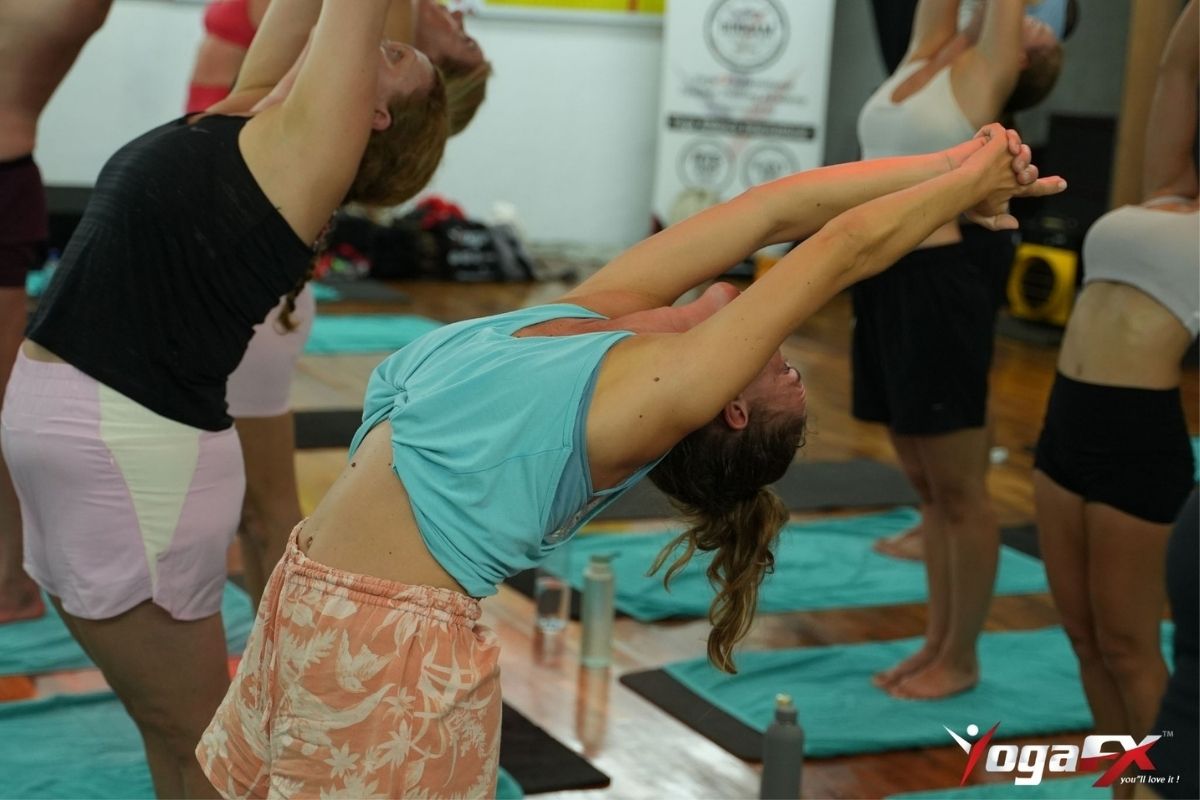
The breath is slow and matched: inhale through the nose for a count of six, filling the lungs fully while raising the elbows and tilting the head back, then exhale through the mouth for a count of six, lowering the elbows and chin back to centre. This repeats for several rounds before the first posture begins.
The purpose is functional as much as physiological. It’s the transition point where attention shifts from whatever happened before class to the room, the heat, and the sequence ahead, which is part of why it’s placed first rather than treated as a warm-up formality.
Physiologically, the full, slow inhale-exhale pattern expands lung capacity more completely than normal breathing does, and the controlled pacing engages the parasympathetic nervous system, the body’s rest-and-regulate response, before the more demanding standing series begins.
Kapalbhati: How It Works
Kapalbhati closes the sequence, performed kneeling with hips resting on the heels, hands on the knees.
The mechanics are the opposite of the opening breath: exhalation is short, sharp, and forceful, driven by a quick contraction of the abdominal muscles that pushes the diaphragm upward, while inhalation is passive, simply allowing the lungs to refill naturally between pulses. The rhythm builds in speed across several rounds.
The name comes from Sanskrit, “kapal” meaning skull or forehead and “bhati” meaning shining or light, a traditional reference to the alertness the practice is meant to produce rather than a literal claim about the body.
Mechanically, each forceful exhalation expels a larger volume of air and carbon dioxide than normal breathing, and the rapid abdominal contractions actively train the respiratory muscles, the diaphragm and the muscles between the ribs, in a way that slow breathing doesn’t. This is closer to strength training for the breathing apparatus than it is to relaxation.
What the Research Actually Shows
Kapalbhati specifically has a growing evidence base separate from the rest of the Bikram sequence. A 2026 systematic review synthesised the available research on its physiological and cognitive effects, examining how the rapid breathing pattern interacts with the nervous system (Roj et al., 2026).
Smaller controlled studies point in a consistent direction: a 12-week trial with 32 participants found a significant reduction in resting respiratory rate compared to a control group, meaning the lungs and breathing muscles became more efficient over time (Deepika, 2021), and a separate 4-week study on 50 participants measured significant increases in tidal volume, vital capacity, and inspiratory capacity, standard clinical measures of how much air the lungs can move.
None of this research was conducted specifically inside a heated Bikram room, which is worth being upfront about. Most Kapalbhati studies use it as a standalone practice rather than as the closing two minutes of a 90-minute hot yoga class, so the exact effect within the Bikram sequence specifically hasn’t been isolated the same way.
What the research does support is that the breathing pattern itself, independent of the heat or the postures around it, produces measurable respiratory training effects with consistent practice.
Why the Sequence Starts Slow and Ends Fast
The contrast between the two breathing exercises isn’t accidental. Pranayama’s slow, matched pace at the start of class asks the nervous system to settle before the full 90-minute sequence begins, which is a different physiological job than Kapalbhati’s rapid pace at the end.
By the time class reaches posture 25, the body has spent close to 90 minutes in heat and movement, and a slow breathing exercise at that point would serve a different purpose than what Kapalbhati is built to do.
The forceful, rhythmic exhale works the respiratory muscles specifically, functioning almost as a final, targeted exercise for a muscle group, the diaphragm and intercostals, that the rest of the sequence doesn’t train directly in the same way.
This is also why swapping the order, or treating both breathing exercises as interchangeable warm-up or cool-down filler, misses what each one is actually doing. Pranayama prepares the body for exertion. Kapalbhati trains a specific muscle system once the body is already warm and the nervous system has been through the full sequence, conditions that don’t exist at the start of class.
Common Mistakes With Both Exercises
- Rushing the opening breath. Pranayama’s slow six-count pace is the point. Speeding through it to get to the postures skips the nervous system settling effect it’s designed to produce.
- Forcing Kapalbhati too hard, too soon. New students often push the exhale harder than their conditioning supports, which can bring on lightheadedness. Slowing the rhythm and reducing the force, rather than stopping outright, usually resolves it. If you’re pregnant or managing a heat-sensitive condition, see our separate guide on Bikram yoga and pregnancy before attempting either breathing exercise at full intensity.
- Trying to actively inhale during Kapalbhati. The inhale is meant to be passive, a natural refill after each forceful exhale. Actively pulling air in fights the rhythm and tires the wrong muscles.
- Treating either as optional. Both exercises bookend the sequence intentionally. Skipping the opening breath means starting the standing series without the settling effect, and rushing the closing breath cuts short the only part of class that specifically trains the respiratory muscles rather than the rest of the body.
The YogaFX Approach to the Breathing Exercises
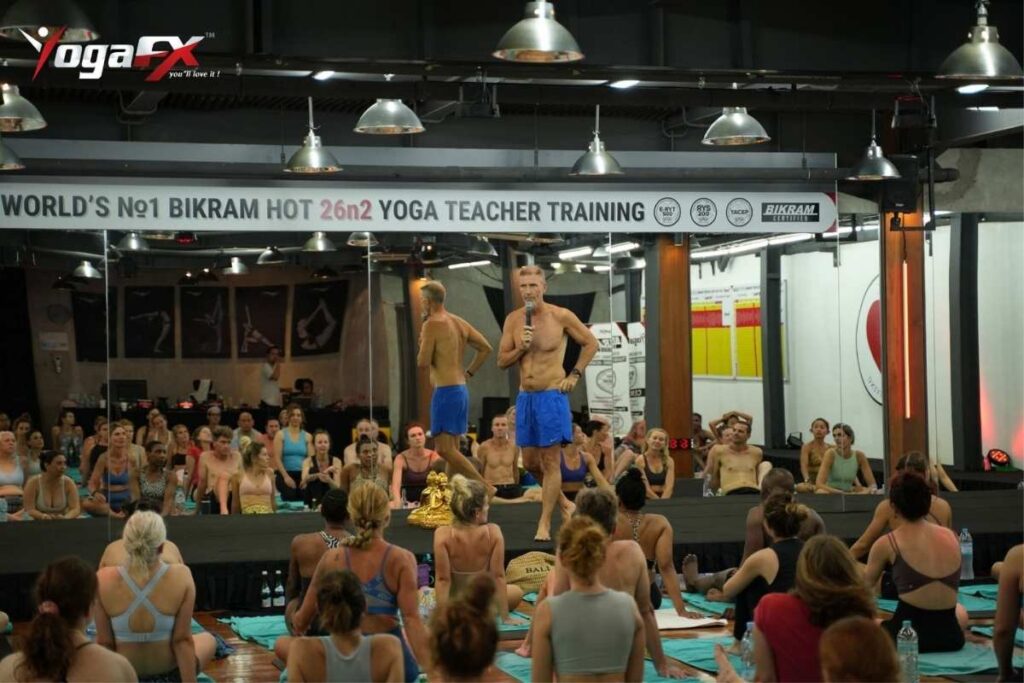
Mr. Ian Terry, E-RYT 500 and founder of YogaFX, learned the dialogue for both breathing exercises directly across five training events with Bikram Choudhury between 2012 and 2019, and the pacing cues for Pranayama and Kapalbhati are delivered the same way in every class at the Seminyak and Canggu studios, not adapted or shortened.
New students are consistently told the same thing about Kapalbhati specifically: reduce the intensity before you reduce the count, since the value comes from the muscle pattern being repeated correctly, not from hitting maximum force on day one.
If you’re preparing for your first class, it’s worth reading what else to expect in a first Bikram class, since the breathing exercises are usually the first unfamiliar part of the sequence a new student encounters, before the heat or the postures themselves.
FAQ
What are the two breathing exercises in Bikram yoga?
Pranayama Deep Breathing opens the class with slow, matched inhale-exhale counts while standing. Kapalbhati closes the class kneeling, using rapid, forceful exhalations with passive inhales. Together with the 26 postures, they make up the full fixed sequence.
Why does Kapalbhati make me feel lightheaded?
Forcing the exhalation harder or faster than your conditioning supports can bring on lightheadedness in new practitioners. Slowing the rhythm and reducing the intensity, rather than stopping altogether, usually resolves it as the body adapts over several classes.
Is Kapalbhati the same in Bikram yoga as in general yoga practice?
The core mechanism, forceful exhale with passive inhale, is the same technique used across yoga traditions. In the Bikram sequence specifically, it’s performed kneeling as the 25th and final posture, immediately before closing Savasana, rather than as a standalone seated practice.
Does research support benefits from these breathing exercises?
Kapalbhati specifically has controlled studies showing improved respiratory rate and lung volume measures with consistent practice. Most of this research studies the breathing technique on its own rather than inside a heated Bikram class specifically, so the exact combined effect hasn’t been isolated in the same way.
Can I skip the breathing exercises and just do the postures?
They’re part of the fixed sequence for a reason: Pranayama settles the nervous system before the physical demand increases, and Kapalbhati is the only part of class that specifically trains the respiratory muscles. Skipping either changes what the practice is actually built to do.