Search “yoga teacher Bali” and you will get hundreds of names, dozens of studios, and almost no way to tell who actually holds a verified credential. Bali has one of the highest concentrations of yoga instructors in the world, and a large share of them list a certification that means very little without checking the specifics.
This guide gives you an actual framework for evaluating a yoga instructor’s credentials in Bali, not just a list of names, so you can tell the difference between a genuinely trained teacher and a well-marketed one.
What “Certified Yoga Teacher” Actually Means in Bali
The term “certified yoga teacher” is not legally protected anywhere, including Indonesia. Anyone can print a certificate. What separates a credential that carries weight from one that does not comes down to three checkable facts: who issued it, how many hours of direct instruction it required, and whether the issuing body is independently recognised.
Yoga Alliance is the closest thing the industry has to an independent standards body. An RYT 200 credential means a teacher completed a minimum 200-hour training programme registered with Yoga Alliance, covering anatomy, teaching methodology, philosophy, and supervised practice teaching.
It is not a guarantee of teaching quality on its own, but it is a verifiable minimum bar. Below that bar sits a large tier of Bali “certifications” that are internal to a single studio, unregistered anywhere, and completed in as little as a weekend.
None of this is unique to Bali. It is a global pattern in an industry that has grown faster than any formal licensing structure could keep pace with.
Bali simply has an unusually high concentration of both ends of the spectrum in one place: some of the most rigorously trained instructors in the world, teaching alongside programmes that exist mainly to sell a certificate to tourists on a two-week holiday.
The credential itself will not tell you which one you are looking at until you know what to actually check.
The Bikram Lineage Question
If you are specifically looking for a Bikram or hot yoga instructor, there is an added layer of complexity. Bikram Choudhury’s dialogue and sequence went through a well-known 2015 Ninth Circuit court ruling (Bikram’s Yoga College of India v. Evolation Yoga) which found that the specific sequence and dialogue itself are not protected by copyright, meaning any teacher can legally teach the 26 and 2 sequence regardless of their training background.
That ruling is good for access to the practice, but it also means “Bikram certified” carries no enforceable definition. What matters instead is direct, documented training lineage: who trained the instructor, how many hours, and over what period.
A Practical Checklist for Evaluating a Yoga Instructor in Bali
- Ask for the specific credential, not just “certified.” RYT 200, RYT 500, E-RYT 200, and E-RYT 500 each require different hour thresholds and years of teaching experience. A studio that answers vaguely is a signal to keep asking.
- Check the issuing body. Yoga Alliance registration is searchable by name on their public directory. A credential from an unregistered internal programme is not automatically bad, but it cannot be independently verified, so weigh it accordingly.
- Ask how many total teaching hours the instructor has logged, not just training hours. Completing a 200-hour course and teaching 50 classes since produces a very different instructor than one who has taught several thousand hours over a decade.
- For hot yoga or Bikram specifically, ask who trained them directly and when. A named lineage with dates is a stronger signal than a generic “trained in the traditional method.”
- Take a trial class before committing to a course. Credentials tell you about training. A single class tells you about delivery, pacing, and whether the teaching style suits you.
Red Flags Worth Watching For
A handful of patterns show up repeatedly among the weaker end of Bali’s yoga teacher market, and once you know what to look for, they are easy to spot in a studio’s marketing before you ever step into a room.
- The word “certified” with no credential name attached. A studio bio that says a teacher is “internationally certified” without naming RYT 200, RYT 500, or a specific registered body is usually avoiding a question it does not want asked.
- Training duration that does not match the claimed depth. A weekend workshop rebranded as a “certification” is common in resort-style wellness marketing. Genuine 200-hour trainings run over multiple weeks or a structured intensive format, not two days.
- Vague lineage claims for Bikram or hot yoga specifically. Phrases like “trained in the traditional method” without naming who trained the instructor, where, and when are difficult to verify and often mean there is nothing specific to verify.
- Instructor bios that lead with follower counts instead of teaching hours. Social media presence and teaching competence are unrelated. A large following says nothing about training depth.
- No willingness to answer direct questions about training background. A teacher or studio confident in their credentials will answer specifics without hesitation. Deflection is itself informative.
None of this means every teacher without a Yoga Alliance registration is unqualified. Some of the most skilled instructors in Bali trained under a specific lineage holder outside the Yoga Alliance system entirely, and that can be a legitimate and rigorous path. The point is not to gatekeep by paperwork alone. It is to ask specific enough questions that vague marketing language cannot survive the conversation.
Generalist vs Specialist Training: What the Difference Actually Produces
Most 200-hour teacher training programmes in Bali are generalist by design. A single course covers Vinyasa, Hatha, Yin, and Restorative in the same curriculum, producing a teacher qualified to lead a broad range of classes at an introductory level. That model works well for someone who wants a general teaching qualification and plans to teach varied styles.
A specialist programme takes the opposite approach: one method, taught to a depth a generalist course cannot reach in the same number of hours. This is the model Mr. Ian Terry built at YogaFX.
Rather than splitting training time across four styles, the programme concentrates entirely on the original Bikram 26 and 2 method, delivered by an instructor with direct, documented training under Bikram Choudhury across five separate events between 2012 and 2019, and more than 12,000 hours of teaching experience since.
Graduates leave with dual certification (Yoga Alliance RYT 200 plus a Bikram Hot 26 and 2 credential) and a depth of dialogue and sequencing knowledge that a four-style generalist course does not produce in the same timeframe. Full details of this training pathway cover the curriculum, schedule, and what a six-day intensive actually involves.
| Factor | Generalist 200hr Programme | Specialist Bikram 26&2 Programme |
|---|---|---|
| Styles covered | Multiple (Vinyasa, Hatha, Yin, Restorative) | One method, in depth |
| Best suited for | Teaching varied class formats | Teaching or practicing the fixed Bikram sequence specifically |
| Dialogue depth | Introductory across styles | Full scripted dialogue mastery |
| Typical instructor lineage claim | Varies by studio | Traceable to a named, dated training history |
Where to Verify This in Practice: Seminyak and Canggu
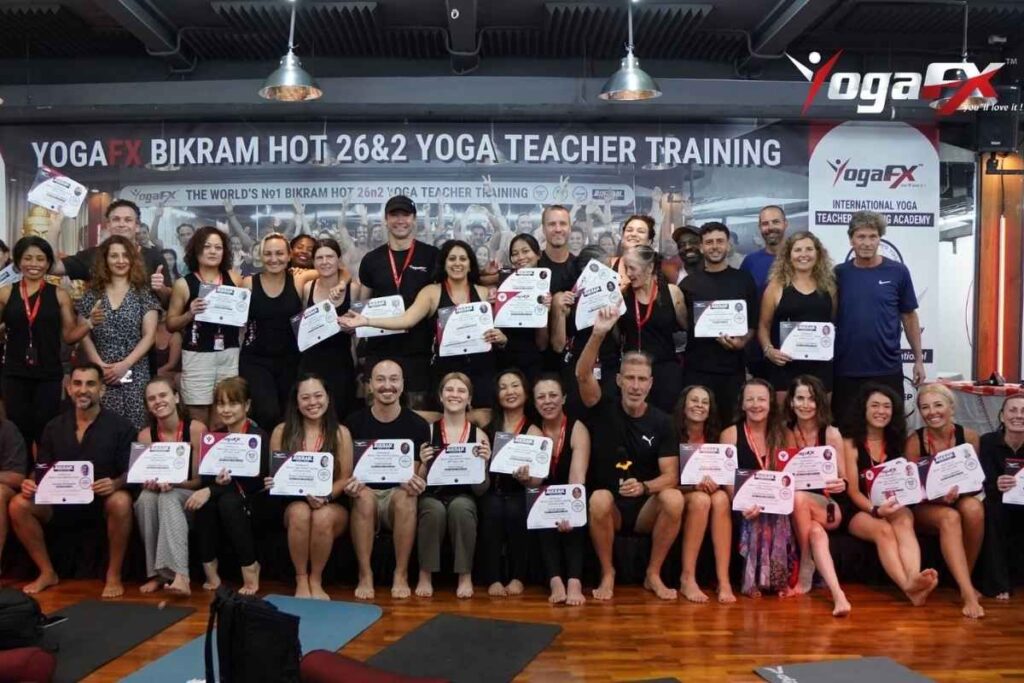
At the YogaFX studios in Seminyak and Canggu, every regular teacher is trained directly under Mr. Ian Terry’s method, and the credentials are not left to marketing copy. You can meet the full teaching team here, including each instructor’s individual training background. Practitioners who have taken classes at the Seminyak studio have described the experience as something they could verify for themselves in the room, not just on a certificate.
One recent example: a teacher at the Seminyak studio, a 2023 graduate of the programme, returned from the World Yogasana Sports Federation Championships in Ahmedabad in June 2026 with a gold and a bronze medal, part of Indonesia’s combined seven-medal result at that event. That kind of outcome does not happen from a weekend certificate. It happens from a training pathway with real depth behind it.
Graduates of the programme also frequently describe the training as changing more than their resume. Several have spoken about leaving with a clearer sense of the difference between being a long-time practitioner and being someone who can actually hold a room and deliver the dialogue under pressure, a distinction that only becomes obvious once you are the one teaching rather than following along.
Others have described the six-day intensive as more demanding than months of prior independent practice, precisely because dialogue memorisation, room management, and postural correction are skills a practitioner never has to build while simply attending classes.
This is also why a trial class matters more than a bio. You can verify credentials on paper, but the way an instructor actually manages a heated room full of mixed-level students for 90 minutes, adjusts pacing when the group is struggling, and keeps the dialogue clear without resorting to demonstration or music, only shows up once you are in the room.
Both studios run daily classes from 6am to 10pm specifically so that a single guest visit is enough to make that judgement for yourself before committing to anything longer. The full Bikram Yoga FAQ answers the most common questions first-timers ask before that trial class.
If You Are Considering Becoming a Teacher Yourself
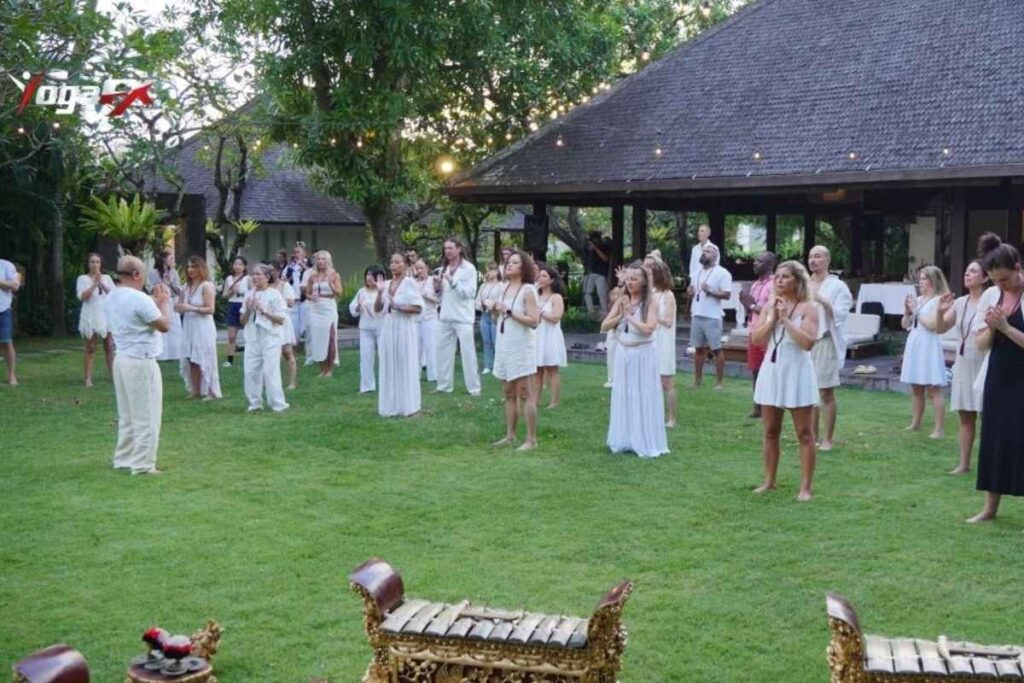
A meaningful share of people who search for “yoga teacher Bali” are not looking to book a class. They are evaluating whether to become one.
If that is you, the same verification framework applies to choosing a training programme as to choosing a teacher: check the credential type, check the lineage of whoever is training you, and check how many total hours of teaching experience stand behind the person leading your course.
If you are weighing the decision itself, what the programme actually costs and whether prior experience is required are usually the next two questions worth answering.
This decision carries more weight than choosing a single class, because the person training you becomes the source of everything you will later tell your own students. A generalist course led by an instructor with a thin teaching history passes that thinness on to their graduates, whatever the marketing says about the programme itself.
Ask the same questions of a training provider that you would ask of a teacher: named lineage, verifiable hours, and a credential you can check against an independent registry, not just the provider’s own website.
The YogaFX programme runs as a 6-day intensive hybrid format, combining online pre-course work with an in-person intensive in Seminyak, capped at 19 students per intake so that dialogue practice and individual correction are actually possible. It leads to dual certification: Yoga Alliance RYT 200 and the Bikram Hot 26 and 2 credential, taught directly under Mr. Ian Terry, E-RYT 500, the founder.
FAQ
How do I know if a yoga teacher in Bali is actually certified?
Ask for the specific credential name, such as RYT 200 or E-RYT 500, and check it against the Yoga Alliance public directory if it is a registered credential. Ask how many total hours the instructor has taught, not just trained, and for hot yoga specifically, ask who trained them directly and when.
What is the difference between RYT 200 and E-RYT 500?
RYT 200 is the entry credential requiring a minimum 200-hour registered training. E-RYT 500 requires 500 training hours plus a minimum of 2,000 hours of documented teaching experience over at least four years, making it a significantly higher bar tied to actual teaching track record, not just course completion.
Is a specialist Bikram teacher training worth it over a generalist 200-hour course?
It depends on your goal. A generalist course suits someone who wants to teach multiple styles. A specialist programme suits someone who wants deep, authentic command of one method, particularly relevant for hot yoga, where dialogue delivery and sequencing precision matter more than in flow-based styles.
Are Bali yoga schools internationally recognised?
Recognition depends on the specific school’s registration status with Yoga Alliance or an equivalent body, not on being located in Bali. A Bali-based programme registered with Yoga Alliance carries the same international recognition as one based anywhere else in the world.
Free Guest Pass
Want to experience a directly-trained instructor before deciding anything? Claim a free 1-day guest pass at the Seminyak or Canggu studio and take a class with the actual teachers behind these credentials. If you are exploring teacher training specifically, the full programme details are on yogafxteachertraining.com.